


















Lesson 3 of 45 · Getting Started
A Short History of Psychology
Follow psychology from Wundt's first laboratory through structuralism, Freud, behaviorism, the cognitive revolution and today's brain science and open science.
People have wondered about the mind for thousands of years, but psychology as an experimental science is young. Its roots lie in philosophy and physiology, and its modern shape came from a series of arguments: Is the mind a proper subject at all? Should we study its contents, its purposes or only behavior? Each answer was partly right, partly corrected by the next generation. Knowing this story makes the perspectives in the next lesson feel less like a list to memorize and more like the results of real debates.
What you will learn
- How philosophy and physiology prepared the ground for psychology.
- What structuralism, functionalism, psychoanalysis, behaviorism, Gestalt and humanism each claimed.
- Why the cognitive revolution and brain imaging changed the field.
- What the replication crisis is and how it is changing research.
- Why the early story was told too narrowly, and who was left out.
Key terms
Introspection: looking inward and reporting your own sensations, thoughts and feelings.
Structuralism: an early school that tried to break experience into basic elements.
Functionalism: a school that asked what mental activities are for.
Behaviorism: a school that studied observable behavior and its link to the environment.
Cognitive revolution: the mid-twentieth-century return to studying mental processes, using ideas from computing and linguistics.
Replication: repeating a study to see whether the original result holds.
Before there was a laboratory
Philosophers had long argued whether the mind and body were separate. René Descartes (1600s) proposed that they were, which is called dualism. John Locke argued that the mind begins "blank" and fills with experience, a view called empiricism. Meanwhile physiologists were measuring things that earlier thinkers had only speculated about. In the 1800s Hermann von Helmholtz timed nerve signals, and Gustav Fechner invented psychophysics, the measurement of the relation between physical stimuli and sensations (Chapter 4). The idea that the mind could be measured was in the air.
Wundt and structuralism (1879)
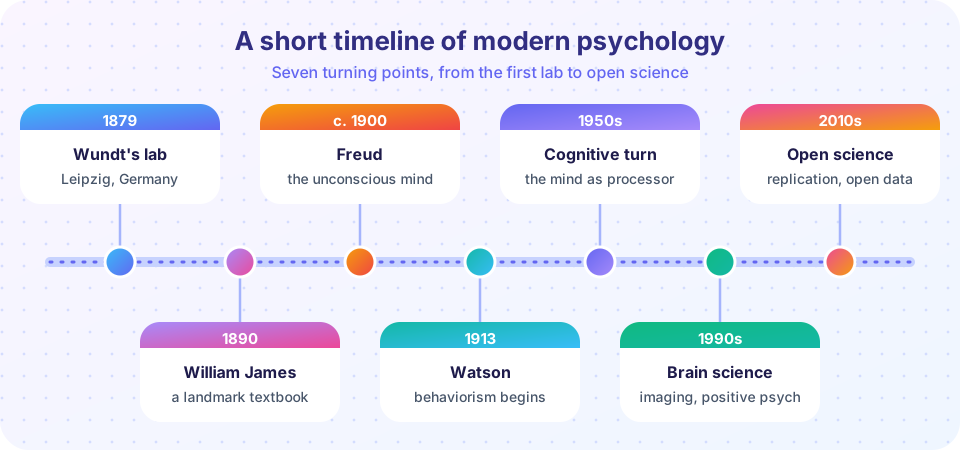
Wilhelm Wundt opened a laboratory in Leipzig, Germany in 1879, a date traditionally taken as the birth of experimental psychology. Wundt trained observers to report precisely on simple experiences, for example the sensation of a metronome beat or a patch of light. His student Edward Titchener took the approach to the United States and called it structuralism: find the "elements" of consciousness the way a chemist finds elements of matter.
Structuralism had a problem. Introspection is private; two trained observers could disagree, and there was no way to settle it. It also could not handle children, animals or people with mental disorders, who cannot give careful reports. Yet it did something lasting: it showed that mental life could be studied with experiments, controls and measurement.
William James and functionalism
In the United States, William James published The Principles of Psychology in 1890. Influenced by Darwin, he asked what the mind is for. Consciousness, he argued, is a flowing "stream", and habits, attention and emotion help organisms adapt. This approach is called functionalism. It opened psychology to studying children, education, individual differences and animals, and it led directly to applied fields such as school and industrial psychology.
Many pioneers were people the early textbooks overlooked. G. Stanley Hall founded the first American psychology laboratory at Johns Hopkins (1883) and the American Psychological Association (1892). Margaret Floy Washburn earned the first PhD in psychology awarded to a woman (1894), and Mary Whiton Calkins became the APA's first woman president (1905). Francis Cecil Sumner earned the first PhD in psychology awarded to a Black American (1920), and Kenneth and Mamie Clark's studies of children's racial attitudes were cited in the US Supreme Court's Brown v. Board of Education decision (1954).
Freud and psychoanalysis
Around 1900 Sigmund Freud, a Viennese physician, built psychoanalysis from his work with patients. He argued that much of mental life is hidden in the unconscious, that childhood experience shapes adult personality and that conflicts between desires and rules produce symptoms. He listened to dreams, slips of the tongue and free association for clues.
Freud's influence on culture was huge: ideas like unconscious motives and defense mechanisms entered everyday language. As science, however, many of his claims were difficult to test, since almost any behavior could be "explained" afterward. Modern researchers have kept some themes (a great deal of mental processing happens outside awareness, early experience matters) while rejecting much of his specific theory. You will meet the psychodynamic perspective again in lesson 4 and in Chapter 8.
Behaviorism: only what can be observed
In 1913 John B. Watson published a manifesto, "Psychology as the Behaviorist Views It", arguing that psychology should be an objective science of behavior. Introspection, he said, produced no reliable data. Building on Ivan Pavlov's studies of conditioned reflexes in dogs, behaviorists studied how stimuli and consequences shape actions. In the 1930s B. F. Skinner developed operant conditioning, showing in careful experiments with animals how rewards and punishments change behavior (Chapter 5).
Behaviorism made psychology more rigorous and produced practical methods still used in classrooms and therapy. Its weakness was the claim that mental processes were irrelevant. Watson's well-known "Little Albert" demonstration (1920), in which a baby was conditioned to fear a white rat, is also remembered today as an ethical warning: it would not be approved now.
Gestalt and the whole
Around 1912 Max Wertheimer and colleagues in Germany argued that we perceive organized wholes, not just sums of parts. The "Gestalt" principles of perception (Chapter 4) came from this school: a melody is more than a list of notes.
Humanistic psychology
In the 1950s and 1960s Abraham Maslow and Carl Rogers reacted against both psychoanalysis (too gloomy, focused on conflict) and behaviorism (too mechanical). They emphasized free choice, personal growth and the human need for meaning. Their ideas, such as Maslow's hierarchy of needs and Rogers's client-centered therapy, shaped counseling. Their theories were harder to test, a theme we revisit in Chapter 8.
The cognitive revolution
Starting in the 1950s, computers offered a new metaphor: the mind as a system that takes in, stores and transforms information. George Miller's 1956 paper on the limits of short-term memory, Noam Chomsky's 1959 critique of Skinner's account of language and Ulric Neisser's 1967 textbook Cognitive Psychology are commonly cited milestones. Researchers could now study attention, memory, language and reasoning with experiments built around reaction times and errors, inferring what happens inside from carefully designed outputs.
Brain science and positive psychology
Brain imaging, especially functional magnetic resonance imaging (fMRI), which began in the early 1990s, allowed researchers to watch brain activity in living people. The 1990s were declared the "Decade of the Brain" in the United States. Cognitive neuroscience, social neuroscience and clinical neuroscience grew from this. In the late 1990s Martin Seligman and colleagues also called for psychology to study strengths, well-being and flourishing instead of only problems; this was positive psychology.
Open science and the replication crisis
In the early 2010s, several events shook confidence in the field. A published paper claimed evidence for precognition using normal statistics, which prompted a hard look at those statistics. A few researchers were found to have fabricated data. Then a large collaborative project, the Open Science Collaboration (2015), tried to repeat 100 published experiments: just over a third produced a statistically significant result again, compared with almost all of the originals. This did not mean that all psychology is false, but it showed that small samples, flexible analysis and publication bias had produced weaker evidence than assumed.
The field responded with reforms: larger samples, preregistration (publishing the plan before collecting data), sharing data and materials, and journals that publish studies regardless of the result. You will see these in Chapter 2. A healthy science finds and fixes its weaknesses, and psychology has been doing this loudly.
Common misconceptions
"Freud founded psychology." Experimental psychology began with Wundt (and others) twenty years before Freud's main books, and Freud was a physician, not an experimentalist.
"Behaviorists said people have no minds." Watson and Skinner argued that mental states cannot be the basis of a science, and Skinner called thoughts private behaviors; they did not deny that experiences exist.
"Old schools are 'wrong', new ones are 'right'." Each left something that survives: introspection reports as data, functionalism's applied focus, behaviorism's rigor, Gestalt's wholes, humanism's emphasis on meaning, cognition's models.
"The history is just famous men in Europe and America." Many women and scientists of color made foundational contributions that were left out of earlier tellings.
Try it
First, an interactive timeline. Click a year to read what happened and what it changed. It is a study aid: the descriptions are short summaries.
Second, flash cards for the key figures. Try to answer before revealing. This is retrieval practice, the study habit from the course map.
Check your understanding
Quick check · 5 questions
of 5 answered You scored / 5 · perfect!
-
1. Why is 1879 often called the birth of experimental psychology?
Wundt's Leipzig lab is traditionally taken as the first dedicated psychology laboratory. -
2. What main problem undermined structuralism's use of introspection?
If two trained observers disagree about a private experience, nothing can settle the dispute. -
3. Which school asked 'What is the mind for?' and was inspired by Darwin?
James and the functionalists focused on how mental activity helps organisms adapt. -
4. What did the Open Science Collaboration (2015) find?
Just over a third of replications were significant, which led to reforms such as preregistration. -
5. Which statement about behaviorism is most accurate?
Behaviorists focused on observable behavior and its environmental causes; they did not deny that experience exists.
Summary
- Experimental psychology began with Wundt's Leipzig lab (1879) and structuralism.
- Functionalism (James) asked what the mind is for; psychoanalysis (Freud) explored the unconscious.
- Behaviorism (Watson, Skinner) demanded observable data; Gestalt and humanism stressed wholes and meaning.
- The cognitive revolution revived mental processes; imaging added brain science.
- The replication crisis led to preregistration, larger samples and open data.
- The full story includes many women and scientists of color.
Track your progress
Create a free account to tick off lessons and pick up where you left off on any device.
of Introduction to Psychology lessons completed