


















Lesson 44 of 45 · Projects and Practice
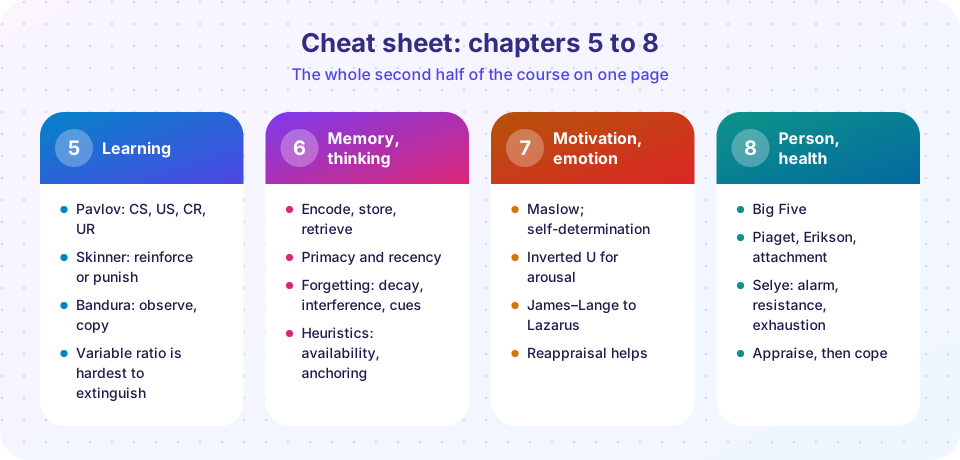
Cheat sheet: chapters 5 to 8 on one page
A one-page recap of learning, memory, thinking, motivation, emotion, personality, development and stress, with a summary poster, key names and dates and a timeline plot.
When you have worked through the chapters, you need a fast way to refresh before a test or a conversation. This page is the whole second half of the course on one page: a poster, tables of names and ideas, a timeline of landmark studies and a self-test. Print it, copy it into your own notes in your own words, or use it as a checklist of what to revise.
What you will learn
- The key idea and key names for every major topic in chapters 5 to 8.
- A rough chronology of landmark studies.
- A short list of habits that research supports.
- A reminder of the main cautions: replication, small samples, correlation and culture.
Key terms
Landmark study: an influential study that shaped a field, even if later work revised it.
Replication: repeating a study to see whether the result holds.
Effect size: how large an effect is, beyond whether it exists.
The ideas in one table
| Topic | One-line idea | Names | Remember |
|---|---|---|---|
| Classical conditioning | A cue that predicts an event triggers a response | Pavlov, Watson, Garcia, Rescorla | Surprise drives learning; biology limits it |
| Operant conditioning | Consequences shape behavior | Thorndike, Skinner | Variable ratio resists extinction |
| Observational learning | We copy models we notice, remember, can imitate and expect to benefit | Bandura | Learning is not performance |
| Cognitive learning | Maps, insight, control | Tolman, Köhler, Seligman | Latent learning |
| Memory | Sensory, working, long-term | Atkinson and Shiffrin, Baddeley, Miller, Cowan | About four chunks; deep processing |
| Retrieval | Cues, spacing and testing help | Tulving, Ebbinghaus, Roediger | Cramming fades fast |
| False memory | Memory is rebuilt | Bartlett, Loftus, Neisser | Confidence is not accuracy |
| Thinking | Heuristics are quick and sometimes wrong | Kahneman, Tversky, Wason, Gigerenzer | Check base rates; test disconfirming cases |
| Motivation | Drives, incentives, needs, goals | Hull, Maslow, Deci and Ryan, Locke | Needs are not a strict ladder |
| Emotion | Order of body, feeling, label, appraisal | James, Cannon, Schachter, Lazarus, Ekman | Replication problems; culture matters |
| Personality | Big Five traits; four perspectives | Costa and McCrae, Freud, Rogers, Mischel | Heritability is about groups |
| Development | Stages, ZPD, attachment, psychosocial challenges | Piaget, Vygotsky, Ainsworth, Erikson | Stages are approximate |
| Stress | Body response plus appraisal | Cannon, Selye, Lazarus and Folkman | Coping, support and sleep matter |
Landmark studies in time
The plot below places some landmark studies on a timeline. Dates refer to the main publication or experiment.
Press Run (or Ctrl + Enter) to see the result here.
Program input · what you'd type while the program runs
Type the answers before you press Run, one per line. Each time the program reads a line (with input()), it gets the next line from this box.
Habits that research supports
- Space and test. Review at growing intervals and retrieve from memory.
- Make meaning. Link new material to what you know; use examples.
- Check your thinking. Look for base rates and evidence against your first idea.
- Set specific goals. Use feedback and break big goals into steps.
- Reframe and connect. Reappraise stress, and build social support.
- Sleep and move. Both are linked with learning, mood and health.
Cautions to remember
- Many famous results are small, old or from narrow samples (Little Albert, Bobo doll, Harlow).
- Replication matters: the pen-in-mouth facial feedback result did not hold in a large check.
- Correlation is not causation; many findings on stress, punishment and media are correlational.
- Stages and types are summaries. People vary, and culture matters.
- Educational information is not diagnosis or treatment.
Try it
Check your understanding
Quick check · 4 questions
of 4 answered You scored / 4 · perfect!
-
1. Which study is paired with the testing effect?
They compared rereading with retrieval practice and found better retention after testing. -
2. Which is the best summary of Bandura's Bobo studies?
They show imitation of novel behavior, not definitive real-world effects of media. -
3. Which is a reasonable use of Maslow's hierarchy?
Research supports the importance of the needs but not a fixed order. -
4. Which habit has the strongest support for durable learning?
Reviews of study methods consistently favor spaced retrieval.
Summary
- Learning: classical (Pavlov), operant (Skinner), observational (Bandura), cognitive (Tolman).
- Memory: three stores, deep processing, spacing and testing; memory is reconstructive.
- Thinking: heuristics speed up decisions and cause predictable biases.
- Motivation and emotion: several theories, each partly right; culture and appraisal matter.
- Personality, development and health: Big Five, stages and attachment, stress as body plus appraisal.
Track your progress
Create a free account to tick off lessons and pick up where you left off on any device.
of Introduction to Psychology lessons completed