


















Lesson 14 of 45 · The Brain and Behavior
The Nervous System, Hormones and Genes
Learn how the central and peripheral nervous systems are organized, how hormones differ from nerve signals, and how genes, twin studies and experience shape behavior.
The brain does not work in isolation. It sits at the center of a wider system of nerves that gathers information from the body and sends commands back, and it is chemically linked to the rest of the body through hormones. All of this is built from instructions in your genes, yet rebuilt continually by your experience. This lesson widens the lens from the brain to the whole system, and then to the old question of how nature and nurture combine.
What you will learn
- How the central and peripheral nervous systems and their subdivisions are organized.
- What the sympathetic and parasympathetic systems do, and how a reflex works.
- How hormones differ from nerve signals, and the main glands.
- How genes and environment interact, and how twin and adoption studies work.
- What brain plasticity is, and when experience matters most.
Key terms
Central nervous system (CNS): the brain and spinal cord.
Peripheral nervous system (PNS): all the nerves outside the brain and spinal cord.
Autonomic nervous system: the part of the PNS that controls automatic functions such as heartbeat and digestion.
Hormone: a chemical messenger released by glands into the blood.
Heritability: the proportion of the variation in a trait across a population that is statistically linked to genetic differences.
Plasticity: the brain's capacity to change with experience.
The nervous system's branches
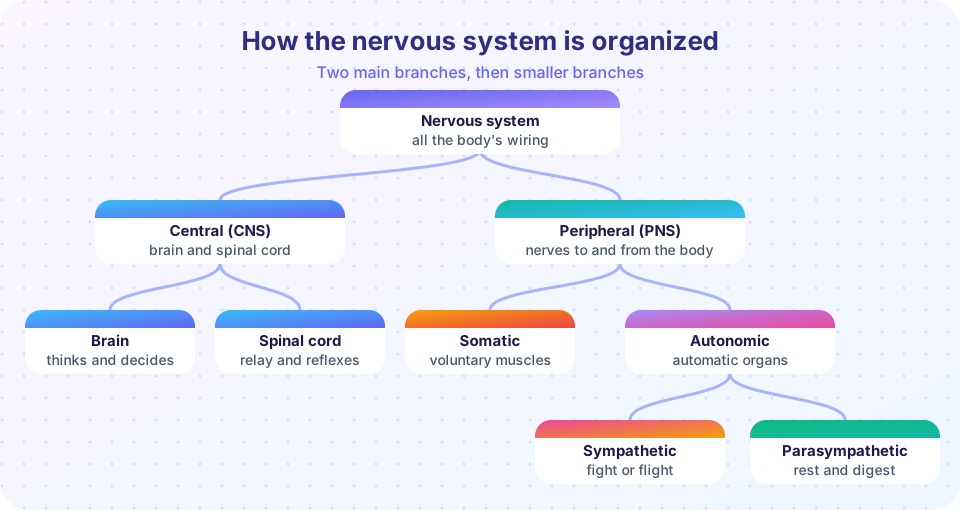
The central nervous system is the command center: the brain interprets and decides, and the spinal cord carries messages between the brain and the body and also runs simple reflexes by itself. The peripheral nervous system consists of nerves that connect the CNS to everything else, and it has two main divisions.
- The somatic nervous system carries sensory information in and commands to the skeletal muscles out. It controls voluntary actions such as writing, kicking and speaking.
- The autonomic nervous system controls glands and the smooth muscle of organs, mostly without conscious effort. It has two opposing branches.
Fight or flight, rest and digest
The sympathetic branch prepares the body for action. In 1915 the physiologist Walter Cannon named the "fight-or-flight" response. When a threat is detected, heart rate and blood pressure rise, breathing speeds up, the pupils widen, digestion slows and glucose is released for energy. The parasympathetic branch does the opposite: it calms the body and promotes "rest and digest" by slowing the heart and activating digestion. Most of the time the two work in balance, like a car's accelerator and brake.
Reflexes
A reflex is a rapid, automatic response. In the knee-jerk reflex, a tap stretches a tendon, a sensory neuron carries the signal to the spinal cord, a motor neuron immediately sends a command back to the muscle, and the leg kicks. The brain is informed too, but the movement does not wait for it. Reflexes protect us: pulling a hand away from a hot object happens before pain is even felt.
Hormones: the slower messengers
The endocrine system is a set of glands that release hormones into the bloodstream. Compared with nerve signals, hormones are slower (seconds to hours, not milliseconds) but their effects are broader and longer lasting.
| Feature | Nervous system | Endocrine system |
|---|---|---|
| Messenger | Electrical spikes and neurotransmitters | Hormones in the blood |
| Speed | Very fast (milliseconds) | Slower (seconds to hours or longer) |
| Target | Specific cells | Any cell with the right receptor |
| Duration | Brief | Often long-lasting |
The hypothalamus in the brain controls the pituitary gland, sometimes called the "master gland" because its hormones direct other glands. Key glands and hormones include:
- Adrenal glands: adrenaline (epinephrine) and noradrenaline for rapid arousal; cortisol, a stress hormone that mobilizes energy over minutes to hours.
- Thyroid: regulates metabolism.
- Pancreas: insulin and glucagon, regulating blood sugar.
- Gonads (ovaries and testes): estrogen, progesterone and testosterone, which influence development and reproduction and have effects on mood and behavior.
- Pineal gland: melatonin, which signals night and helps regulate sleep.
- Oxytocin, released by the pituitary, is involved in birth, breastfeeding and bonding. Popular claims that it is simply a "love" or "trust" hormone are overstated, since its effects depend strongly on context.
Stress shows the two systems working together: a threat triggers the fast sympathetic response within seconds, and the slower hormonal wave (cortisol) sustains it. Chapter 8 returns to what chronic stress does to health.
Genes and behavior
Your cells carry 23 pairs of chromosomes made of DNA, which contains roughly 20,000 protein-coding genes. You inherit half from each parent. Your genotype is your genetic makeup and your phenotype is the traits that result when genes interact with the environment.
Single genes can cause some conditions, but most psychological traits, such as intelligence, personality and risk for most mental disorders, are polygenic: many genes, each with a very small effect, and strongly influenced by experience. This is why claims about "the gene for" a complex behavior are almost always misleading.
Twin and adoption studies
Researchers separate genetic and environmental influence using natural experiments:
- Identical (monozygotic) twins come from one fertilized egg and share essentially all of their DNA.
- Fraternal (dizygotic) twins share about half of the genes that vary between people, like ordinary siblings.
- If identical twins resemble each other more than fraternal twins on a trait, genes probably contribute. A rough formula by Falconer estimates heritability as twice the difference between the identical-twin and fraternal-twin correlations.
- Adoption studies compare adopted children with their biological and adoptive parents. Resemblance to biological parents suggests genes; resemblance to adoptive parents suggests the family environment.
- Famous projects include the Minnesota Study of Twins Reared Apart, led by Thomas Bouchard, which found striking similarities among twins raised in different homes.
Large studies find moderate heritability for many traits; estimates for adult intelligence and personality are often reported around 40 to 60 percent, with big caveats.
What heritability does and does not mean
Heritability is a population statistic. It does not say that "50 percent of your intelligence comes from genes". It says that, in a particular population and environment, about half of the differences between people are statistically associated with genetic differences. It can change when the environment changes. Height is highly heritable, yet average height has risen over generations as nutrition improved. A high heritability never means a trait cannot be changed: eyesight is highly heritable and glasses fix it.
Genes and environment interact
Genes and environment are not simply added together. In gene-environment interaction, the same environment affects people differently depending on their genes. In gene-environment correlation, genes influence the environments people choose and evoke (a naturally curious child seeks books; parents give more of them). Epigenetics studies chemical marks that change how genes are switched on and off without changing the DNA code, in response to experience.
A cautionary tale: in 2003 Avshalom Caspi and colleagues reported that a particular variant of a serotonin-transporter gene made people more likely to develop depression after stressful life events. The finding was hugely influential. Later, very large analyses found weak or no support for the simple version of the claim. This is a good illustration of why replication matters, and why "the gene for X" stories need caution.
Plasticity: the brain changes with experience
The brain is not fixed at birth. In the 1960s Mark Rosenzweig and colleagues found that rats raised in stimulating environments with toys and companions developed thicker cortex than rats raised in bare cages. In the 1960s David Hubel and Torsten Wiesel showed that kittens whose vision in one eye was blocked during early weeks developed lasting visual problems, evidence of a critical period, an early time when the right input is especially important. Adults retain plasticity: practice strengthens relevant brain circuits, and after a stroke other regions can take over some lost functions with rehabilitation. New neurons form in the adult hippocampus, at least in some animals, though the extent in humans is debated.
Common misconceptions
"There is a gene for intelligence, or for aggression, or for happiness." Complex traits involve thousands of genes with tiny effects plus environment.
"Heritability tells you how much of an individual's trait is genetic." It is about variation in a group, in a given environment.
"Hormones are 'male' or 'female' chemicals." Everyone has estrogen, testosterone and others, in different amounts, and their behavioral effects are complex and context-dependent.
"Stress is purely psychological." Stress involves real, measurable changes in the nervous and endocrine systems, and thoughts about a situation affect them.
Try it
First, a switch between the two autonomic branches. Choose a situation and see how the body responds.
Second, estimate heritability from twin correlations with Falconer's formula. The correlations below are made up for illustration; change them to see how the estimate behaves. The three pieces are genes (h²), shared family environment (c²) and everything else including measurement error (e²).
Press Run (or Ctrl + Enter) to see the result here.
Program input · what you'd type while the program runs
Type the answers before you press Run, one per line. Each time the program reads a line (with input()), it gets the next line from this box.
Third, the knee-jerk reflex step by step. Notice that the spinal cord handles it without waiting for the brain.
Check your understanding
Quick check · 5 questions
of 5 answered You scored / 5 · perfect!
-
1. Which part of the nervous system prepares the body for 'fight or flight'?
The sympathetic branch raises heart rate and releases energy; the parasympathetic branch calms the body. -
2. Compared with nerve signals, hormones are generally
Hormones travel in the blood, taking seconds to hours, with broader and longer effects. -
3. Identical twins correlate 0.80 on a trait and fraternal twins 0.50. Falconer's formula gives h² of
h² = 2 × (0.80 - 0.50) = 0.60. -
4. What does 'heritability = 0.5' mean?
Heritability is a population statistic and not a fixed or individual share. -
5. Hubel and Wiesel's kitten studies illustrate
Blocking input during an early window caused lasting visual deficits.
Summary
- The CNS (brain and spinal cord) and PNS (somatic and autonomic) form the nervous system; the autonomic branch has sympathetic (arousal) and parasympathetic (calming) parts.
- Reflexes are fast, spinal responses.
- Hormones from endocrine glands are slower and longer lasting than nerve signals; the hypothalamus and pituitary coordinate them.
- Most traits are polygenic; twin and adoption studies estimate genetic and environmental contributions, and heritability is a population statistic.
- Genes and environment interact, and the brain stays plastic, with critical periods in early development.
Track your progress
Create a free account to tick off lessons and pick up where you left off on any device.
of Introduction to Psychology lessons completed