


















Lesson 19 of 45 · Sensation and Perception
Perception and Illusions: How the Brain Builds Your World
Learn how the brain organizes sensation into objects and scenes: Gestalt grouping, depth cues, constancies, attention, and why illusions reveal how perception works.
Look at the page you are reading. You see lines of text on a flat surface, a screen in a room, perhaps a window behind it. Yet the signals reaching your retinas are just a changing mosaic of light and dark patches, flat and upside down. Turning that mosaic into stable, three-dimensional objects with meaning is perception, and it is a feat of problem solving that we perform without effort or awareness. The best way to see how it works is to look at where it makes mistakes.
What you will learn
- The Gestalt principles by which the brain organizes parts into wholes.
- How we perceive depth with two eyes and with one.
- What perceptual constancies are and why they matter.
- How attention limits what we notice (selective attention and inattentional blindness).
- Why illusions are useful clues about the rules perception follows.
Key terms
Gestalt: a German word for a whole form; Gestalt psychologists argued that we perceive organized wholes, not just sums of parts.
Figure-ground: the organization of a scene into an object (figure) that stands out against its background.
Binocular cues: depth cues that need both eyes, such as retinal disparity.
Perceptual constancy: perceiving objects as unchanged despite changes in the sensory input (size, shape, color).
Inattentional blindness: failing to notice an unexpected object because attention is elsewhere.
Organizing the scene: Gestalt principles
In the early 1900s Max Wertheimer, Wolfgang Kohler and Kurt Koffka noticed that the mind organizes input according to a few automatic rules. A melody is not just a list of notes, and a face is not a list of features. The best-known principles:
- Figure and ground. We separate an object from its surroundings. A famous example is Edgar Rubin's vase, which can be seen as a vase or as two faces: which part is "figure" flips.
- Proximity. Items near each other are grouped together.
- Similarity. Items that look alike are grouped.
- Continuity. We prefer smooth, continuous lines over abrupt changes of direction.
- Closure. We fill gaps to see complete shapes. A circle drawn with a small gap still looks like a circle.
- Common fate. Elements that move in the same direction are seen as a unit, like a flock of birds.
These rules are shortcuts that usually give the right answer. Camouflage works by breaking them: it removes the figure-ground contrast.
Seeing depth
The retina is a flat surface, so depth must be computed. The brain uses several cues.
Binocular cues (both eyes):
- Retinal disparity. Your two eyes see slightly different images; the closer an object, the larger the difference. The brain uses the difference to compute distance. Charles Wheatstone demonstrated this in 1838 with the stereoscope, and 3D movies use the same principle with different images for each eye.
- Convergence. Your eyes turn inward more for near objects, and the muscle tension provides a cue.
Monocular cues (work with one eye, and are used by painters):
- Relative size: if two objects are likely the same size, the smaller one looks farther away.
- Interposition (overlap): an object that blocks another is nearer.
- Linear perspective: parallel lines, like railway tracks, appear to converge in the distance.
- Texture gradient: texture looks finer with distance.
- Relative height: objects higher in the picture (below the horizon) look farther.
- Light and shadow, and aerial perspective (distant mountains look hazier and bluer).
- Motion parallax: when you move, near objects sweep past faster than far ones.
In 1960 Eleanor Gibson and Richard Walk built the visual cliff, a glass-covered table with a "shallow" side and an apparent drop. Most infants aged six to fourteen months who were old enough to crawl refused to cross the "deep" side, even when their mother called them. This showed that crawling infants perceive depth, though it cannot by itself show whether the ability is innate or learned.
Perceptual constancy
When someone walks away from you, their image on your retina shrinks to a fraction of its size, yet you do not see them shrinking. This is size constancy. The brain combines retinal size with perceived distance. Other constancies include shape constancy (a door looks rectangular though its retinal image is a trapezoid when open), color constancy and brightness constancy (a white shirt looks white in shade and sun). Constancies make the world stable, but they also set a trap: a cue to distance, if misleading, will change the apparent size (for example in the Ames room, built so that people appear to grow or shrink as they walk across it).
Motion and illusions of motion
We see motion by comparing images across time. Wertheimer's phi phenomenon (1912) showed that two stationary lights blinking in alternation appear to move from one to the other. Film and animation work this way: still frames shown quickly are seen as smooth motion.
Perceptual set and context
Your expectations strongly affect what you see. In an ambiguous figure such as the duck-rabbit drawing, whether you see a duck or a rabbit can be influenced by what you were primed with. A noisy recording sounds like words when you have read the text first. This perceptual set is top-down processing at work (see the overview lesson for the distinction). Context also changes the meaning of the same input: a shape between the letters "A" and "C" is read as a "B", and between the numbers 12 and 14 as a "13".
Attention: the bottleneck
You cannot process everything, so attention chooses. At a noisy party you can follow one conversation and still notice your name in another: the cocktail party effect (Colin Cherry, 1953). The cost of this selectivity is that things outside the focus can go unseen.
In a well-known 1999 experiment by Daniel Simons and Christopher Chabris, observers watched a video of people passing basketballs and counted the passes by one team. Midway, a person in a gorilla suit walked through the scene, thumping its chest. About half of the observers did not notice the gorilla. This is inattentional blindness. Change blindness is similar: large changes in a scene can go unnoticed if they happen during a blink or a brief interruption. Research like this raises serious cautions for activities such as driving, where using a phone divides attention.
Illusions: what mistakes reveal
Illusions are not failures of the visual system; they are by-products of rules that are usually helpful.
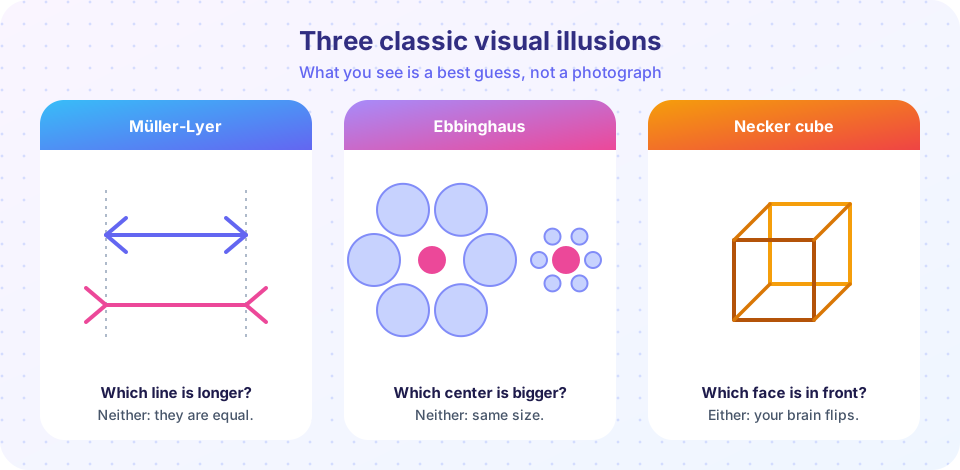
- Müller-Lyer illusion. Two lines of equal length look unequal when arrow-like fins point in or out. One explanation is that the fins act like corners seen in depth, so the brain scales the line's length by its "distance". Cross-cultural work by Marshall Segall, Donald Campbell and Melville Herskovits (1966) found that susceptibility varied among groups, and one interpretation was that people raised in environments full of right-angled buildings are more affected, but later studies and reviews disagree about how large the differences are and why, so this remains debated.
- Ebbinghaus illusion. A circle surrounded by larger circles looks smaller than an identical circle surrounded by smaller ones. The brain judges size relative to context.
- Necker cube. A line drawing with two valid depth interpretations: the front face seems to flip.
Illusions also show how the brain is always interpreting. Because the interpretation is nearly always right, you hardly notice it, until a clever picture exposes it.
On extrasensory perception. Claims of perception without the senses (telepathy, clairvoyance) have been tested in many experiments. No claim has been reliably replicated under controlled conditions, so the scientific consensus is that there is no good evidence for ESP. The cognitive biases in this chapter and in Chapter 2 explain why such claims feel convincing.
Common misconceptions
"Seeing is believing: what I see is what is there." What you see is the brain's best interpretation, which is usually accurate but can be fooled, as illusions and inattentional blindness show.
"Illusions mean your eyes are faulty." They show normal visual rules applied to unusual stimuli.
"If something important happens in front of you, you will notice." Attention is limited, and unexpected objects often go unnoticed when you are focused on something else.
Try it
First, measure your Müller-Lyer illusion. The top line has fins pointing outward and is fixed. Adjust the bottom line (fins pointing inward) until the two look the same length, then press Check to see the truth. Most people set the inward-fin line longer than the other. This is a demonstration of a well-known effect, so individual results vary.
Second, the Gestalt principles of proximity and similarity. Switch the dots between modes and see how your brain groups the same arrangement into rows, columns or colored sets.
Third, a change-blindness test. The scene flickers between two versions with a short blank in between. One object differs. Click I see it when you spot the change, then Reveal. People are often slower than they expect, even with a large difference.
Check your understanding
Quick check · 6 questions
of 6 answered You scored / 6 · perfect!
-
1. Which Gestalt principle explains seeing a circle with a small gap as a complete circle?
Closure is the tendency to fill gaps to perceive complete shapes. -
2. Retinal disparity is a
Disparity needs two eyes, which see the scene from slightly different positions. -
3. Seeing a friend as the same size whether near or far shows
The brain combines retinal size and perceived distance to keep size stable. -
4. In the Simons and Chabris gorilla study, about half of observers missed the gorilla because of
Attention was focused elsewhere, so an unexpected object went unnoticed. -
5. Which statement best describes illusions?
Illusions are by-products of useful rules applied to unusual stimuli. -
6. A painter makes a far mountain smaller and hazier. Which cues is the painter using?
Smaller size and haziness are monocular pictorial cues to distance.
Summary
- Perception organizes input into wholes by Gestalt rules: figure-ground, proximity, similarity, continuity, closure, common fate.
- Depth comes from binocular cues (disparity, convergence) and monocular cues (relative size, overlap, perspective, texture, motion parallax).
- Constancies keep objects stable, but misleading cues can distort apparent size.
- Attention is limited: inattentional blindness and change blindness show how much goes unnoticed.
- Illusions reveal the assumptions behind normal perception, and evidence for ESP is lacking.
Track your progress
Create a free account to tick off lessons and pick up where you left off on any device.
of Introduction to Psychology lessons completed