


















Lesson 36 of 45 · Personality, Development and Health
Personality theories: psychodynamic, learning, humanistic and trait
Compare four perspectives on personality, learn the Big Five traits, the person-situation debate, heritability, and why quizzes like the MBTI deserve caution.
Ask ten friends to describe a mutual acquaintance and you will hear words like "shy," "reliable," "funny" and "stubborn." Everyday language is full of personality descriptions, and psychologists have tried to make them precise: which dimensions really matter, where do they come from, and how well can they predict what a person will do?
This lesson compares the four big perspectives and then focuses on the one with the best measurement evidence, the Big Five.
What you will learn
- The central ideas and limits of four perspectives: psychodynamic, learning (social-cognitive), humanistic and trait.
- The five factors, how they are measured and how stable they are.
- What twin studies say about genes and environment.
- The person-situation debate.
- Why popular quizzes such as the MBTI and horoscopes need careful interpretation.
Key terms
Trait: a stable dimension of personality along which people vary.
Factor analysis: a statistical method that finds clusters among many measurements.
Self-concept: your beliefs about who you are.
Barnum (Forer) effect: believing vague, general statements are specifically about you.
Reliability and validity: whether a test gives consistent results, and whether it measures what it claims to.
Four perspectives
Psychodynamic
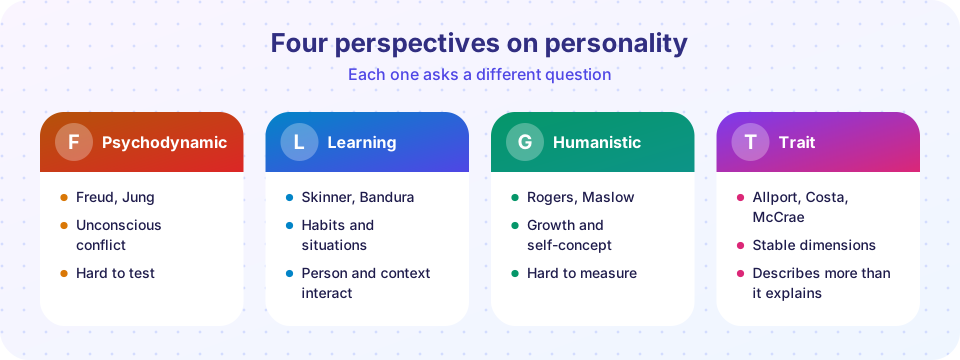
Sigmund Freud proposed that behavior is driven by unconscious conflicts between the id (impulses), the ego (reality) and the superego (conscience), and by experiences in early childhood. His ideas shaped the culture, and concepts such as defense mechanisms and the importance of early experience are still discussed. But the core claims are mostly hard to test and some predictions failed when tested. Carl Jung described introversion and extraversion and the "collective unconscious"; the first idea led to modern trait research, while the second is not supported by evidence. Today the strongest legacy of psychodynamic thinking is its emphasis that we are not always aware of why we act.
Learning and social-cognitive
For behaviorists like Skinner, personality is a set of learned habits shaped by reinforcement. Albert Bandura and Walter Mischel emphasized that people think about situations. Bandura's reciprocal determinism says that person, behavior and environment influence each other. Mischel's 1968 book argued that behavior varies so much across situations that traits predict poorly. His later "if-then" view says people have consistent patterns within types of situations: someone may be bold with friends and quiet with authority figures, consistently.
Humanistic
Carl Rogers and Abraham Maslow emphasized free will, growth and subjective experience. Rogers described the self-concept and said that people grow best when they receive unconditional positive regard, acceptance without conditions. The approach influenced counseling and education and put the person's own view at the center. It is hard to test, however, and critics say it is overly optimistic and vague.
Trait
Trait psychologists describe people on measurable dimensions. Gordon Allport collected thousands of trait words from the dictionary. Raymond Cattell and Hans Eysenck used factor analysis to reduce them to a few main factors. Over decades, a consensus emerged around five.
The Big Five
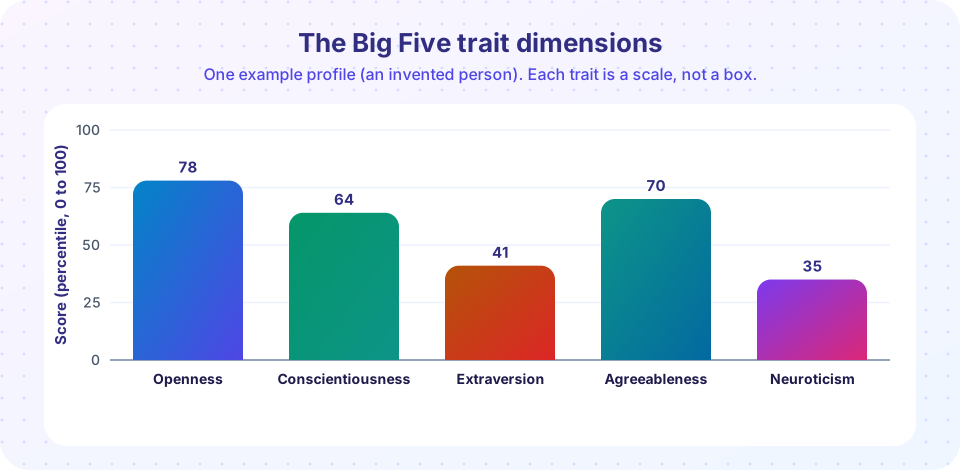
Researchers including Paul Costa and Robert McCrae and Lewis Goldberg found that five broad dimensions appear again and again in questionnaires and in ratings by others. A common memory aid is OCEAN.
| Trait | High scorers tend to be | Low scorers tend to be |
|---|---|---|
| Openness to experience | Curious, imaginative, open to new ideas | Practical, conventional, prefer routine |
| Conscientiousness | Organized, dependable, self-disciplined | Spontaneous, flexible, less structured |
| Extraversion | Sociable, energetic, assertive | Reserved, quieter, prefer solitude |
| Agreeableness | Cooperative, trusting, warm | Skeptical, competitive, blunt |
| Neuroticism | Prone to worry and negative emotions | Calm, emotionally steady |
Key findings:
- Stability. Scores are moderately stable. In an influential meta-analysis, Brent Roberts and Wendy DelVecchio (2000) found that rank order stability rises with age, while average levels change: people on average become more conscientious, agreeable and emotionally steady from young adulthood to middle age.
- Prediction. Conscientiousness predicts school and job performance and health-related outcomes. Neuroticism is linked to higher risk of anxiety and low mood; these are statistical links for groups, not predictions for an individual.
- Culture. The five factors have been found in many countries, though the evidence from some societies is less clear and the factors are measured in languages that differ.
- Genes. Twin and adoption studies often estimate that about 40 to 50 percent of the differences among people in the Big Five traits are associated with genetic differences. The environment shared by siblings accounts for little; individual experiences and chance account for much of the rest. Heritability is a group statistic and says nothing about how changeable a trait is.
The Big Five describe what people are like more than why. They are summaries, not explanations.
Person versus situation
Mischel's challenge was that the average correlation between a trait score and a behavior in a single situation is modest (often around 0.3). Defenders replied that averaging behavior across many situations predicts far better, and that traits and situations interact: shy people are quiet at a party but not in a trusted group. Most psychologists now accept an interactionist view. Behavior is shaped by both the person and the context.
Measuring personality, and cautions
Personality is usually measured with self-report questionnaires using Likert scales ("strongly disagree" to "strongly agree"). Good tests are reliable (stable over time and consistent across items) and valid (they predict relevant outcomes). Limits include faking, differences in how people use scales and cultural differences in answering.
Popular quizzes vary widely in quality:
- The Myers–Briggs Type Indicator (MBTI) sorts people into 16 types. Research raises concerns: scores are on continuous scales that are split into categories, many people get a different type when retaking the test after a few weeks, and the types predict job performance poorly compared with Big Five scores.
- Horoscopes and "personality" readings often use vague statements that fit most people. In a classic 1948 study, Bertram Forer gave his students the same "individual" description and asked them to rate how well it fit. On average they rated it as highly accurate. This is the Barnum effect.
A good habit: ask who made a test, what evidence supports it and whether it gives you scales or only labels. Nothing in this lesson can diagnose a person, and the demonstration below is not a validated test.
Common misconceptions
"You are either an introvert or an extravert." Extraversion is a continuum; most people are in the middle.
"Personality never changes." Traits are fairly stable but change gradually across life, often in response to roles and experiences.
"A test result is who you are." A score is a snapshot with measurement error, on a scale designed for groups.
Try it
Press Run (or Ctrl + Enter) to see the result here.
Program input · what you'd type while the program runs
Type the answers before you press Run, one per line. Each time the program reads a line (with input()), it gets the next line from this box.
Check your understanding
Quick check · 5 questions
of 5 answered You scored / 5 · perfect!
-
1. Which perspective emphasizes unconditional positive regard and the self-concept?
Carl Rogers's humanistic approach centers on the self and the conditions that foster growth. -
2. Which are the Big Five traits?
The Big Five are measured as continuous dimensions, often remembered as OCEAN. -
3. What did Roberts and DelVecchio find about personality stability?
People's relative positions become more stable with age, while averages shift gradually. -
4. In Mischel's view, why did he challenge trait theory?
He emphasized situational variability, leading to interactionist views. -
5. A 'personality reading' feels uncannily accurate but is the same for everyone. This is called:
Vague statements feel personally accurate to most readers.
Summary
- Four perspectives (psychodynamic, learning, humanistic, trait) answer different questions about personality.
- The Big Five are the best-supported way to describe differences; traits are continuous and moderately stable.
- Genes and environment both contribute; heritability describes groups, not individuals.
- Person and situation interact; tests vary in quality and results are not labels.
Next: Child development
Track your progress
Create a free account to tick off lessons and pick up where you left off on any device.
of Introduction to Psychology lessons completed