


















Lesson 43 of 45 · Projects and Practice
Glossary: key terms from chapters 5 to 8
A searchable glossary of key psychology terms from learning, memory, motivation, emotion, personality, development, health and research methods, with short definitions.
Psychology has its own vocabulary. Some words are everyday words with narrower meanings ("reinforcement," "stress," "schema"), and some are technical ("blocking," "heritability"). Knowing the exact meaning helps you read studies, answer exam questions and spot misuse of terms in the media.
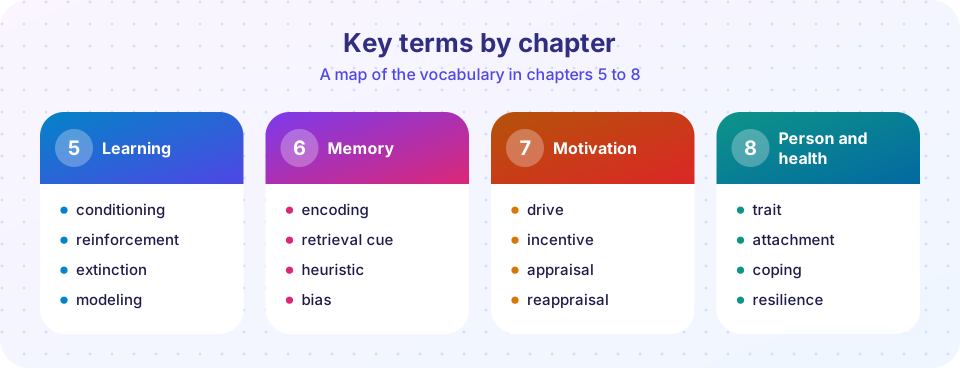
This glossary collects the key terms from the second half of the course. Use the table to review by chapter, or the search box below to look up a word.
What you will learn
- The precise meaning of about seventy key terms.
- How terms group by chapter and connect to each other.
- How to write a short definition in your own words.
- Where to find each idea in the lessons.
Key terms
Glossary: an alphabetical or thematic list of terms with short definitions.
Operational definition: a precise description of how a concept is measured in a study.
Construct: an abstract idea, such as motivation or intelligence, that psychologists study indirectly.
Terms by chapter
Chapter 5: Learning and conditioning
| Term | Meaning |
|---|---|
| Learning | A relatively lasting change in behavior or knowledge produced by experience. |
| Habituation | A decrease in response to a repeated, harmless stimulus. |
| Sensitization | An increase in response after a strong or threatening stimulus. |
| Classical conditioning | Learning that one stimulus predicts another, so the first triggers a response. |
| Unconditioned stimulus (US) | A stimulus that triggers a response without learning. |
| Conditioned stimulus (CS) | A formerly neutral cue that triggers a response after pairing with a US. |
| Extinction | The weakening of a learned response when the expected outcome stops following. |
| Spontaneous recovery | The return of a weakened response after a rest period. |
| Blocking | Little learning about a new cue because an existing cue already predicts the outcome. |
| Operant conditioning | Learning in which consequences change the likelihood of a behavior. |
| Reinforcement | A consequence that makes a behavior more likely. |
| Punishment | A consequence that makes a behavior less likely. |
| Shaping | Reinforcing successive approximations of a target behavior. |
| Variable-ratio schedule | Reinforcement after an unpredictable number of responses. |
| Observational learning | Learning by watching a model's behavior and its consequences. |
| Latent learning | Learning that is not shown until there is a reason to show it. |
| Cognitive map | An internal representation of the layout of a place. |
| Learned helplessness | Passivity after experiencing outcomes that cannot be controlled. |
Chapter 6: Memory and thinking
| Term | Meaning |
|---|---|
| Encoding | Turning information into a form memory can store. |
| Storage | Keeping encoded information over time. |
| Retrieval | Bringing stored information back to mind. |
| Working memory | A small active workspace for information in use. |
| Chunking | Grouping items into meaningful units to hold more. |
| Episodic memory | Memory for personal events. |
| Semantic memory | Memory for facts and meanings. |
| Procedural memory | Memory for skills and habits. |
| Levels of processing | The idea that deeper, meaning-based processing produces stronger memory. |
| Encoding specificity | Retrieval works best when cues match the context at encoding. |
| Spacing effect | Spread-out practice produces longer-lasting memory than massed practice. |
| Testing effect | Practicing retrieval improves later retention. |
| Interference | Forgetting caused by competition between memories. |
| Misinformation effect | Distortion of a memory by information given after the event. |
| Schema | Organized knowledge about how things usually are. |
| Heuristic | A quick mental shortcut that is often right but can mislead. |
| Confirmation bias | Favoring evidence that agrees with what you already believe. |
| Functional fixedness | Seeing objects only in their usual role. |
Chapter 7: Motivation and emotion
| Term | Meaning |
|---|---|
| Motivation | The processes that start, direct and sustain goal-directed behavior. |
| Drive | An internal state of tension that pushes an organism to act. |
| Incentive | An external object or event that pulls behavior toward it. |
| Homeostasis | Keeping internal conditions within a stable range. |
| Intrinsic motivation | Doing something for its own sake. |
| Extrinsic motivation | Doing something for a separate reward or to avoid a penalty. |
| Overjustification effect | Lower interest after an expected reward for an activity already enjoyed. |
| Self-determination theory | The view that autonomy, competence and relatedness are basic psychological needs. |
| Appraisal | An evaluation of what an event means for your goals. |
| Display rules | Cultural norms about when and how to show emotion. |
| Reappraisal | Changing how you think about a situation to change its emotional impact. |
Chapter 8: Personality, development and health
| Term | Meaning |
|---|---|
| Personality | Relatively stable patterns of thinking, feeling and behaving. |
| Trait | A dimension on which people vary, such as shyness. |
| Big Five | Openness, conscientiousness, extraversion, agreeableness and neuroticism. |
| Heritability | The share of differences in a group linked to genetic differences. |
| Barnum effect | Accepting vague, general statements as personally accurate. |
| Schema (Piaget) | A mental framework built and revised through experience. |
| Object permanence | Knowing that objects continue to exist when out of sight. |
| Zone of proximal development | The gap between what a learner can do alone and with help. |
| Theory of mind | Understanding that others have beliefs and knowledge different from your own. |
| Attachment | A lasting emotional bond between a child and a caregiver. |
| Temperament | Inborn differences in emotional reactivity and activity level. |
| Stressor | An event or demand that challenges a person's ability to cope. |
| General adaptation syndrome | Selye's alarm, resistance and exhaustion pattern. |
| Coping | Efforts to manage demands that feel taxing. |
| Resilience | The ability to adapt well in the face of adversity. |
Chapter 9: Research
| Term | Meaning |
|---|---|
| Hypothesis | A specific, testable prediction. |
| Independent variable | What the researcher changes on purpose. |
| Dependent variable | What is measured. |
| Counterbalancing | Varying the order of conditions across participants. |
| Cronbach's alpha | A summary of the internal consistency of a scale. |
| Reliability | Consistency of a measurement. |
| Validity | Whether a measure captures what it claims to. |
Study tip
To learn a term, do three things: read the definition, say it back in your own words and write one new example. Then test yourself a day later and again a week later (spaced retrieval practice from How memory works).
Common misconceptions
"Negative" always means bad. In reinforcement and punishment, negative means something is removed.
"Theory" means a guess. In science a theory is a well-supported framework that explains many observations.
"Stress" and "emotion" are the same. Stress is a response to demands; emotion is a broader category of feeling states.
Try it
Press Run (or Ctrl + Enter) to see the result here.
Program input · what you'd type while the program runs
Type the answers before you press Run, one per line. Each time the program reads a line (with input()), it gets the next line from this box.
Check your understanding
Quick check · 5 questions
of 5 answered You scored / 5 · perfect!
-
1. Which term means a decrease in response to a repeated, harmless stimulus?
Habituation is the simplest form of learning: you stop responding to something that does not matter. -
2. Heritability describes:
It is a population statistic, not a statement about one person. -
3. A quick mental shortcut that can lead to bias is a:
Heuristics are fast and often right, but they cause predictable errors in some situations. -
4. Which term refers to cultural norms about showing emotion?
Display rules govern when and how emotions are expressed. -
5. What does Cronbach's alpha summarize?
It measures how well scale items agree with each other.
Summary
- Many psychology words have narrower meanings than in everyday speech; learn the precise definitions.
- Group terms by chapter and connect them to examples.
- Use spaced retrieval to learn terms; search and drills help.
Track your progress
Create a free account to tick off lessons and pick up where you left off on any device.
of Introduction to Psychology lessons completed