


















Lesson 7 of 45 · The Science of Psychology
Research Methods: How Psychologists Collect Evidence
Learn the main psychology research methods, from case studies and surveys to experiments with random assignment, control groups, placebos and double-blind designs.
Suppose you wonder whether typing notes on a laptop leads to worse learning than writing by hand. How would you find out? You could ask students, watch a classroom, or compare exam scores. Each choice has strengths and traps. Psychologists use a toolbox of methods, and the central skill is choosing the right one for the question and knowing what it can and cannot show.
What you will learn
- The main descriptive methods: case studies, naturalistic observation and surveys.
- The logic of an experiment: variables, groups, random assignment and controls.
- How bias creeps in (expectations, placebos, demand characteristics) and how double-blind designs stop it.
- When a quasi-experiment is the only option.
Key terms
Independent variable (IV): the factor the researcher manipulates.
Dependent variable (DV): the outcome that is measured.
Random assignment: using chance to place participants in groups so groups are alike on average.
Confound: an uncontrolled factor that varies along with the IV and could explain the result.
Double-blind: neither participants nor those running the study know who is in which group.
Placebo: an inactive treatment that may still produce a response because of expectations.
Descriptive methods
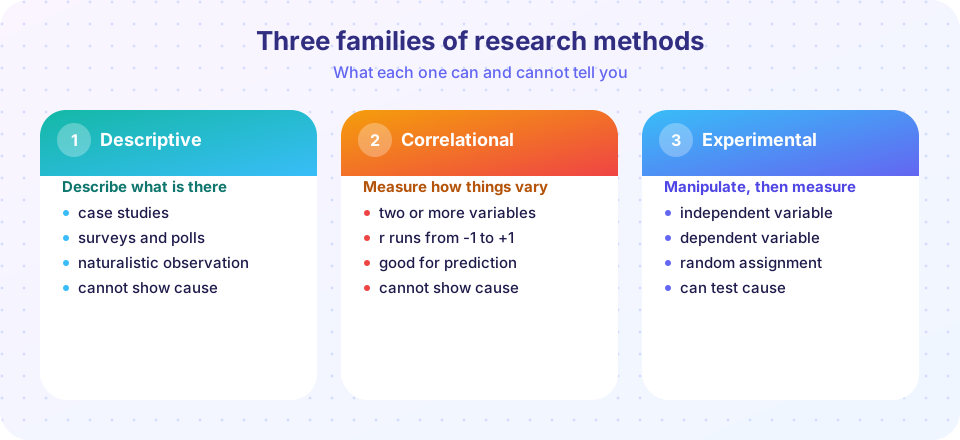
Descriptive methods answer "what is there?". They cannot say what causes what, but they are essential for discovery.
Case studies examine one person or a small group in depth. The most famous in neuroscience is Henry Molaison ("H.M."), who after surgery in 1953 could no longer form new long-term memories but could still learn motor skills. This revealed that memory has separate systems (Chapter 6). The weakness: one person may not represent everyone.
Naturalistic observation records behavior where it happens, with no interference: children on a playground, shoppers in a store. Jane Goodall's long observation of chimpanzees in the wild is a famous example from the related science of primatology. Researchers must define behaviors clearly beforehand ("a push counts as aggression only if...") and beware that people who know they are watched act differently.
Surveys ask many people questions. Surveys are cheap and reach large groups, but answers depend on wording ("Do you support helping the poor?" versus "Do you support welfare?"), on memory, and on social desirability: wanting to look good. And a survey is only informative about the group that actually answered; we return to this in measurement, sampling and ethics.
Correlational method
A correlational study measures two or more variables as they naturally occur and checks whether they vary together (for example sleep hours and exam scores). The next lesson explains why this method, while valuable for prediction, cannot show that one thing causes another.
The experiment
An experiment is the only method that can test cause and effect. Its logic is simple: change one thing, hold everything else equal, and see if the outcome changes.
- Pick a question: does the way people take notes affect later understanding?
- Define variables. IV: note-taking method (handwriting or typing). DV: score on a test of understanding a lecture, measured a week later.
- Create groups: an experimental group gets the treatment; a control group gets the comparison condition.
- Randomly assign participants to groups.
- Keep other things constant: same lecture, same room, same time limits, same test.
- Compare the DVs, using statistics to check whether the difference is bigger than chance.
A well-known study by Pam Mueller and Daniel Oppenheimer (2014) compared laptop and handwritten notes and reported an advantage for handwriting on conceptual questions. Later attempts to repeat it found smaller or no differences. This is a perfect real example of why a single study is a clue, not a verdict.
Why random assignment is powerful
If you let students choose their method, the careful ones might choose handwriting, and then any difference might be due to carefulness rather than the method. Random assignment spreads such hidden differences (motivation, prior knowledge, tiredness) evenly across groups, on average, so the only systematic difference left is the IV. The third demonstration lets you watch this work.
Within and between participants
In a between-subjects design, different people are in each condition. In a within-subjects design, each person experiences all conditions (in varied order, to avoid order effects). Within-subjects designs need fewer people and remove differences between individuals, but practice or fatigue can spill over from one condition to the next.
How bias sneaks in, and how to stop it
Placebo effects. Participants who believe they are receiving a treatment may feel better. That is why drug trials include a placebo group.
Demand characteristics. Participants guess what the study is about and try to cooperate (or rebel). Cover stories and careful debriefing help.
Experimenter bias. Researchers' expectations can alter how they treat participants or record results. In the 1960s Robert Rosenthal told students that certain rats were "maze-bright" and others "maze-dull" when they were in fact randomly assigned; the "bright" rats reportedly performed better, apparently because of how they were handled. An earlier famous case is Clever Hans, a horse who seemed to do arithmetic but was in fact reading tiny cues from his questioner.
The remedy is the double-blind design: neither the participants nor the people interacting with them or scoring the results know who is in which group. Use of objective measures, written protocols and, where possible, automated procedures helps too.
When you cannot randomize
You cannot randomly assign people to be male or female, to grow up in poverty or to have a brain injury. Such studies are quasi-experiments: they compare naturally occurring groups. They can be informative, but because group membership was not randomly assigned, confounds are always a risk.
Other design choices include cross-sectional studies (comparing different age groups at one time) and longitudinal studies (following the same people over years). Longitudinal work shows change within people but is slow and loses participants over time.
Common misconceptions
"If a study has a control group, it is an experiment." An experiment needs the researcher to manipulate the IV and to assign groups at random. Comparing existing groups is a quasi-experiment.
"Random assignment and random sampling are the same." Random sampling picks who is in the study (so it can represent a population). Random assignment decides which group each participant goes to (so groups are alike). They answer different problems.
"Bigger groups remove all bias." Size reduces random error but not systematic bias such as a leading question or an unrepresentative sample.
Try it
First, measure your own reaction time. This is a classic dependent variable. It is a demonstration of a measurement, not a health test, and results vary with the device, your attention and the screen.
Second, run a tiny within-subjects experiment on yourself. The IV is whether the ink color matches the word (congruent) or not (incongruent). The DV is your response time. This is the Stroop effect, first described by John Ridley Stroop in 1935. Click the ink color, not the word.
Third, watch random assignment work. We create 40 participants whose "motivation" varies, split them at random into two groups 1,000 times, and look at how different the group averages are. Then we repeat with 400 participants.
Press Run (or Ctrl + Enter) to see the result here.
Program input · what you'd type while the program runs
Type the answers before you press Run, one per line. Each time the program reads a line (with input()), it gets the next line from this box.
Check your understanding
Quick check · 5 questions
of 5 answered You scored / 5 · perfect!
-
1. Which feature makes an experiment different from other methods?
Manipulating the IV with random assignment lets researchers test cause and effect. -
2. In a study of whether music improves test scores, the test score is the
The DV is the outcome measured; here, the score. -
3. Why use a double-blind design?
If nobody who interacts or scores knows the condition, expectations cannot bias the outcome. -
4. Researchers compare memory in people with and without a brain injury. This is a
The IV (injury) was not manipulated or randomly assigned. -
5. Which is the best description of random assignment?
Random assignment balances hidden differences across groups; random sampling is about who is in the study.
Summary
- Descriptive methods (case studies, observation, surveys) describe; they cannot test cause.
- Experiments manipulate an IV, measure a DV, and use random assignment and controls to test cause.
- Expectations bias results (placebo, demand characteristics, experimenter bias); double-blind designs reduce this.
- Quasi-experiments compare existing groups when randomization is impossible, with more risk of confounds.
- One study is a clue; replication builds confidence.
Track your progress
Create a free account to tick off lessons and pick up where you left off on any device.
of Introduction to Psychology lessons completed