


















Lesson 29 of 45 · Memory and Thinking
Thinking and decision making: shortcuts and biases
Learn how people solve problems and decide: algorithms, heuristics, Kahneman and Tversky's biases, framing, confirmation bias, functional fixedness and how to think better.
Every day you make hundreds of decisions, most of them without noticing: which route to take, whether a stranger seems trustworthy, whether a headline sounds right. Doing this by careful calculation every time would be impossible. So the mind uses shortcuts that are fast and usually good enough. Psychologists study when those shortcuts help and when they lead us astray.
This lesson covers problem solving and decision making. It leans on the work of Daniel Kahneman and Amos Tversky, whose research in the 1970s launched the study of judgment biases and earned Kahneman the 2002 Nobel Memorial Prize in Economic Sciences (Tversky had died in 1996).
What you will learn
- The difference between algorithms and heuristics.
- How availability, representativeness and anchoring work, with examples.
- What framing and confirmation bias show about how we handle evidence.
- What mental set and functional fixedness do to problem solving.
- Why heuristics are not simply "mistakes", and how to reason more carefully.
Key terms
Algorithm: a step-by-step procedure that guarantees a solution if followed correctly.
Heuristic: a rule of thumb that is quick and often right but not guaranteed.
Bias: a systematic tendency to err in a particular direction.
Base rate: how common something is in the population.
Framing effect: choices change when the same facts are described differently.
Solving problems
An algorithm is a procedure that always works. Long multiplication is one. A heuristic is a shortcut. If you are looking for a lost key, "check the places I usually put it first" is a heuristic. It usually works, but there is no guarantee.
Researchers describe problem solving as moving from an initial state to a goal state. Useful strategies include means-end analysis (reducing the gap between where you are and where you want to be by setting subgoals), working backward from the goal, and analogies to earlier problems.
Two obstacles show up in research.
- Mental set: sticking with a method that worked before. Abraham Luchins (1942) had people solve water-jar problems using one complicated formula. They kept using it even when a much simpler solution was available.
- Functional fixedness: seeing objects only in their usual role. In Karl Duncker's 1945 candle problem, people were given a candle, matches and a box of tacks, and asked to attach the candle to a wall so wax would not drip. Many did not think of emptying the box and tacking it to the wall as a shelf. When the tacks were shown outside the box, the box looked like a possible tool, and more people solved it.
Some solutions seem to arrive suddenly. Insight (see Chapter 5) is a feeling of the "aha," but it usually follows hidden work, rest or a change of perspective.
Two ways of thinking
Kahneman's 2011 book Thinking, Fast and Slow popularized the idea of two modes. System 1 is quick, automatic and intuitive. System 2 is slow, effortful and deliberate. This is a helpful way to talk, but the "systems" are not two literal brain parts, and researchers debate how sharply the two modes separate. Think of it as two tendencies: sometimes we go with the first answer that feels right, and sometimes we check.
Heuristics and the biases they cause
Availability
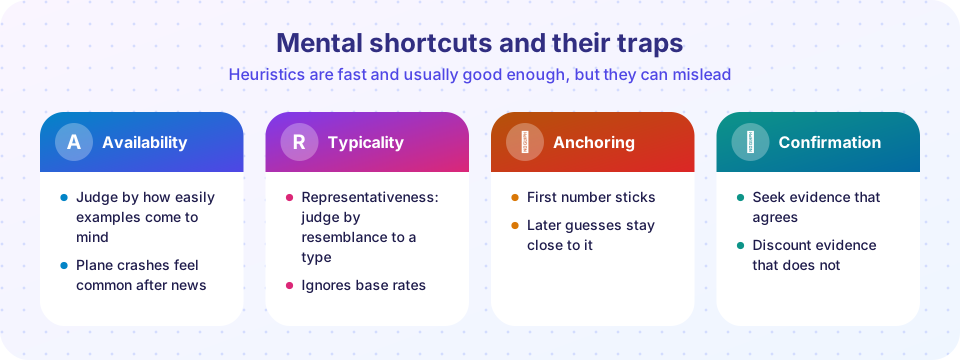
Tversky and Kahneman (1973) showed that we judge frequency by how easily examples come to mind. After news coverage of an airline crash, flying feels riskier, though driving remains more dangerous per kilometer. Vivid, recent or emotional events are more available. The heuristic is often right, because common things are easier to recall, but media coverage and drama distort availability.
Representativeness
We judge probability by how well something matches a typical example. In the famous "Linda problem" (1983), Linda is described as outspoken and concerned with social justice. Most people judged it more likely that she is "a bank teller and active in the feminist movement" than that she is "a bank teller." But the first group is a subset of the second, so it cannot be more probable. This is the conjunction fallacy. We also tend to neglect base rates: ignoring how common something is.
Anchoring
In a well-known study, people spun a rigged wheel that stopped at a low or high number and then estimated a quantity, such as the percentage of African countries in the United Nations. Those who saw the higher number gave noticeably higher estimates, even though they knew the wheel was random. Anchoring has been replicated widely and is one of the sturdier findings in this area. Negotiators and sellers use it deliberately by naming the first price.
Confirmation bias
Peter Wason's 1960 "2-4-6 task" showed that people test ideas by looking for evidence that fits them. The experimenter says the sequence 2, 4, 6 follows a rule, and you must find the rule by proposing new sequences. Most people guess "numbers going up by two" and test only sequences like 8, 10, 12, which always fit. The real rule is simply "any increasing numbers," and you only discover that by trying a sequence that violates your guess. Seeking disconfirming evidence is harder, and it is the basis of scientific testing.
Framing and loss aversion
Tversky and Kahneman (1981) described a disease outbreak expected to kill 600 people. One group chose between a program that would save 200 for certain and one with a one-third chance of saving all 600. Another group chose between a program in which 400 would die for certain and one with a one-third chance that nobody would die. The options are identical in numbers, yet most people chose the sure option in the "saved" version and the gamble in the "die" version. People are more sensitive to losses than gains, a pattern called loss aversion, and a central element of prospect theory.
Are we irrational?
Not quite. Gerd Gigerenzer and colleagues argue that heuristics are "fast and frugal" and can match or beat complex methods in uncertain, real-world settings. Part of the debate is about how problems are presented: many people reason well when given natural frequencies ("10 out of 1,000 have the condition") instead of percentages. Other researchers find that biases persist even with training. A fair summary is that heuristics are efficient tools that fit many environments well and fail in predictable ways in others. Not every famous result in this area has held up: several of the "priming" and "ego depletion" results popular a decade ago did not replicate, while anchoring and framing generally have.
Thinking better
These are general habits supported by research, not guaranteed fixes.
- Slow down for important decisions, especially when you feel rushed or strongly emotional.
- Look for the base rate before judging a case.
- Consider the opposite: ask what would show you are wrong.
- Use checklists and outside views. Compare to similar past cases rather than only the details in front of you.
- Beware of first numbers in negotiations and estimates.
Common misconceptions
"Heuristics are always errors." They are efficient and usually accurate in the environments where they evolved or were learned.
"Smart people do not fall for biases." Intelligence offers limited protection; being aware helps only a little without changing procedures.
"Intuition is magic." Expert intuition can be excellent in stable areas with lots of feedback (chess, firefighting), but poor where feedback is rare or misleading.
Try it
Press Run (or Ctrl + Enter) to see the result here.
Program input · what you'd type while the program runs
Type the answers before you press Run, one per line. Each time the program reads a line (with input()), it gets the next line from this box.
Press Run (or Ctrl + Enter) to see the result here.
Program input · what you'd type while the program runs
Type the answers before you press Run, one per line. Each time the program reads a line (with input()), it gets the next line from this box.
Check your understanding
Quick check · 5 questions
of 5 answered You scored / 5 · perfect!
-
1. A person overestimates the risk of shark attacks after seeing news coverage. Which heuristic is at work?
Vivid, recent examples come easily to mind, so the event feels more common. -
2. In the Linda problem, choosing 'bank teller and feminist' over 'bank teller' is an example of:
A conjunction cannot be more likely than one of its parts, yet resemblance to a stereotype makes it feel likelier. -
3. Which strategy best counters confirmation bias?
Wason's task shows that disconfirming tests reveal what confirming tests cannot. -
4. In Duncker's candle problem, many failed because of:
They saw the box only as a container, not as a platform. -
5. Which description of heuristics fits the research best?
The debate between the biases view and the fast-and-frugal view ends in a balanced picture.
Summary
- Algorithms guarantee solutions; heuristics are fast shortcuts that usually work.
- Availability, representativeness, anchoring and confirmation bias create predictable errors.
- Framing and loss aversion show that how choices are described changes decisions.
- Mental set and functional fixedness block problem solving.
- Slowing down, checking base rates and testing disconfirming cases help.
Next: Chapter 6 review
Track your progress
Create a free account to tick off lessons and pick up where you left off on any device.
of Introduction to Psychology lessons completed