


















Lesson 30 of 45 · Memory and Thinking
Chapter 6 review: memory and thinking
Review how memory works, why we forget and misremember, and how heuristics shape decisions, with a chapter poster, a recap table and a ten-question quiz.
Use this page to check that the pieces of Chapter 6 fit together. Start with the picture, scan the table, then try the quiz without looking back. Questions you miss tell you which lesson to reread.
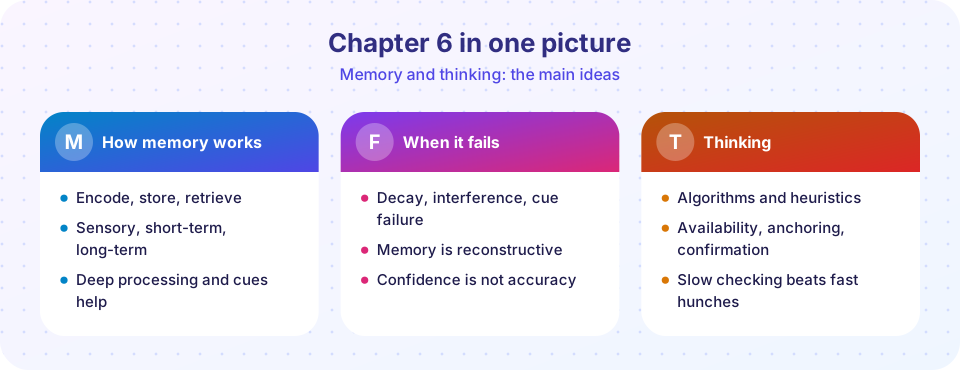
Recap table
| Topic | Key ideas | Names to know | Lesson |
|---|---|---|---|
| Memory stores | Sensory, working, long-term; about 4 chunks in working memory | Atkinson and Shiffrin, Sperling, Miller, Cowan, Baddeley and Hitch | How memory works |
| Long-term memory | Episodic, semantic, procedural, priming; hippocampus and new explicit memories | Tulving, Scoville and Milner (HM) | How memory works |
| Encoding and retrieval | Levels of processing, encoding specificity, spacing, testing effect | Craik and Lockhart, Tulving and Thomson, Roediger and Karpicke | How memory works |
| Forgetting | Curve, decay, interference, cue failure, motivated forgetting | Ebbinghaus, McGeoch, Anderson | Forgetting |
| False memories | Reconstruction, misinformation, eyewitness errors, flashbulb memories | Bartlett, Loftus, Neisser and Harsch | Forgetting |
| Thinking | Algorithms and heuristics, mental set, functional fixedness | Luchins, Duncker | Thinking |
| Judgment | Availability, representativeness, anchoring, confirmation, framing | Kahneman, Tversky, Wason, Gigerenzer | Thinking |
Three habits this chapter should leave you with
- Study actively. Space your practice and test yourself instead of rereading.
- Doubt vividness. A clear, confident memory can still be wrong; write down important details early.
- Slow down for big decisions. Check base rates and look for evidence against your first idea.
Explain it in your own words
Answer each prompt in two or three sentences before you look back at the lessons.
- Why is rereading a weaker study method than self-testing, even though rereading feels easier?
- Describe the difference between decay and interference using a real example.
- A friend is certain she remembers exactly where she was during a major news event. What would you tell her about flashbulb memories?
- Give one situation where availability misleads and one where it helps.
- Why is a positive result on an accurate test sometimes unlikely to mean the person has a rare condition?
Clear explanations are the best sign that an idea has been understood, and writing them is itself retrieval practice.
Try it
Press Run (or Ctrl + Enter) to see the result here.
Program input · what you'd type while the program runs
Type the answers before you press Run, one per line. Each time the program reads a line (with input()), it gets the next line from this box.
Check your understanding
Quick check · 10 questions
of 10 answered You scored / 10 · perfect!
-
1. Sperling's partial-report technique demonstrated that:
A cue right after the flash let people report any row, showing a larger but fleeting store. -
2. Which is an example of implicit memory?
Skills like typing are procedural and shown through performance. -
3. Godden and Baddeley's divers remembered words best when:
This is context-dependent memory, an instance of encoding specificity. -
4. Learning a new password makes you forget the old one. This is:
New information disrupts the old, which is retroactive interference. -
5. What did Loftus and Palmer's study show?
The verb 'smashed' raised speed estimates and later false reports of broken glass. -
6. Which pair is correctly matched?
Wason's task shows our preference for confirming tests. -
7. A flashbulb memory is best described as:
Neisser and Harsch found that confident memories changed over time. -
8. Which is the best example of anchoring?
The first number pulls later judgments toward it. -
9. Why is a positive result on a fairly accurate test often misleading when the condition is rare?
When few people have the condition, even a small false-alarm rate produces many false positives. -
10. Which study habit is best supported by the testing effect?
Roediger and Karpicke found retrieval practice improves later retention.
Summary
- Memory has stores with different durations and capacities; encoding depth and cues control what you can retrieve.
- Forgetting has several causes; memory is reconstructive and can be altered by suggestion.
- Heuristics are efficient but create predictable biases; slowing down and testing alternatives helps.
Track your progress
Create a free account to tick off lessons and pick up where you left off on any device.
of Introduction to Psychology lessons completed