


















Lesson 31 of 45 · Motivation and Emotion
Chapter 7 overview: motivation and emotion
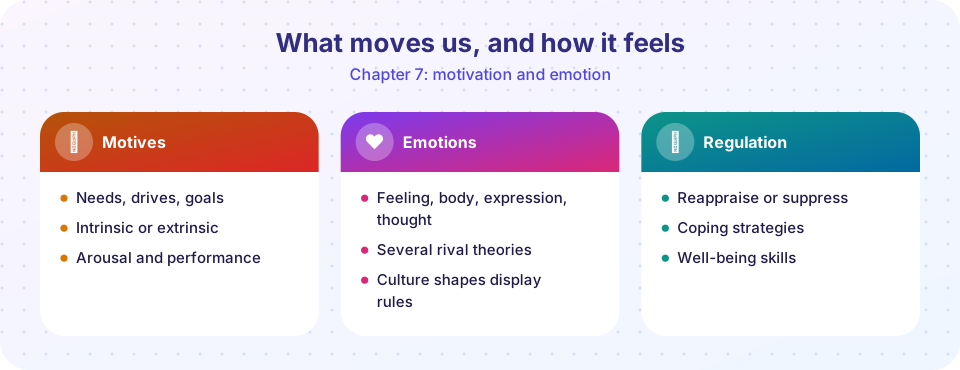
A map of motivation and emotion: why we act, how we feel, how the two interact, and what the lessons in Chapter 7 cover, with a hero illustration and slides.
Why did you start reading this page, and why will you keep going or stop? Why does a song give you shivers, and why can a small insult ruin your afternoon? Motivation asks what moves us. Emotion asks how we feel and how those feelings shape what we do. The two share a root: the Latin movere, "to move."
Psychologists treat the topics together because they interact. A need creates a drive, success feels good, failure feels bad, and those feelings steer the next choice. This chapter gives you the main theories and the evidence behind them, with attention to which ideas have held up.
What you will learn
- What motivation and emotion are and how they relate.
- The main families of motivation theory.
- The main families of emotion theory.
- How people regulate emotions and why culture matters.
- How the lessons in this chapter fit together.
Key terms
Motivation: the processes that start, direct and sustain goal-directed behavior.
Intrinsic motivation: doing something for its own sake, such as interest or enjoyment.
Extrinsic motivation: doing something for a separate reward or to avoid a penalty.
Emotion: a short-lived state that combines a feeling, bodily changes, expression and thoughts.
Mood: a longer, lower-intensity feeling state, often without a clear cause.
Chapter at a glance
Why we act
How we feel
Four emotion theories
Each answers: what comes first?
Managing feelings
The big picture
Motivation theories started with instincts, built-in patterns of behavior, and drive reduction: Clark Hull suggested that bodily needs create tension that we act to relieve. Then came more nuanced ideas: we also chase positive incentives, we work toward goals, and we seek optimal arousal. Abraham Maslow placed needs in a hierarchy, and Edward Deci and Richard Ryan argued that autonomy, competence and relatedness are basic psychological needs. You will see in theories of motivation which of these have empirical support and which are better treated as useful guides.
Emotion theories ask about the order of events. When you see a bear, do you tremble and then feel fear (William James and Carl Lange), or does the experience of fear come at the same time as the trembling (Walter Cannon and Philip Bard)? Does thinking come first (Richard Lazarus)? The emotion theories lesson also covers facial expressions, culture and the problems with some famous experiments.
Where the two meet
- Emotions motivate. Fear pushes you to escape; pride pushes you to repeat success.
- Motives create emotions. When a goal is blocked, frustration follows.
- Both are regulated. People can change how they feel about a situation and, sometimes, what they do about it.
What each lesson covers
- Theories of motivation: drives, incentives, Maslow, self-determination, goal setting and the arousal curve.
- Emotion theories: the four classic theories, the brain's role, facial expression, culture and regulation.
- Chapter review: a poster, a recap table and ten questions.
Common misconceptions
"Rewards always increase motivation." External rewards can sometimes reduce interest in activities people already enjoy (the overjustification effect).
"Emotions are irrational." Emotions carry information and guide decisions; many choices go badly without them.
"Basic emotions are the same everywhere." Some expressions are widely recognized, but the extent to which emotions are universal is actively debated.
Try it
Press Run (or Ctrl + Enter) to see the result here.
Program input · what you'd type while the program runs
Type the answers before you press Run, one per line. Each time the program reads a line (with input()), it gets the next line from this box.
Check your understanding
Quick check · 4 questions
of 4 answered You scored / 4 · perfect!
-
1. Which pair correctly defines intrinsic and extrinsic motivation?
Intrinsic motivation comes from interest or enjoyment of the activity itself; extrinsic motivation depends on outside outcomes. -
2. How does emotion differ from mood?
Emotions are brief and often triggered by an event; moods are longer and less focused. -
3. What question separates the classic emotion theories?
James-Lange, Cannon-Bard, Schachter-Singer and Lazarus disagree about what comes first. -
4. The overjustification effect suggests that:
Lepper, Greene and Nisbett found that expected rewards reduced later free play with a drawing activity.
Summary
- Motivation explains why we start and keep going; emotion explains how we feel and how that guides action.
- Theories range from instinct and drives to needs, goals and self-determination.
- Emotion theories differ on whether body, feeling or appraisal comes first.
- Culture and regulation shape how emotions are expressed and managed.
Next: Theories of motivation
Track your progress
Create a free account to tick off lessons and pick up where you left off on any device.
of Introduction to Psychology lessons completed