


















Lesson 12 of 45 · The Brain and Behavior
Neurons and Synapses: The Brain's Messaging System
Learn the parts of a neuron, how an action potential fires, how chemical messengers cross synapses, and what major neurotransmitters do.
Every thought you have, every muscle you move, every memory you form comes down to cells passing signals to other cells. The star of the show is the neuron. Understanding how one neuron works, and how neurons talk across tiny gaps called synapses, is the foundation for everything else in this chapter: how drugs change mood, why practice changes the brain and what goes wrong in conditions such as Parkinson's disease.
What you will learn
- The parts of a neuron and what each one does.
- How a neuron decides to fire: resting potential, threshold, the all-or-none action potential.
- How signals cross a synapse and how neurotransmitters work.
- What major neurotransmitters do, and how drugs act on synapses.
Key terms
Dendrite: a branching fiber that receives signals from other neurons.
Axon: a long fiber that carries the signal away from the cell body.
Action potential: a brief electrical spike that travels along the axon.
Synapse: the junction where one neuron passes a signal to another.
Neurotransmitter: a chemical messenger released at a synapse.
Myelin: a fatty insulating sheath around many axons that speeds up signals.
Meet the neuron
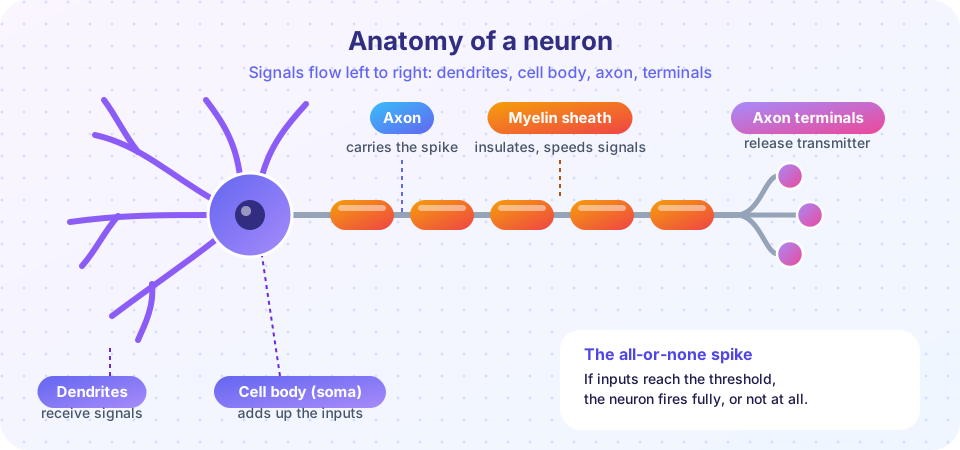
A typical neuron has four parts. The dendrites collect incoming messages. The cell body (soma) holds the nucleus and adds up the inputs. The axon carries a signal away, sometimes a meter long in the human body (the axons running from your spinal cord to your toes). At the end, axon terminals release chemical messengers.
Neurons come in three broad kinds: sensory neurons carry information in from the senses, motor neurons carry commands out to muscles and glands, and interneurons connect neurons within the brain and spinal cord. The vast majority are interneurons.
Alongside neurons the brain has glial cells, which feed, protect and support them. Some glia form myelin, the fatty wrapping around many axons. Myelin acts like insulation and also lets the electrical signal jump between small gaps (the nodes of Ranvier), so insulated axons conduct at up to around 100 meters per second, while thin unmyelinated fibers can be about a hundred times slower over the same distance. In multiple sclerosis, the immune system damages myelin, disrupting signaling.
How a neuron fires
Like a tiny battery, a neuron at rest is electrically charged: the inside is about 70 millivolts (mV) negative compared with the outside. This resting potential is kept by pumps and channels that keep ions (charged atoms) such as sodium and potassium at different concentrations inside and outside the cell.
Incoming signals nudge the voltage up (excitatory) or down (inhibitory). If the combined push brings the voltage to a threshold (roughly -55 mV), channels in the membrane open, sodium rushes in and the voltage spikes to roughly +30 mV in about a millisecond. This is the action potential. Potassium channels then open and restore the resting state. For a short moment (the refractory period) the neuron cannot fire again, which keeps the signal moving in one direction.
Two facts are worth remembering:
- All or none. An action potential has the same size whether the stimulus barely crossed the threshold or crossed it hugely. A neuron fires fully or not at all.
- Strength is in the rate. A stronger stimulus produces more spikes per second, not bigger spikes. The first demonstration below lets you see this.
This idea of adding up inputs and firing at a threshold is the basis of simple models of neurons, including those used in artificial neural networks, although real neurons are far more complex than the models.
Crossing the gap: the synapse
The axon terminal does not touch the next neuron. There is a gap of about 20 nanometers, the synaptic cleft. When the spike reaches the terminal it triggers calcium to enter, and small packets called vesicles release neurotransmitters into the cleft. These molecules drift across and fit into receptors on the receiving neuron like keys in locks, opening channels and changing its voltage. The chemical is then cleared away: it may be taken back up into the sending neuron (reuptake) or broken down by enzymes, so the signal stops.
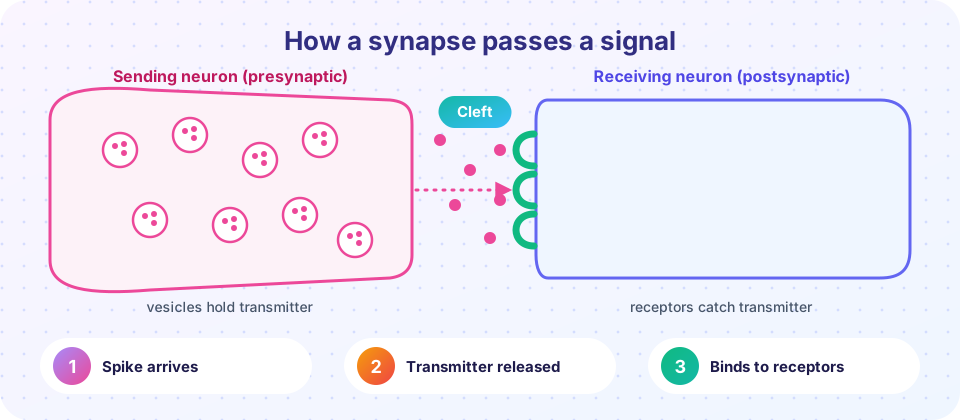
A transmitter can be excitatory (making the next neuron more likely to fire) or inhibitory (less likely), depending on the receptor. One neuron may receive thousands of inputs, and the cell body keeps a running total.
Major neurotransmitters
| Neurotransmitter | Some of its roles | Linked to |
|---|---|---|
| Acetylcholine (ACh) | Muscle movement, attention, memory | Loss of ACh neurons in Alzheimer's disease; blocked by curare, causing paralysis |
| Dopamine | Movement, motivation and reward | Loss of dopamine neurons in Parkinson's disease; involved in addiction |
| Serotonin | Mood, sleep, appetite | Target of many antidepressant drugs |
| Norepinephrine | Alertness and arousal | Stress responses |
| GABA | The brain's main inhibitory messenger | Calming; anxiety medications act on GABA receptors |
| Glutamate | The main excitatory messenger | Learning and memory |
| Endorphins | Natural pain relief and pleasure | Released with exercise and pain |
Many drugs work at synapses. Some are agonists, which mimic or boost a transmitter; others are antagonists, which block it. Cocaine, for instance, blocks the reuptake of dopamine, leaving more in the cleft. Antidepressants called SSRIs slow serotonin reuptake. Botulinum toxin stops acetylcholine release.
Educational information only. This is a description of how scientists understand the biology, not advice on any medicine or condition. Talk to a qualified health professional about treatment.
Learning changes synapses
In 1949 Donald Hebb proposed that when one neuron repeatedly helps to fire another, the connection between them strengthens, often summarized as "cells that fire together wire together". Later experiments found a mechanism called long-term potentiation, in which a synapse becomes more responsive after intense use. This is a leading candidate for how memories are physically stored (Chapter 6).
Common misconceptions
"Low serotonin causes depression." The popular "chemical imbalance" story is an oversimplification. Serotonin is involved in the action of many treatments, but depression has many interacting causes (biological, psychological and social), and no single chemical explains it.
"A stronger stimulus makes a bigger spike." The spike size is fixed. The neuron codes strength by firing faster, and many neurons together code more.
"Dopamine is the pleasure chemical." Dopamine is better described as involved in motivation, learning what is worth pursuing, and movement. Pleasure involves other systems as well.
"The brain is wired once and for all." Synapses form, strengthen and prune throughout life, though especially in childhood and adolescence.
Try it
First, a model neuron. The simulation adds up incoming current and fires a spike when the voltage reaches the threshold, then resets. Move the slider. Notice that spikes are always the same height and that the spike rate rises with input. This is a simplified "leaky integrate-and-fire" demonstration, not a biologically complete neuron.
Second, the same model in Python, measuring the firing rate for different input strengths and comparing with the exact formula. The shape of the curve is the "rate code": no spikes below threshold, then a steady rise.
Press Run (or Ctrl + Enter) to see the result here.
Program input · what you'd type while the program runs
Type the answers before you press Run, one per line. Each time the program reads a line (with input()), it gets the next line from this box.
Third, how long does a signal take to travel? Speed depends on fiber type. The values are rough textbook ranges, which is why the code uses ranges rather than exact numbers.
Press Run (or Ctrl + Enter) to see the console output here.
No output.
Check your understanding
Quick check · 5 questions
of 5 answered You scored / 5 · perfect!
-
1. What happens when a neuron's voltage reaches threshold?
Action potentials are all-or-none: the same size whatever the strength of the stimulus. -
2. How does a neuron signal a stronger stimulus?
Strength is coded in rate (and by how many neurons fire), not in size. -
3. What is the job of myelin?
Myelin lets the electrical signal jump between gaps and conduct faster. -
4. Which neurotransmitter is the brain's main inhibitory messenger?
GABA reduces the likelihood that the receiving neuron fires; glutamate is the main excitatory messenger. -
5. SSRIs are described as acting by
They keep more serotonin available in the cleft. This is a description of the mechanism, not a claim that low serotonin causes depression.
Summary
- A neuron has dendrites (receive), a cell body (sums), an axon (conducts) and terminals (release).
- It fires an all-or-none action potential when inputs reach threshold; strength is coded by firing rate.
- Myelin speeds conduction; glia support neurons.
- Synapses use chemical messengers; transmitters are excitatory or inhibitory and are then cleared.
- Dopamine, serotonin, acetylcholine, GABA, glutamate and others have different roles, and drugs act on synapses.
- Synapses strengthen with use (Hebb, long-term potentiation), which underlies learning.
Track your progress
Create a free account to tick off lessons and pick up where you left off on any device.
of Introduction to Psychology lessons completed