


















Lesson 22 of 45 · Learning and Conditioning
Classical conditioning: learning what predicts what
Learn classical conditioning with Pavlov's dogs, Little Albert, taste aversion and the Rescorla-Wagner model, plus a runnable simulation of acquisition and extinction.
At the start of the twentieth century, the Russian physiologist Ivan Pavlov was studying digestion in dogs. He measured how much saliva flowed when food reached the mouth. Then he noticed something that had nothing to do with digestion: after a few days the dogs began to drool before the food arrived, when they heard the assistant's footsteps or saw the food bowl. Pavlov, who received a Nobel Prize in 1904 for his digestion research, realized that this "psychic secretion" was more interesting than the digestion itself. He spent the rest of his career studying it.
What Pavlov described is now called classical conditioning: learning that one event predicts another. It is one of the foundations of psychology, and it explains many everyday reactions, from the sound that makes your stomach growl to why a smell can bring back a memory and a feeling.
What you will learn
- The four key terms of classical conditioning: US, UR, CS and CR.
- How acquisition, extinction, spontaneous recovery, generalization and discrimination work.
- What Little Albert and taste aversion showed, and what they got wrong or right.
- Why modern theory says prediction (contingency), not just closeness in time, drives learning.
- How to run a simple model of the process.
Key terms
Unconditioned stimulus (US): something that triggers a response without any learning, such as food.
Unconditioned response (UR): the automatic response to the US, such as salivating.
Conditioned stimulus (CS): a formerly neutral cue that, after pairing with the US, triggers a response, such as the bell.
Conditioned response (CR): the learned response to the CS. It is often similar to the UR but not always identical.
Extinction: the weakening of a CR when the CS keeps appearing without the US.
The classic set-up
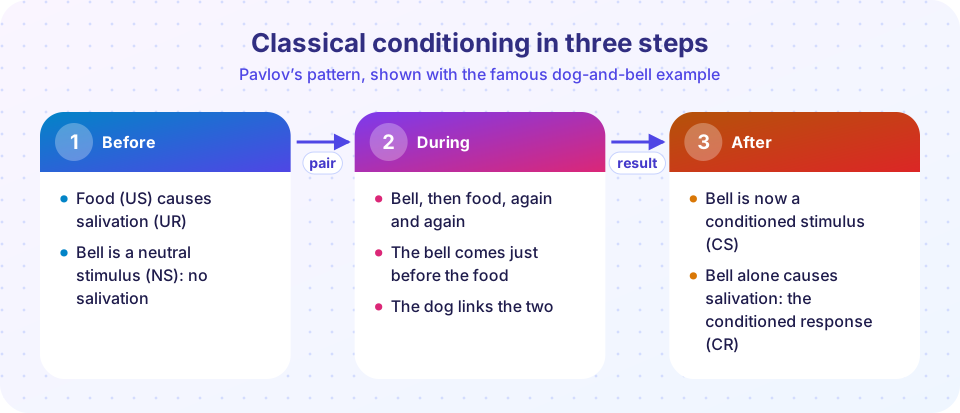
Before conditioning, food (US) makes a dog salivate (UR). A bell is a neutral stimulus (NS): it produces a brief orienting response but no salivation. During conditioning, the bell sounds just before the food, over and over. This stage is acquisition. After enough pairings, the bell alone causes salivation. The bell is now a conditioned stimulus and salivation to the bell is a conditioned response.
Two details are worth remembering.
- Timing matters. Conditioning is usually strongest when the CS begins shortly before the US (forward pairing). If the food comes first and the bell afterward, the animal learns little, because the bell predicts nothing.
- The CR is not always a copy of the UR. For a CS that signals a shock, the animal may freeze or show a heart-rate change, even if the shock itself would cause a different reaction. The CR often prepares the animal for what is about to happen.
Pavlov's own experiments used many cues, including metronomes, lights and touches. The popular image of a ringing bell is a simplification.
Acquisition, extinction and recovery
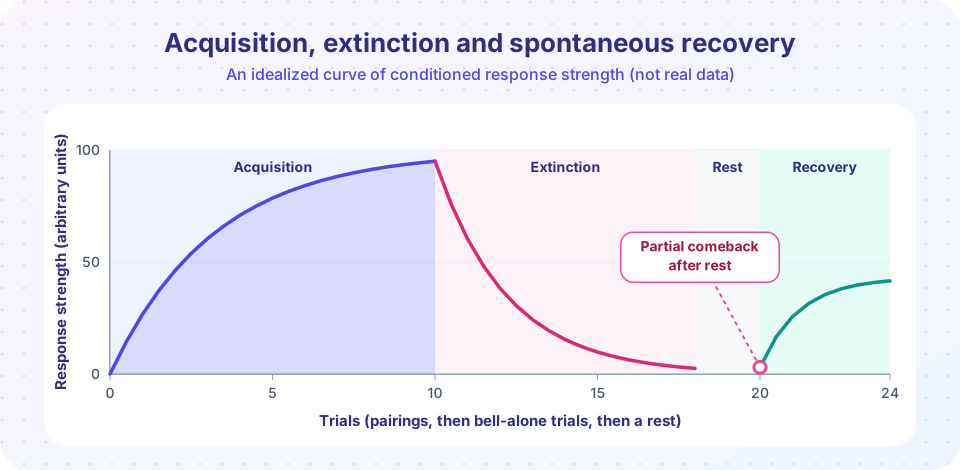
During acquisition the CR grows quickly at first, then levels off. If you then present the CS repeatedly without the US, the CR fades: this is extinction. But extinction is not forgetting. After a rest period the CR often returns in a weakened form when the CS appears again. This spontaneous recovery shows that the original learning was suppressed, not erased. Researchers now think extinction is new learning ("the bell no longer predicts food") that competes with the old learning.
Two more processes govern how far learning spreads:
- Stimulus generalization: a CR also appears for cues similar to the CS. A dog conditioned to a high tone may also respond to a slightly lower tone.
- Stimulus discrimination: learning to respond to the CS but not to similar cues, because only the CS is followed by the US.
In higher-order conditioning, an established CS acts like a US to condition another cue. If a bell reliably predicts food, a light that predicts the bell can become a second-level CS.
Emotional learning: Little Albert
In 1920, John B. Watson and Rosalie Rayner reported an experiment on an infant they called Albert B. A white rat, which Albert at first approached, was paired with a loud, sudden clang behind his head. Afterward, Albert reportedly cried at the rat and showed some distress at similar furry objects, which looks like generalization.
The study is famous but deserves caution. It had one child, no proper control, and the procedure would not be allowed today because it deliberately frightened a baby and nobody recorded undoing the fear. Later researchers have also argued that the published account is inconsistent. What survives is the broad idea that emotions, including fears, can be conditioned. Modern therapies for phobias build on the same principle in reverse: they teach new, safer associations and use extinction under professional guidance.
This course gives educational information only. It does not diagnose or treat any condition; anyone struggling with strong fears should talk to a qualified professional.
Taste aversion and biological limits
In 1966, John Garcia and Robert Koelling gave rats flavored water followed by sickness caused by radiation. The rats later avoided the flavor, even though the nausea began hours after drinking. This conditioned taste aversion breaks the "close in time" rule and needs only one pairing. In the same research, rats did not link flavor with a shock or sounds and lights with sickness as easily.
Martin Seligman called this biological preparedness: animals are primed by evolution to link some things (taste and illness) more readily than others. People show the same pattern. Many adults avoid a food that made them sick once, even when they know that something else caused the illness. Preparedness may also help explain why fears of snakes and heights are more common than fears of flowers.
Prediction, not just pairing
For decades people assumed that conditioning simply needed the CS and US to occur together (contiguity). Robert Rescorla (1967) challenged this. In his experiments, one group of animals got a tone and shock paired often, but also got many shocks when no tone was playing. For these animals, the tone did not predict the shock any better than chance, and they showed little fear of it, even though pairings were frequent. Learning depends on contingency: how much the CS tells you about whether the US will come.
Leon Kamin's blocking experiment (1969) supports this. If a light has already been taught to predict shock, adding a tone to the light afterward produces little learning about the tone, because the tone adds no new information.
The Rescorla–Wagner model (1972) captures this with one equation. On each trial the associative strength V of a cue changes by
ΔV = α β (λ − ΣV)
where λ is the maximum learning the US can support, ΣV is the total strength of all cues present, and α and β are learning rates. Learning is driven by surprise: the gap between what happened (λ) and what was predicted (ΣV). When the prediction is already perfect, nothing more is learned. This same idea of error-driven learning appears in modern machine learning and in the study of dopamine neurons.
Common misconceptions
"The dogs learned because the bell and food were close in time." Closeness helps, but prediction is what counts. A cue that does not add information is not learned, as blocking shows.
"Extinction erases what was learned." Spontaneous recovery and relearning show that the old association remains in some form.
"Classical conditioning means people are puppets." Conditioning describes how cues come to trigger reactions. People can notice, think about and change their associations.
Try it
Press Run (or Ctrl + Enter) to see the result here.
Program input · what you'd type while the program runs
Type the answers before you press Run, one per line. Each time the program reads a line (with input()), it gets the next line from this box.
Check your understanding
Quick check · 5 questions
of 5 answered You scored / 5 · perfect!
-
1. A child hears a dentist's drill (CS) that was previously paired with pain (US) and tenses up. Which term describes the tensing?
The tensing is a learned response to a cue that predicts pain, so it is a conditioned response. -
2. A dog's salivation to a bell disappears after many bell-alone trials, but returns somewhat after a rest. This return is called:
Spontaneous recovery is the reappearance of a CR after extinction and a rest period. -
3. What did Garcia and Koelling's taste-aversion research show?
Taste aversion formed after one pairing and a long delay, supporting biological preparedness. -
4. In the Rescorla-Wagner model, learning on a trial is largest when:
The change in strength is proportional to the difference between what happened and what was predicted, so surprise drives learning. -
5. Why is the Little Albert study treated with caution today?
The study used a single infant, lacked controls, and deliberately caused distress, so it is both methodologically weak and unethical by modern standards.
Summary
- In classical conditioning a neutral cue (CS) comes to trigger a response because it predicts a US.
- Acquisition builds the CR; extinction weakens it; spontaneous recovery shows the learning was not erased.
- Generalization spreads the response to similar cues; discrimination narrows it.
- Biology shapes what is easy to learn (taste aversion, preparedness).
- Rescorla and Wagner showed learning follows surprise, not just closeness in time.
Next: Operant conditioning
Track your progress
Create a free account to tick off lessons and pick up where you left off on any device.
of Introduction to Psychology lessons completed