


















Lesson 4 of 45 · Getting Started
Perspectives in Psychology
Compare the biological, psychodynamic, behavioral, cognitive, humanistic and sociocultural perspectives, with one example explained six ways and the big debates.
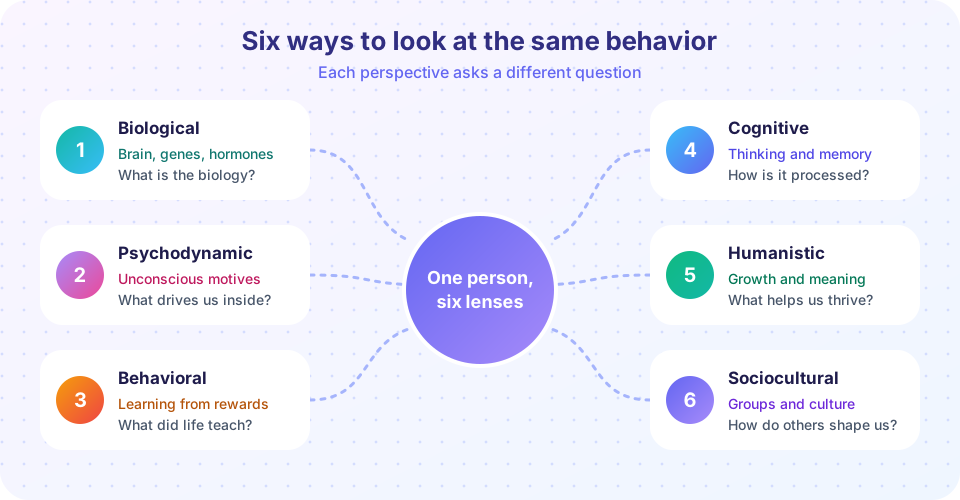
Why are some people afraid of dogs? One answer: because of something that happened to them. Another: because their brains react strongly to threat. Another: because their parents were anxious too. All three can be partly true. Psychologists group the major kinds of explanation into perspectives: broad lenses that point to different causes and suggest different studies. They are not rival teams you must join. They are tools, and a good psychologist keeps several in the toolbox.
What you will learn
- The central idea, key names and typical methods of each of six perspectives.
- How one behavior (a fear of dogs) is explained by each.
- Strengths and limits of each lens.
- The big debates that run through the whole of psychology.
Key terms
Perspective: a broad approach with its own assumptions about what causes behavior.
Nature and nurture: the debate (and interaction) between inherited biology and experience.
Natural selection: the process by which inherited traits that help survival and reproduction become more common.
Unconscious: mental processes outside awareness that still affect behavior.
Culture: shared beliefs, values, language and customs passed between people.
1. The biological perspective
Core idea: behavior has roots in the body. Brain structures, neurotransmitters, hormones and genes all influence what we do and feel.
Methods: brain imaging, studies of twins and adoptees, drug studies, studies of patients with brain damage (Chapter 3).
Example: a strong reaction to dogs may involve an overactive amygdala, a brain region that flags threat, together with genetic differences in how reactive people are.
Strengths: concrete and measurable; explains links between body and mind. Limits: can slide into "nothing but biology" (reductionism). Brain activity shows what happens during a feeling, but does not by itself explain the person's reasons or situation.
The evolutionary perspective is closely related. It asks how a trait might have helped our ancestors to survive and reproduce, using Charles Darwin's idea of natural selection. A fear of heights or of snakes may be easier to learn than a fear of flowers because caution was useful. This is a source of hypotheses; critics rightly warn against "just-so stories" that sound plausible but cannot be tested.
2. The psychodynamic perspective
Core idea: behavior is driven by motives and conflicts, many of them unconscious, and early experiences shape later life. Sigmund Freud started this approach; Carl Jung, Alfred Adler and later theorists changed it.
Methods: case studies, interpretation of dreams and associations in psychotherapy.
Example: a fear of dogs might be traced to an unresolved childhood conflict that has been displaced onto the animal.
Strengths: it drew attention to the unconscious and to the importance of childhood and relationships; modern attachment theory and research on implicit (unconscious) processing grew from related questions. Limits: many claims are hard to test and can explain any outcome after the fact, which is why most experimental psychologists treat classical psychoanalysis with caution.
3. The behavioral perspective
Core idea: behavior is learned from the environment through conditioning: associations between events (classical conditioning, Pavlov) and consequences (operant conditioning, Skinner).
Methods: controlled experiments, often with animals at first, and observation of behavior in specific settings.
Example: a child bitten by a dog learns to associate dogs with pain. Fear then keeps itself going because avoiding dogs removes the discomfort (a reward for avoiding).
Strengths: testable, practical; basis for behavior therapies and classroom techniques. Limits: leaves out thinking and innate predispositions. Albert Bandura showed that people also learn by watching others (social learning), which bridged this view and the next.
4. The cognitive perspective
Core idea: the mind processes information: it perceives, remembers, reasons and decides, and these steps explain behavior.
Methods: laboratory tasks measuring accuracy and reaction time, computational models, brain imaging.
Example: a person who interprets every dog's bark as an attack ("that dog wants to bite me") feels fear because of that interpretation, and notices threatening cues more than friendly ones.
Strengths: rigorous, links to neuroscience and artificial intelligence; basis of cognitive therapy. Limits: laboratory tasks may be far from daily life, and the computer analogy can undersell emotion and the body.
5. The humanistic perspective
Core idea: people are active, growth-seeking beings with free will and a need for meaning, and they are best understood from their own point of view. Key names: Carl Rogers and Abraham Maslow.
Methods: interviews, personal accounts, client-centered therapy, questionnaires about self-concept and well-being.
Example: it would ask what the fear means for the person's life and what support would help them grow beyond it.
Strengths: respect for individual experience; influence on counseling and positive psychology. Limits: concepts such as "self-actualization" are hard to measure; early claims were less tested.
6. The sociocultural perspective
Core idea: behavior is shaped by other people and by culture: families, groups, norms, language, institutions and inequality.
Methods: surveys, field studies, cross-cultural comparisons, experiments on conformity, obedience and prejudice.
Example: growing up in a house where relatives talked about "dangerous dogs", in a neighborhood where strays are common, or in a culture that keeps dogs as workers instead of pets will change what the animal means.
Strengths: reminds us that the lab participants of the past were often not typical of humankind. Most of the classic studies used students from wealthy Western societies, a pattern Joseph Henrich and colleagues (2010) labeled "WEIRD" (Western, Educated, Industrialized, Rich, Democratic). Limits: culture is hard to measure and easily stereotyped.
The same behavior through six lenses
| Perspective | Why might someone fear dogs? | A possible study |
|---|---|---|
| Biological | A reactive amygdala; inherited tendency | Brain scan while viewing dog photos |
| Psychodynamic | Displaced unconscious conflict | Case study in therapy |
| Behavioral | Learned association with a painful event | Conditioning experiment |
| Cognitive | Threat-focused interpretations | Tests of attention to threat words |
| Humanistic | Obstacle to personal growth | Interviews about meaning |
| Sociocultural | Family and cultural messages | Cross-cultural survey |
Look at the right-hand column: each perspective produces different studies, and good evidence for one does not rule out the others. Treatments reflect this too: exposure therapy (behavioral), changing interpretations (cognitive), medication (biological), talking about relationships (psychodynamic and humanistic) and family or community work (sociocultural).
The big debates
Four questions run through the field. They are better treated as ranges than as either-or choices.
- Nature versus nurture. How much do genes and experience matter? Almost every trait involves both, and they interact: genes affect which environments people seek, and environments affect how genes work (Chapter 3).
- Free will versus determinism. Are our choices free, or fully caused by prior events? Most psychologists use a pragmatic position: behavior has causes, yet people respond to reasons and can change.
- Conscious versus unconscious. How much of what we do do we control? A great deal of processing happens outside awareness.
- Stability versus change. Is personality fixed, or does it change across life? Both: there is considerable stability, with meaningful change (Chapter 8).
Common misconceptions
"You have to pick one perspective." Most modern research is integrative; for example, "cognitive neuroscience" combines two lenses.
"A perspective that is hard to test is useless." Hard-to-test ideas can still inspire testable ones. The key is to keep asking what evidence would support or refute them.
"Evolution means traits are fixed or good." Evolutionary explanations describe how traits could have become common; they do not say a trait is inevitable or morally right.
"Biology means no change is possible." Brains change with experience (neuroplasticity), and genetic influence does not equal destiny.
Try it
Match each statement to the perspective it best represents. It is a study aid with one best answer per item, though real research often blends lenses.
Next, a toy model of natural selection, labeled as a simplified demonstration, not a prediction about real traits. A trait ("caution") gives a small survival advantage. Watch how its frequency changes over generations in five random runs.
Press Run (or Ctrl + Enter) to see the result here.
Program input · what you'd type while the program runs
Type the answers before you press Run, one per line. Each time the program reads a line (with input()), it gets the next line from this box.
Check your understanding
Quick check · 5 questions
of 5 answered You scored / 5 · perfect!
-
1. A researcher uses brain scans to compare people who do and do not have a strong fear reaction. Which perspective is this?
Brain imaging is a signature method of the biological perspective. -
2. Which perspective is best associated with the idea that behavior is learned through rewards and associations?
Behaviorists such as Pavlov and Skinner studied conditioning. -
3. What is the main criticism of classical psychodynamic theory by experimental psychologists?
Untestable claims cannot be checked by evidence, a weakness of science. -
4. 'WEIRD' samples refers to participants who are
Henrich, Heine and Norenzayan (2010) pointed out that many studies draw on a narrow slice of humanity. -
5. Most psychologists today treat the nature-nurture question as
Genes and experience interact, and each shapes how the other has its effect.
Summary
- Perspectives are lenses: biological, evolutionary, psychodynamic, behavioral, cognitive, humanistic and sociocultural.
- Each asks a different question and uses different methods, so each reveals something the others miss.
- The same behavior can be explained at several levels, and integrated explanations are strongest.
- Four debates (nature-nurture, free will, conscious-unconscious, stability-change) are best seen as ranges.
- Avoid just-so stories and narrow samples: always ask what the evidence is and in whom.
Track your progress
Create a free account to tick off lessons and pick up where you left off on any device.
of Introduction to Psychology lessons completed