


















Lesson 33 of 45 · Motivation and Emotion
Emotion theories: body, brain, thought and culture
Compare the classic theories of emotion, the brain's role, facial expressions and culture, and emotion regulation, with a valence-arousal plot and a two-factor demo.
You are walking home when a dog bursts out of a gate and barks at you. In under a second your heart pounds, you jump, your face changes, you think "danger," and you feel afraid. Which of those came first? That question, deceptively simple, started a century-long debate. The answer matters because it asks whether feelings cause bodily changes, or the other way around, or neither.
This lesson takes you through the main theories, what the brain does, whether expressions are universal, and how people regulate emotions.
What you will learn
- The four classic theories: James–Lange, Cannon–Bard, Schachter–Singer and Lazarus.
- The role of the amygdala and the "fast route" described by LeDoux.
- The evidence on facial expressions, including Ekman's work and its critics.
- Why the facial-feedback hypothesis failed one famous replication.
- Cultural display rules and emotion regulation strategies.
Key terms
Appraisal: your evaluation of what an event means for your goals and well-being.
Arousal: bodily activation, such as faster heartbeat and breathing.
Display rules: cultural norms about when and how to show emotions.
Reappraisal: changing how you think about a situation to change its emotional impact.
Valence: how pleasant or unpleasant a feeling is.
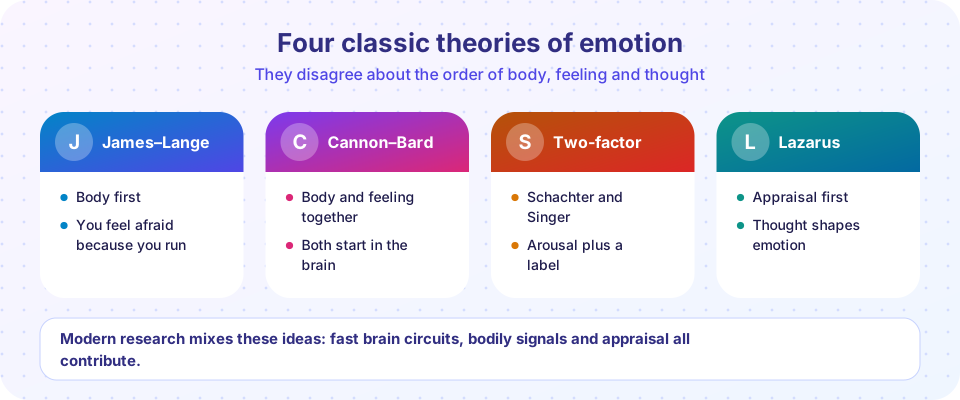
Four classic theories
James–Lange: body first
In 1884 William James, and independently the Danish physician Carl Lange, argued for a surprising order: we do not run because we are afraid; we are afraid because we run. Perception of an event triggers bodily changes, and the awareness of those changes is the emotion. If you could remove all bodily feeling, said James, an emotion would become a cool intellectual thought.
Evidence: people differ in how strongly they sense their bodies, and those who tune in better to their heartbeat often report stronger emotions. But studies of people with spinal cord injuries, who feel less bodily sensation, reported that emotions remained, which weakens the strong version of the theory. Modern views keep a weaker idea: bodily signals feed into feelings.
Cannon–Bard: simultaneous
Walter Cannon argued in 1927, and Philip Bard added, that body and feeling occur together. Cannon pointed out that bodily changes are too slow and too similar across emotions (fear, anger and excitement all raise heart rate) to make the difference. In their view the thalamus sends signals at once to the cortex, which produces the experience, and to the body, which produces arousal. The theory was right that the body does not distinguish emotions as sharply as James assumed, but the specific brain pathway has been revised.
Schachter–Singer: two factors
Stanley Schachter and Jerome Singer (1962) proposed that an emotion needs physiological arousal plus a cognitive label from the situation. In their experiment, volunteers were injected with adrenaline (epinephrine) and given different information about its effects. Then they waited in a room with a confederate who acted either euphoric or angry. The idea was that uninformed participants, aroused but unsure why, would label their state using the confederate's behavior. The results were mixed and weaker than usually described, and later attempts to replicate were not clear-cut. Still, the broad idea that context helps interpret arousal has support: in studies of "misattribution," people who feel aroused for one reason sometimes credit it to something else, such as the person in front of them.
Lazarus: appraisal first
Richard Lazarus (1984) argued that thought comes first: you appraise an event as dangerous, beneficial, or irrelevant, and the emotion follows. Robert Zajonc replied that some feelings, like liking something after a brief exposure, arrive before conscious thought. Most researchers today say both can be true: there are fast, automatic evaluations and slower, deliberate ones.
The emotional brain
Joseph LeDoux described two routes for fear. A "low road" sends a rough signal from the thalamus straight to the amygdala, an almond-shaped structure deep in the temporal lobe, triggering a quick reaction. A "high road" sends the signal to the cortex for a more detailed analysis. The low road explains why you may jump at a stick that looks like a snake before knowing what it is. The amygdala is involved in fear learning but is not a "fear center" and works with many other regions; claims that any single structure is "the" seat of an emotion are oversimplified. The prefrontal cortex helps regulate emotional responses, and the insula contributes to awareness of bodily states.
Dimensions and basic emotions
Some theorists describe emotions along two dimensions: valence (pleasant to unpleasant) and arousal (calm to excited). James Russell's circumplex model (1980) arranges emotion words around this space. Excited sits at high arousal and positive valence; sad sits at low arousal and negative valence.
Others describe a small set of basic emotions. Paul Ekman and colleagues proposed that facial expressions for anger, fear, sadness, joy, disgust and surprise (and later others) are recognized across cultures. In the 1960s and 1970s, Ekman showed photographs to people in the United States, Japan, and the Fore people of Papua New Guinea, who had little contact with Western media, and found agreement above chance on which face matched a story.
The evidence has been criticized. Lisa Feldman Barrett and colleagues point out that studies often give people a short list of emotion words to choose from, which boosts agreement, and that studies of other groups, such as the Himba of Namibia, find less agreement when people sort faces freely. Barrett's theory of constructed emotion proposes that the brain builds emotions from bodily signals, past experience, and concepts learned in culture. Researchers continue to disagree, so the fair summary is that there are some widely recognized expressions, but that how universal and distinct emotions are remains debated.
Does smiling make you happier?
The facial feedback hypothesis says that expressions can influence feelings. In a well-known 1988 study, Fritz Strack, Leonard Martin and Sabine Stepper had people hold a pen in their teeth (forcing a smile) or in their lips (blocking a smile) while rating cartoons. Smiling participants rated them as funnier. But a 2016 Registered Replication Report involving 17 labs failed to find the effect reliably. This is a good example of why science needs replication: an elegant and popular result did not hold up in a large check, though the broader question of facial feedback is still studied with other methods.
Culture and display rules
Expressions are shaped by display rules. In Ekman and Friesen's studies, Japanese and American students watched an unpleasant film. When alone, both groups showed similar expressions of disgust and distress. When an authority figure was present, the Japanese participants more often masked their negative expressions with polite smiles. The rules differ across cultures and situations, such as what is appropriate at a funeral or a celebration.
Regulating emotions
James Gross separated two common strategies.
- Reappraisal changes the meaning of the situation ("this interview is a chance to learn"). It tends to reduce negative emotion with relatively little cost.
- Suppression hides the outward expression. It does not reduce the inner feeling much and can raise physiological stress and reduce memory for the situation.
Other helpful habits include getting enough sleep, physical activity, social support and, for some, mindfulness. Evidence that mindfulness helps is moderate and varies by study. This is general information; if emotions feel overwhelming or last a long time, a doctor or qualified counselor is the right contact.
Common misconceptions
"Everyone shows emotions the same way." Expression is shaped by culture, personality and the situation.
"Suppressing feelings makes them go away." Suppression changes the visible expression but often leaves, or raises, the inner arousal.
"The amygdala is the brain's fear button." It is part of a wider network and also responds to novelty, ambiguity and positive events.
Try it
Press Run (or Ctrl + Enter) to see the result here.
Program input · what you'd type while the program runs
Type the answers before you press Run, one per line. Each time the program reads a line (with input()), it gets the next line from this box.
Check your understanding
Quick check · 5 questions
of 5 answered You scored / 5 · perfect!
-
1. According to the James-Lange theory, you feel afraid because:
James and Lange proposed that awareness of bodily changes is the emotion. -
2. What did Cannon criticize about the James-Lange theory?
Cannon argued that visceral changes are too slow and non-specific to account for the variety of emotions. -
3. In Schachter and Singer's theory, an emotion requires:
Their two-factor theory combines physiological arousal and a situational label. -
4. What happened in the 2016 Registered Replication Report on the pen-in-mouth study?
Seventeen labs failed to obtain the effect reliably, which weakened confidence in that result. -
5. Which regulation strategy generally has fewer costs?
Gross's research finds that reappraisal reduces negative emotion with relatively little cost, while suppression has side effects.
Summary
- Classic theories disagree about the order of body, feeling, label and appraisal; modern views blend them.
- The amygdala supports fast fear responses, but emotion involves wide networks.
- Basic-emotion claims and facial-feedback findings are debated, and culture shapes expression through display rules.
- Reappraisal tends to be more effective than suppression for managing emotion.
Next: Chapter 7 review
Track your progress
Create a free account to tick off lessons and pick up where you left off on any device.
of Introduction to Psychology lessons completed