


















Lesson 27 of 45 · Memory and Thinking
How memory works: sensory, working and long-term memory
Learn how memory is encoded, stored and retrieved, from Sperling and Miller to Baddeley's working memory, levels of processing, HM and study methods that really work.
You hear a phone number, say it quietly to yourself until you dial it, and ten minutes later it is gone. Yet you can still sing songs from a decade ago. Clearly memory is not one thing. Psychologists describe several systems that differ in how long they hold information and how much, and each can fail in its own way.
This lesson walks through the classic model, the more modern idea of working memory, and what research says about getting information into long-term memory.
What you will learn
- The Atkinson–Shiffrin model and its three stores.
- How Sperling, Miller and Peterson and Peterson measured sensory and short-term memory.
- The parts of Baddeley and Hitch's working memory model.
- The types of long-term memory and the case of HM.
- Levels of processing, encoding specificity, spacing and testing, and what they mean for study.
Key terms
Sensory memory: a very brief store of raw sensory information.
Chunking: grouping items into meaningful units to hold more.
Explicit memory: memories you can consciously state (facts and events).
Implicit memory: memory shown through performance, such as skills and priming.
Retrieval cue: anything that helps bring a memory back.
The three-stage model
In 1968 Richard Atkinson and Richard Shiffrin proposed that information flows through three stores.
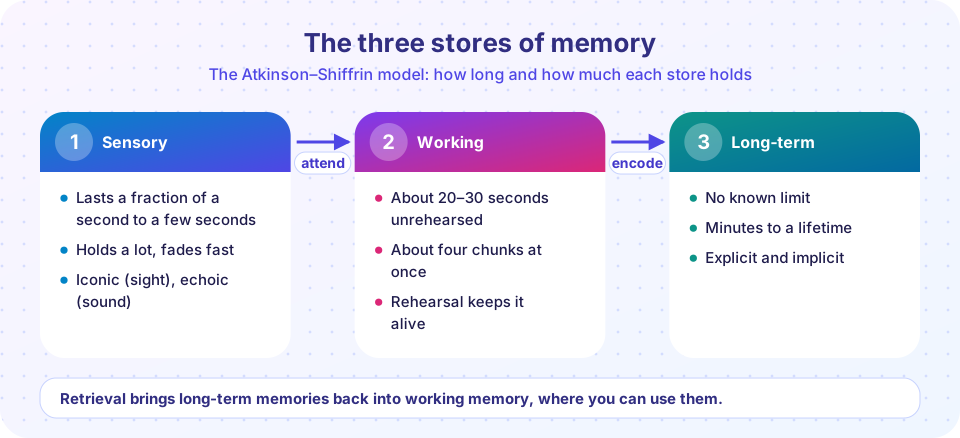
- Sensory memory holds an exact copy of what your senses received, for a fraction of a second to a few seconds. In 1960 George Sperling flashed a grid of 12 letters for about a twentieth of a second. People could report only about four or five letters. But when a tone told them which row to report right after the flash, they got most of that row right. They had briefly "seen" the whole grid, but it faded while they were reading it out. Visual sensory memory is called iconic, auditory is echoic.
- Short-term memory holds what you attend to, for around 20 to 30 seconds if you do not rehearse it. In 1959 Lloyd and Margaret Peterson had people remember three consonants and then count backward by threes. Recall fell quickly with delay, showing that unrehearsed items fade fast or are overwritten.
- Long-term memory is for storing information for minutes to a lifetime, with no known upper limit.
George Miller's famous 1956 paper, "The magical number seven, plus or minus two," proposed that people hold about seven items. Later work, notably by Nelson Cowan (2001), suggested the true limit is closer to four chunks. What counts as an item is flexible. The letters F, B, I, C, I, A are six items, but FBI and CIA are two chunks, so you can hold them easily.
The model was influential but too simple. Short-term memory is not only a waiting room, and information does not always have to pass through it in a fixed order.
Working memory
Alan Baddeley and Graham Hitch (1974) argued that the short-term store is an active workspace with parts.
- The phonological loop holds sounds and words, a kind of inner voice and inner ear. This is why you repeat a phone number to yourself.
- The visuospatial sketchpad holds images and layouts, such as the route from your door to your bedroom.
- The central executive directs attention and coordinates the parts.
- The episodic buffer (added in 2000) combines information from the loop, the sketchpad and long-term memory into scenes.
Evidence for separate parts comes from dual-task experiments. Doing two verbal tasks at once interferes more than doing one verbal and one visual task. Working memory capacity differs between people and predicts reading comprehension and reasoning, which is why training and strategy use are studied. Brain training programs have produced mixed evidence: people improve on trained tasks, but transfer to everyday skills is usually small.
Long-term memory
Long-term memory has several kinds.
| Kind | What it holds | Example |
|---|---|---|
| Episodic (explicit) | Events from your life | Your last birthday |
| Semantic (explicit) | Facts and word meanings | Paris is the capital of France |
| Procedural (implicit) | Skills and habits | Riding a bike |
| Priming (implicit) | Easier processing after previous exposure | Recognizing "doctor" faster after "nurse" |
Endel Tulving proposed the episodic and semantic distinction. The strongest evidence that these systems can separate comes from patients with amnesia. In 1953 the surgeon William Scoville removed parts of the medial temporal lobes, including the hippocampus, of a man known for decades as HM (later revealed as Henry Molaison) to reduce severe epilepsy. Brenda Milner found that HM could hold a conversation and remembered his childhood, but could not form new explicit memories afterward (anterograde amnesia). Yet he improved at a mirror-drawing task over days without remembering having practiced it. So the hippocampal region is critical for forming new explicit memories, and procedural memory depends on other circuits.
Getting information in: encoding
How you process information matters more than how long you stare at it. In 1972 Fergus Craik and Robert Lockhart proposed levels of processing. Shallow processing focuses on appearance ("is the word in capitals?"), a bit deeper on sound ("does it rhyme with chair?"), and deepest on meaning ("does it fit in this sentence?"). Craik and Tulving (1975) found that words processed for meaning were remembered much better than words processed for appearance or sound.
Other encoding findings:
- Self-reference. Relating information to yourself helps.
- Organization. Grouping and outlines help; chunking helps.
- Imagery and mnemonics. The method of loci (placing items along a familiar route) and vivid images improve recall of lists.
- Elaboration. Asking "why?" and connecting to what you know beats rereading.
Getting information out: retrieval
Endel Tulving and Donald Thomson (1973) proposed encoding specificity: retrieval works best when cues at recall match the context at encoding. In a famous 1975 study Duncan Godden and Alan Baddeley had divers learn word lists either on land or underwater. Recall was better when the place of recall matched the place of learning. Some later replications are mixed, and the effects seem to be small and depend on the task. Mood can also act as a cue.
Recall is harder than recognition: a multiple-choice question gives you cues, while an essay does not. This is why a name can be on the tip of your tongue but is easy to pick from a list.
A pattern worth knowing: the serial position effect
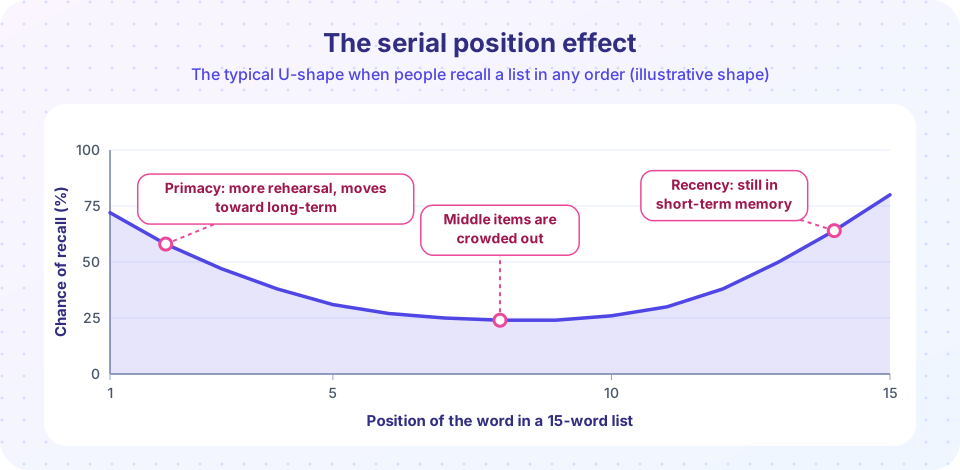
When people hear a list of words and recall them in any order, they remember the first few words (the primacy effect) and the last few (the recency effect) better than the middle. Bennet Murdock described the curve in 1962. The standard explanation fits the model: early words get more rehearsal and are more likely to reach long-term memory, while the last words are still sitting in short-term memory. Glanzer and Cunitz (1966) supported this by showing that a 30-second delay filled with counting removed the recency effect but left primacy.
Making memories last: consolidation
New memories are fragile at first. Consolidation is the process by which they are stabilized, involving changes at synapses within hours and reorganization across brain regions over days and longer. Sleep helps: studies find better retention of material learned before a night of sleep than after the same time awake, though the size of the effect varies by task.
What the evidence says about studying
Two strategies stand out in the research on learning.
- Spacing. Spreading practice over time beats cramming for the same total time. Ebbinghaus first noticed this in the 1880s, and a large body of research since confirms it.
- Retrieval practice (the testing effect). In a 2006 study, Henry Roediger and Jeffrey Karpicke had students read a passage and then either reread it or take recall tests. A week later, those who had tested themselves remembered more, even though they felt less confident right after studying.
Rereading and highlighting feel productive, but they rank low in most reviews. See study skills and exam technique for practical routines.
Common misconceptions
"Short-term memory holds exactly seven items." Seven plus or minus two was an influential estimate; later work puts it nearer four chunks, depending on how items are grouped.
"Long-term memory fills up." No upper limit has been found. Forgetting is mostly about access, not space.
"Cramming works." It can help for a test tomorrow, but information learned in one session is forgotten faster than information spaced over days.
Try it
Press Run (or Ctrl + Enter) to see the result here.
Program input · what you'd type while the program runs
Type the answers before you press Run, one per line. Each time the program reads a line (with input()), it gets the next line from this box.
Check your understanding
Quick check · 5 questions
of 5 answered You scored / 5 · perfect!
-
1. In Sperling's experiment, why did cueing a row right after the flash improve reporting?
A brief store held the whole grid, and the cue let people read out one row before the trace faded. -
2. Which component of working memory coordinates attention?
The central executive directs attention and manages the other parts. -
3. HM could not form new explicit memories but improved at mirror drawing. This suggests that:
Different memory systems rely on different brain circuits, so skills could improve despite amnesia for events. -
4. Which study approach is best supported by evidence?
Spacing and retrieval practice produce stronger long-term retention. -
5. The divers study by Godden and Baddeley illustrates:
Recall was better when the retrieval context matched the learning context.
Summary
- Information passes from brief sensory memory into limited working memory and, with good encoding, into long-term memory.
- Working memory has components (loop, sketchpad, executive, buffer) and holds about four chunks.
- Long-term memory includes episodic and semantic (explicit) and procedural and priming (implicit) memory.
- Deep processing, meaningful cues, spacing and retrieval practice strengthen memory.
Track your progress
Create a free account to tick off lessons and pick up where you left off on any device.
of Introduction to Psychology lessons completed