


















Lesson 18 of 45 · Sensation and Perception
Hearing, Touch, Taste, Smell and Balance
Explore how the ear turns sound waves into signals and how touch, pain, taste, smell and the balance senses work, including the gate-control theory of pain.
You can close your eyes, but you cannot close your ears. Hearing works around the clock, even during sleep, warning us of danger and carrying speech, music and the voices of the people we love. This lesson follows sound from the air to the brain, then turns to the other senses that make up your experience of the world: touch, pain, taste, smell and the senses of balance and body position.
What you will learn
- How the physical properties of sound waves relate to pitch, loudness and timbre.
- The route sound takes through the ear and where transduction happens.
- How place and frequency theories explain pitch, and how we locate sounds.
- How touch, pain, taste, smell and the balance senses work.
- Why pain is more than a signal from damaged tissue.
Key terms
Frequency: the number of wave cycles per second, measured in hertz (Hz); it determines pitch.
Amplitude: the height of a wave; it determines loudness, measured in decibels (dB).
Cochlea: a fluid-filled, snail-shaped structure in the inner ear where sound is transduced.
Hair cells: the auditory receptor cells, whose bending creates neural signals.
Nociceptors: receptors that respond to potentially damaging stimuli and signal pain.
Vestibular system: the inner-ear sense of balance and head movement.
Sound waves
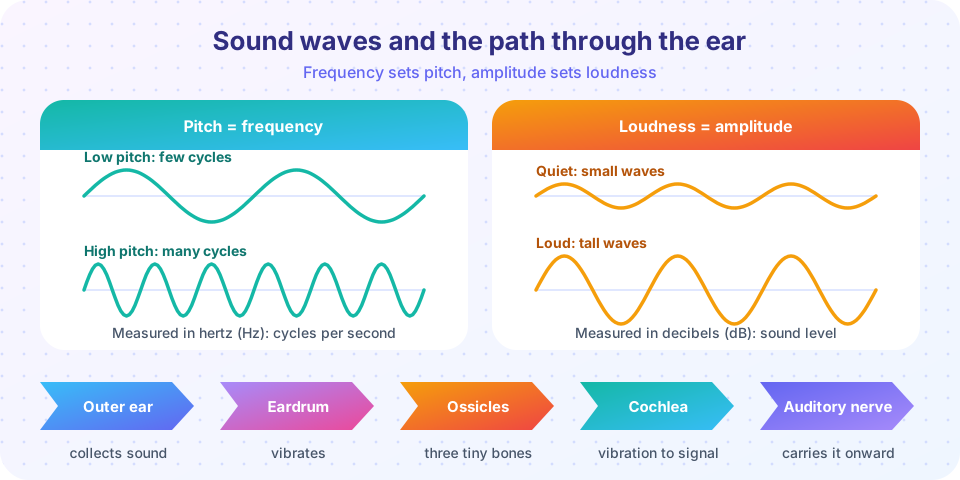
Sound is a pattern of pressure changes traveling through air (or water or solid material). Two properties of the wave matter most.
- Frequency, in hertz, sets pitch. A wave with few cycles per second sounds low; one with many cycles sounds high. Young people with healthy hearing can detect roughly 20 to 20,000 Hz, with the highest frequencies fading with age.
- Amplitude sets loudness. Loudness is measured in decibels (dB), a logarithmic scale: every increase of 10 dB means ten times the sound intensity. A whisper is about 30 dB, normal conversation about 60 dB, busy traffic around 80 to 85 dB and a loud concert around 110 dB. Sustained exposure above about 85 dB can damage hearing over time, and the louder the sound, the shorter the safe exposure.
A third property, timbre, is the quality that lets you tell a violin from a flute playing the same note. It comes from the mix of frequencies in the wave.
The route through the ear
- The outer ear (the pinna and the ear canal) collects sound and funnels it inward.
- The eardrum vibrates with the sound waves.
- Three tiny bones, the ossicles (hammer, anvil and stirrup), amplify the vibrations and pass them to the oval window of the cochlea.
- In the fluid-filled cochlea, the vibrations make waves travel along a flexible strip called the basilar membrane. The membrane carries thousands of hair cells. When the membrane moves, the tiny hairs bend, and the hair cells convert the motion into electrical signals: this is transduction.
- The auditory nerve carries the signals to the brainstem, then the thalamus and finally the auditory cortex in the temporal lobe.
Human hair cells do not regenerate after they die. Loud noise, aging and some drugs can destroy them, and the resulting sensorineural hearing loss is permanent. (By contrast, conduction hearing loss, caused by problems with the eardrum or ossicles, can often be treated.) Cochlear implants bypass damaged hair cells by stimulating the auditory nerve electrically, and they can restore useful hearing for many people with severe loss.
How do we hear pitch?
Georg von Bekesy, who won a Nobel Prize in 1961, studied how the basilar membrane moves. High-frequency sounds make the stiff, narrow base near the oval window vibrate most; low-frequency sounds peak near the far, wider end. This is the place theory: pitch is coded by where on the membrane the vibration peaks. For low frequencies, the frequency theory adds that neurons can fire in time with the sound wave. Modern accounts combine both.
Where is the sound?
Because we have two ears, the brain can compare them. A sound from the right reaches the right ear slightly earlier and slightly louder, because the head casts a "shadow" on the far ear. For a sound directly to one side, the time difference is only about half a millisecond, yet the brainstem can detect it. The second demonstration below calculates these numbers.
Touch
The skin contains receptors for pressure, vibration, stretch and temperature, spread unevenly: the fingertips and lips have far more than the back. Signals travel to the somatosensory cortex in the parietal lobe, which is organized as a map of the body (the homunculus from brain regions). The map explains why a light touch on the fingers feels sharper than on the back, and why phantom sensations can appear in missing limbs after an amputation.
Pain
Nociceptors respond to intense pressure, heat, cold and chemicals released by damaged cells. But pain is not simply a measure of damage. In 1965 Ronald Melzack and Patrick Wall proposed the gate-control theory: signals travel through a "gate" in the spinal cord, which can be closed by other input (rubbing a bumped elbow reduces the pain) and by signals coming down from the brain. Attention, mood, expectations and culture all adjust the gate. Pain relief can come from the brain's own opioid chemicals, the endorphins, and a placebo (an inactive treatment that the person believes works) can produce real pain relief for some people.
Pain is also a protective sense: people born without the ability to feel pain often suffer serious injuries because they never learn to protect themselves. Phantom limb pain, where people feel pain in a limb that has been removed, shows how much pain depends on the brain's own body map.
Educational information only. This describes how pain is understood scientifically; it is not medical advice. Anyone with persistent pain should see a health professional.
Taste
Taste receptors in the taste buds, mostly on the tongue, respond to five basic qualities: sweet, sour, salty, bitter and umami (a savory taste associated with glutamate, discovered by the Japanese chemist Kikunae Ikeda in 1908). Each quality is thought to signal something useful: sweet for energy, salty for minerals, bitter for possible toxins. The familiar "tongue map", which assigns each taste to a separate region, is a myth based on a misreading of early data: all regions of the tongue can detect all basic tastes.
What we call flavor is mostly smell. When you have a cold, food seems bland because aroma molecules cannot reach the nasal receptors. Texture, temperature, appearance and expectation also shape flavor.
Smell
Smell (olfaction) is a chemical sense. Molecules in the air bind to receptors high in the nose; humans have roughly 400 types of functioning olfactory receptor, and any odor activates a pattern across many of them. Signals go to the olfactory bulb and then directly to areas of the limbic system, including the amygdala and the hippocampus, without first going through the thalamus. This direct link is one reason why smells can bring back vivid memories and emotions, an experience sometimes called the "Proustian" memory after the French novelist.
Balance and body position
The vestibular system in the inner ear senses head movement and position. Three fluid-filled semicircular canals detect rotation and two small organs detect linear acceleration and the pull of gravity. Proprioception (or kinesthesis) is your sense of the position and movement of your limbs, from receptors in muscles, tendons and joints. It lets you touch your nose with your eyes closed. Motion sickness may arise when the vestibular system disagrees with vision, for example when reading in a moving car: the eyes say you are still while the inner ear says you are moving.
Common misconceptions
"The tongue has separate regions for sweet, sour, salty and bitter." All basic tastes can be detected across the tongue.
"Louder just means higher." Loudness (amplitude) and pitch (frequency) are independent.
"Pain is proportional to injury." Pain depends on attention, mood, expectations and context, as the gate-control theory and placebo effects show.
"Hearing damage from music shows up immediately." It accumulates, and often the first sign is a ringing in the ears (tinnitus) or difficulty following speech in noise.
Try it
First, a wave maker. Move the sliders for frequency and amplitude and watch what changes. The lines count cycles in a fixed window; this is a drawing, not a sound.
Second, the decibel scale. The levels below are typical approximate values, with the ratios computed from the logarithmic definition. Notice how quickly intensity multiplies.
Press Run (or Ctrl + Enter) to see the result here.
Program input · what you'd type while the program runs
Type the answers before you press Run, one per line. Each time the program reads a line (with input()), it gets the next line from this box.
Third, how big is the timing cue for locating a sound? A sound from the side has to travel an extra distance to the far ear. The code uses an approximate ear spacing of 18 cm.
Press Run (or Ctrl + Enter) to see the console output here.
No output.
Check your understanding
Quick check · 6 questions
of 6 answered You scored / 6 · perfect!
-
1. Which pair correctly matches wave property and experience?
Frequency sets pitch and amplitude sets loudness. -
2. Where does transduction of sound into neural signals take place?
Bending hair cells create the electrical signals sent along the auditory nerve. -
3. Why is sensorineural hearing loss usually permanent?
Damaged hair cells are not replaced in humans, though devices such as cochlear implants can help. -
4. The gate-control theory of pain says that
Melzack and Wall proposed that the spinal cord 'gate' is influenced by touch and by messages from the brain. -
5. The 'tongue map' of taste regions is
All basic tastes can be detected across the tongue. -
6. A sound 10 dB louder has how much more intensity?
The decibel scale is logarithmic: +10 dB is a tenfold increase in intensity.
Summary
- Frequency sets pitch and amplitude sets loudness; decibels are logarithmic.
- Sound passes through the eardrum and ossicles to the cochlea, where hair cells transduce it; hair cells do not regenerate.
- Place and frequency theories together explain pitch; timing and loudness differences locate sounds.
- Touch maps to the somatosensory cortex; pain is shaped by the gate-control mechanism, attention and expectation.
- Taste has five basic qualities, flavor is mostly smell, and smell connects directly to the limbic system.
- The vestibular system and proprioception provide balance and body position.
Next: Perception and Illusions
Track your progress
Create a free account to tick off lessons and pick up where you left off on any device.
of Introduction to Psychology lessons completed