


















Lesson 11 of 45 · The Brain and Behavior
Chapter 3 Overview: The Brain and Behavior
A map of chapter 3: how about 86 billion neurons, regions and chemical messengers produce thought, feeling and action, and what each lesson will cover.
Everything you think, feel and do passes through about 1.4 kilograms (roughly 3 pounds) of soft tissue inside your skull. It uses about a fifth of the body's energy while making up only about 2 percent of its weight. This chapter explores that organ at three levels: the cells (neurons and their chemical messages), the regions (the lobes and deeper structures) and the systems (the nervous system, hormones and genes).
What you will learn
- Why psychologists study the brain, and why biology alone is not the whole story.
- The scale of the brain: how many cells, how fast the signals.
- The structure of the chapter and what each lesson covers.
- Common myths about the brain.
Key terms
Neuron: a nerve cell that receives, processes and passes on signals.
Cerebral cortex: the thin, folded outer layer of the brain involved in perception, thought and voluntary action.
Neuroscience: the scientific study of the nervous system.
Localization of function: the idea that different brain areas have different jobs, which work together in networks.
The big picture
Three levels of the brain
From cells to behavior
Many cells, one behavior
The scale of the brain
The human brain contains about 86 billion neurons, according to a careful count published by Suzana Herculano-Houzel and colleagues in 2009, and a similar number of supporting cells called glia. Each neuron can connect to thousands of others, forming trillions of connections. Signals travel along the fastest (insulated) fibers at around 100 meters per second, which is fast, but far slower than electricity in a wire. That is why you can often see a fast ball but still cannot swat it in time: processing takes tens to hundreds of milliseconds.
Where the chapter goes
| Lesson | What you will learn |
|---|---|
| Neurons and synapses | Parts of a neuron, the all-or-none spike, how chemical messengers cross gaps, what common neurotransmitters do |
| Brain regions | The four lobes, deeper structures, famous cases (Gage, H.M.), brain imaging and the left-right myth |
| Nervous system, hormones and genes | CNS and PNS, fight or flight, endocrine glands, heredity, twin studies, plasticity |
| Chapter 3 review | Recap picture and ten-question quiz |
Brain and mind: how to think about it
Psychologists treat the brain as necessary for the mind, but they avoid two traps. The first is reductionism: saying "it is just neurons" and ignoring the level of beliefs, relationships and culture. The second is neuro-hype: treating a colorful brain scan as proof of something it does not show. A scan shows where blood flow changed, not a thought itself, and "this area lights up when..." rarely means "this area is the center of...". Keep in mind the biopsychosocial model from Chapter 1: brain activity is one important level among several.
Common misconceptions
"We use only 10 percent of our brains." Scans show activity throughout the brain over a day, and damage almost anywhere causes some loss of function.
"Brain cells never regrow, so damage is permanent." Adult brains do form some new neurons in particular regions, and brains reorganize with experience (plasticity), although recovery from major injury is limited.
"Bigger brains mean smarter people." Brain size across species and between individuals is only a rough guide at best; organization matters more.
Try it
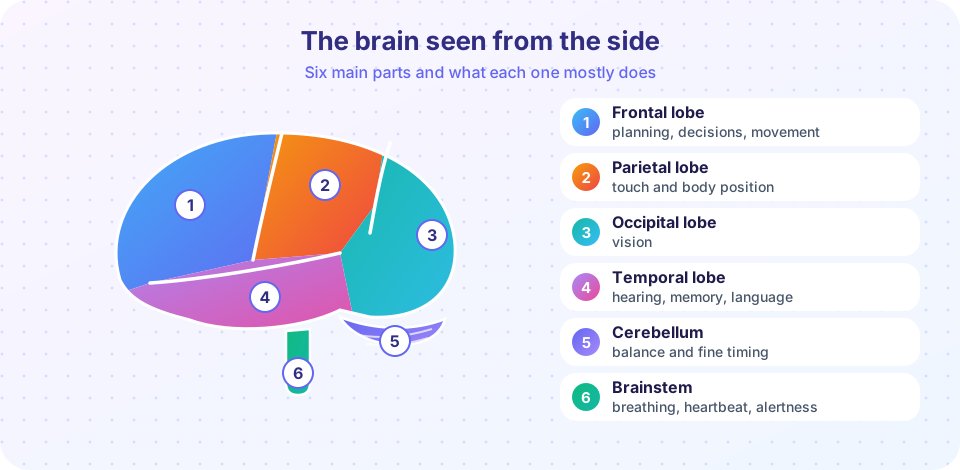
First, an interactive brain. Click a lobe to read its main jobs. It is a simplified diagram: real functions are spread over networks, not packed neatly into colored zones.
Second, put the numbers in perspective. The chart uses approximate neuron counts that are widely cited in neuroscience; treat them as rough orders of magnitude.
Press Run (or Ctrl + Enter) to see the result here.
Program input · what you'd type while the program runs
Type the answers before you press Run, one per line. Each time the program reads a line (with input()), it gets the next line from this box.
Check your understanding
Quick check · 4 questions
of 4 answered You scored / 4 · perfect!
-
1. About how many neurons does the human brain contain?
A 2009 count estimated about 86 billion neurons, plus a similar number of glial cells. -
2. Which is a good caution about brain scans?
Scans give indirect measures of activity; interpretation needs care. -
3. The idea that people use only 10 percent of their brains is
Activity is found throughout the brain, and damage almost anywhere has effects. -
4. Reductionism in psychology is the mistake of
Behavior involves biological, psychological and social levels.
Summary
- The brain has about 86 billion neurons and uses about a fifth of the body's energy.
- The chapter studies cells, regions and systems.
- Brain scans are informative but indirect; avoid neuro-hype and reductionism.
- Myths (10 percent, fixed brain, size equals smarts) are not supported by evidence.
Next: Neurons and Synapses
Track your progress
Create a free account to tick off lessons and pick up where you left off on any device.
of Introduction to Psychology lessons completed