


















Lesson 41 of 45 · Projects and Practice
Project: a Likert survey and its reliability
Build and score a short Likert-scale questionnaire, reverse-score items, compute total scores and Cronbach's alpha in Python, and learn what reliability does and does not tell you.
A great deal of psychology is measured with questionnaires: personality, mood, attitudes, satisfaction, motivation. A questionnaire turns something invisible into numbers, and the quality of those numbers depends on how the questions are written and checked. In this project you will build a tiny survey, score it the way researchers do, and compute a standard check of reliability.
You will practice the tools you met in the personality lesson (Likert scales, reverse items) and add a new one, Cronbach's alpha. This is a hands-on skills lesson, so every number you see comes from code that you can run.
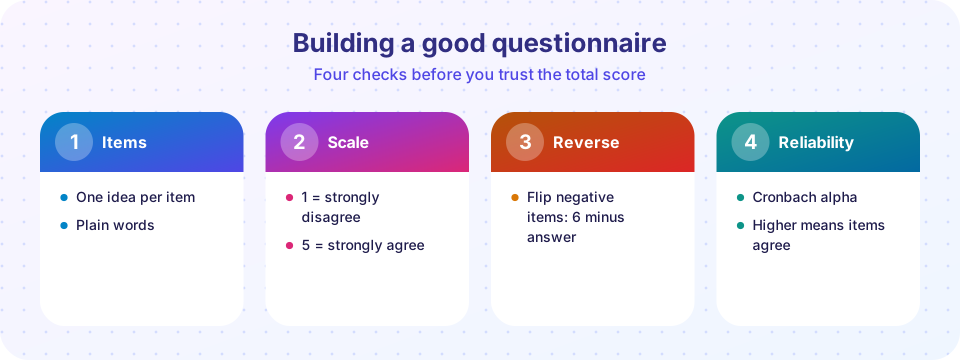
What you will learn
- How to write clear survey items and use a Likert scale.
- How reverse scoring works and why it is needed.
- How to compute scale scores and Cronbach's alpha.
- What reliability means, and how it differs from validity.
- Ethical points for collecting survey data.
Key terms
Likert scale: a response format in which people rate agreement, usually from 1 to 5 or 1 to 7.
Reverse-keyed item: an item worded in the opposite direction, so a high rating means a low score on the trait.
Internal consistency: the degree to which the items of a scale measure the same thing.
Cronbach's alpha: a number, usually between 0 and 1, summarizing internal consistency.
Validity: whether a scale measures what it claims to measure.
Step 1: write good items
Good items are short, simple and about one thing. Compare:
- Weak: "I am satisfied with my school and my teachers." (two ideas: if you like one and not the other, how do you answer?)
- Better: "I feel I learn useful things at school."
- Weak: "Do you never feel bad about homework?" (a double negative)
- Better: "Homework feels like a burden to me." (reverse-keyed)
Mix positively and negatively worded items so that someone who simply agrees with everything does not get a perfect score. This is called controlling for acquiescence bias.
Our project scale is a six-item "School engagement" mini-scale, written for this lesson. It is a teaching example and not a validated instrument.
- I look forward to learning new things at school.
- I often lose interest during lessons. (reverse)
- I feel I can do the work asked of me.
- School feels like a waste of time. (reverse)
- I try hard even when work is difficult.
- I find it hard to concentrate in class. (reverse)
Step 2: score it
Answers run from 1 (strongly disagree) to 5 (strongly agree). For reverse items, flip the answer with 6 - answer. Then add or average the six values. Higher totals mean higher engagement. The table shows a worked example.
| Item | Reverse? | Raw answer | Scored value |
|---|---|---|---|
| 1 | No | 4 | 4 |
| 2 | Yes | 2 | 6 - 2 = 4 |
| 3 | No | 5 | 5 |
| 4 | Yes | 1 | 6 - 1 = 5 |
| 5 | No | 3 | 3 |
| 6 | Yes | 4 | 6 - 4 = 2 |
The total is 4 + 4 + 5 + 5 + 3 + 2 = 23 out of 30, so the mean is about 3.8.
Step 3: check reliability
If all six items measure the same thing, people who score high on one should tend to score high on the others. Cronbach's alpha summarizes this:
alpha = (k / (k - 1)) × (1 - Σ item variances / variance of total score)
where k is the number of items. Values near 0 mean the items do not hang together; values near 1 mean they agree. Many textbooks treat 0.7 or higher as acceptable for research scales, but this is a rule of thumb, not a law. A very high value (above about 0.95) can mean the items are redundant. Alpha also rises as you add items, so it is not a pure measure of quality.
Alpha is a measure of reliability (consistency). A scale can be consistent and still not measure what you think: a bathroom scale that reads 2 kg too heavy is perfectly reliable but not valid. Validity requires other evidence, such as the scale predicting relevant outcomes or matching other measures of the same concept.
Press Run (or Ctrl + Enter) to see the result here.
Program input · what you'd type while the program runs
Type the answers before you press Run, one per line. Each time the program reads a line (with input()), it gets the next line from this box.
The practice data are invented and unusually tidy, which is why alpha comes out very high. Real data are messier, and alpha values around 0.7 to 0.9 are more typical for a short scale. Notice what happens to alpha if you forget to reverse-score: it can drop below zero, a loud warning that something is wrong with the scoring.
Step 4: ethics and good practice
- Make participation voluntary and explain what the survey is for.
- Keep data anonymous where possible and do not collect more than you need.
- Avoid questions that could upset people or reveal sensitive information, unless you have proper approval and support in place. Surveys on health, trauma or private matters belong in the hands of trained researchers.
- Do not present a quick quiz as a diagnosis.
- Report the sample size and say who the participants were: results from 12 classmates do not speak for all students.
See research methods in psychology for sampling, bias and ethics in more depth.
Common misconceptions
"A high alpha means the scale is valid." Alpha is about consistency. Validity needs separate evidence.
"Likert data are exact measurements." They are ordered categories. Treating them as numbers is common and often reasonable, but differences between steps may not be equal.
"More items always make a better survey." Long surveys tire people and increase careless answers.
Check your understanding
Quick check · 5 questions
of 5 answered You scored / 5 · perfect!
-
1. A respondent answers 2 on a reverse-keyed item on a 1-to-5 scale. What is the scored value?
Reverse scoring is 6 minus the answer: 6 - 2 = 4. -
2. Why mix positively and negatively worded items?
Reverse items reduce the effect of yes-saying. -
3. Cronbach's alpha measures:
It summarizes how well items agree with each other. -
4. A scale gives the same reading every time but is always 2 kg off. It is:
It is consistent, but it does not measure the truth correctly. -
5. What is the best way to describe results from a survey of 12 classmates?
Small convenience samples limit generalization.
Summary
- Good items are short, clear and about one idea; mix positive and reverse-keyed items.
- Reverse scoring (6 minus the answer on a 1-to-5 scale) must be done before summing.
- Cronbach's alpha checks internal consistency, not validity.
- Ethical surveys are voluntary, anonymous when possible and honest about sample limits.
Track your progress
Create a free account to tick off lessons and pick up where you left off on any device.
of Introduction to Psychology lessons completed