


















Lesson 26 of 45 · Memory and Thinking
Chapter 6 overview: memory and thinking
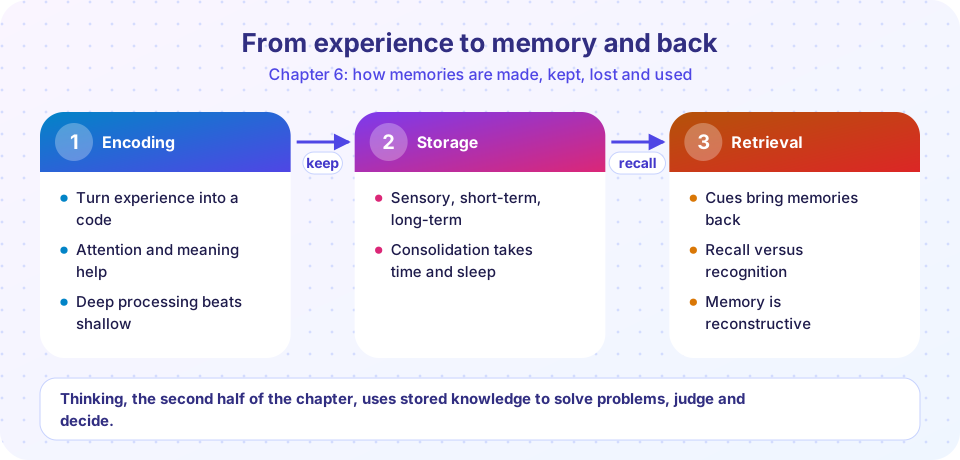
A big-picture map of memory and thinking: encoding, storage, retrieval, forgetting, false memories, problem solving and decision making, with a guide to Chapter 6.
Everything you know, including your name, how to ride a bike, and what happened yesterday, lives in memory. And everything you decide, from what to eat to whom to trust, draws on it. Memory and thinking are two sides of one system: memory stores what you know, and thinking uses it.
Psychologists tend to describe memory as an information-processing system, a metaphor borrowed from computers in the 1950s and 1960s. It is a useful metaphor, with a big warning: human memory is not a recording. It is rebuilt each time you recall it, which is why it can be astonishingly good and surprisingly wrong.
What you will learn
- The three jobs of memory: encoding, storage and retrieval.
- How sensory, short-term (working) and long-term memory differ.
- Why forgetting and false memories happen, in outline.
- How thinking uses mental shortcuts, and what goes wrong with them.
- How the lessons in this chapter fit together.
Key terms
Encoding: turning information into a form memory can store.
Storage: keeping encoded information over time.
Retrieval: bringing stored information back to mind.
Working memory: the small, active workspace for information you are using right now.
Heuristic: a mental shortcut that is quick and often right but sometimes misleading.
Chapter at a glance
Three jobs of memory
Three kinds of storage
When memory fails
Memory is rebuilt, so it can be wrong.
Thinking
The big picture
The first lesson, How memory works, introduces the three-stage model proposed by Richard Atkinson and Richard Shiffrin in 1968 and its refinement by Alan Baddeley and Graham Hitch, who in 1974 described working memory as a set of components rather than a single box. It explains why some study strategies, such as testing yourself and spacing practice over time, work better than rereading.
The second, Forgetting and false memories, turns to failure. Hermann Ebbinghaus charted forgetting in 1885 by memorizing nonsense syllables. Later work, especially by Elizabeth Loftus, showed that memories can be changed by suggestion. Those findings matter for the courtroom and for everyday trust in our own recollections.
The third, Thinking and decision making, covers how we solve problems, use concepts, and decide. Daniel Kahneman and Amos Tversky catalogued systematic mistakes called biases that come from the shortcuts we use. You will also see why the shortcuts exist and when they work well.
The last, the chapter review, gives a one-page summary and ten questions.
Common misconceptions
"Memory works like a video camera." Memory reconstructs events from pieces and general knowledge, so details can change, merge, or be added.
"We use only 10 percent of our brains." This is a myth. Brain imaging shows activity throughout the brain over a day, and damage to almost any region has effects.
"Confident memories are accurate memories." Confidence and accuracy are only loosely related, as research on eyewitnesses and on vivid "flashbulb" memories shows.
Try it
Press Run (or Ctrl + Enter) to see the result here.
Program input · what you'd type while the program runs
Type the answers before you press Run, one per line. Each time the program reads a line (with input()), it gets the next line from this box.
Check your understanding
Quick check · 4 questions
of 4 answered You scored / 4 · perfect!
-
1. Which sequence lists the three jobs of memory in order?
Information must be encoded first, stored over time, and later retrieved. -
2. What did Baddeley and Hitch change about the three-stage model?
Their working memory model replaced one passive box with components such as the central executive and phonological loop. -
3. Why is confidence a poor guide to memory accuracy?
Research on eyewitnesses and flashbulb memories shows vivid, confident memories can still be wrong. -
4. A heuristic is best described as:
Heuristics save effort but can produce systematic biases.
Summary
- Memory must encode, store and retrieve information, and thinking uses what is stored.
- Memory is reconstructive, not a recording, so it can be both useful and wrong.
- This chapter covers how memory works, why it fails, and how shortcuts shape thinking.
Next: How memory works
Track your progress
Create a free account to tick off lessons and pick up where you left off on any device.
of Introduction to Psychology lessons completed