


















Lesson 35 of 45 · Personality, Development and Health
Chapter 8 overview: personality, development and health
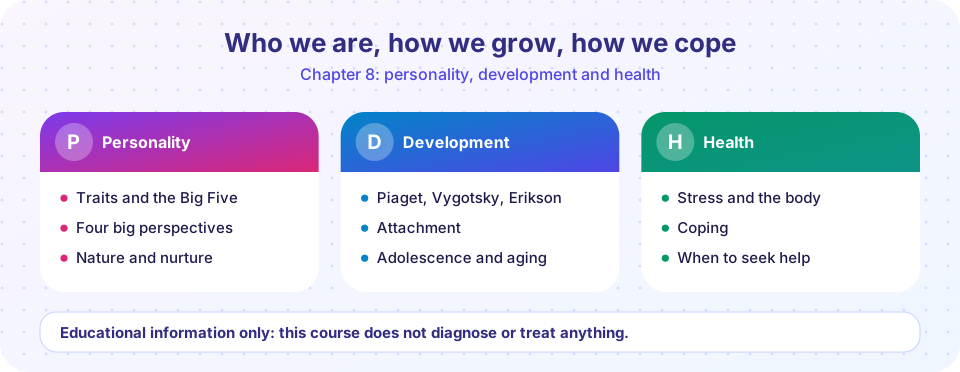
A map of personality, human development and health psychology: how people differ, how they change over a lifetime and how stress affects body and mind.
Two people can face exactly the same situation and respond very differently. A newborn becomes a toddler, a teenager and an adult, yet somehow remains recognizably the same person. And stress, which every person meets, can leave one person energized and another exhausted. This chapter looks at three connected questions: how people differ (personality), how they change (development), and how mind and body affect each other (health).
These topics ask for particular care. Personality labels can feel like facts about you when they are only descriptions, developmental stories can sound like fixed destinies, and health topics can sound like advice. Throughout, remember: this course gives educational information. It does not diagnose, treat, or replace a doctor or counselor.
What you will learn
- What psychologists mean by personality, development and health psychology.
- The major themes and debates in each area.
- How nature and nurture interact.
- How to read personality tests and stage theories critically.
- How the lessons in this chapter fit together.
Key terms
Personality: a person's relatively stable patterns of thinking, feeling and behaving.
Trait: a dimension on which people differ, such as shyness or curiosity.
Development: systematic changes across the lifespan.
Temperament: inborn differences in emotional reactivity and activity level.
Health psychology: the study of how psychological and social factors affect health and illness.
Chapter at a glance
Personality
Development
Health
Ask a professional when worried.
The big picture
Personality research began with grand theories and moved to measurement. Sigmund Freud's psychodynamic theory, Carl Rogers's humanistic view and the learning-based views of Skinner and Bandura each try to explain why individuals are consistent. The strongest evidence today comes from the trait approach and the Big Five: openness, conscientiousness, extraversion, agreeableness and neuroticism. See personality theories.
Development asks how thinking, relationships and identity change. Jean Piaget described stages of thinking; Lev Vygotsky emphasized the social setting of learning; Erik Erikson proposed psychosocial challenges across life; John Bowlby and Mary Ainsworth studied attachment between children and caregivers. Modern research has revised each of these. See child development.
Health psychology studies how stress, thinking, behavior and relationships affect the body. Hans Selye described the stress response, and Richard Lazarus and Susan Folkman showed that how you appraise stress matters. See stress and health.
Nature and nurture
Few topics are as often misunderstood. Twin and adoption studies find that genes explain a substantial share of differences in personality traits, often estimated at around half, and the environment you share with siblings explains much less than people expect. But "heritable" does not mean fixed or determined: genes act through experience, and environments can change which genes matter. Researchers now study gene–environment interplay rather than a contest between the two.
What each lesson covers
- Personality theories: the four perspectives, the Big Five, the person-situation debate and cautions about tests.
- Child development: Piaget, Vygotsky, theory of mind, attachment, Erikson and moral development.
- Stress and health: the stress response, appraisal and coping, social support and a note on mental health.
- Chapter review: poster, table and ten questions.
Common misconceptions
"Personality is fixed by age 30." Traits show moderate stability, and rank order becomes more stable with age, but average levels change across life, and people can change.
"Stage theories are strict rules." Stages are useful summaries but development is more gradual, varies by culture and skill, and abilities often appear earlier than predicted.
"Stress is always bad." Short-term, manageable stress can help performance; chronic, uncontrollable stress is the main concern.
Try it
Press Run (or Ctrl + Enter) to see the result here.
Program input · what you'd type while the program runs
Type the answers before you press Run, one per line. Each time the program reads a line (with input()), it gets the next line from this box.
Check your understanding
Quick check · 4 questions
of 4 answered You scored / 4 · perfect!
-
1. Which definition of personality fits best?
Personality refers to consistent patterns across time and situations. -
2. What does 'heritability' of about 50 percent for a trait mean?
Heritability describes differences within a population, not how much of an individual is genetic. -
3. Which pair is correct?
Selye described the general adaptation syndrome. -
4. A fair view of stage theories is that:
Later research revised many stage claims while keeping their descriptive value.
Summary
- Personality, development and health psychology describe how people differ, change and cope.
- Trait research gives the best evidence for personality; stage and attachment theories shaped development research.
- Genes and environment interact; heritability is about group differences, not individual destiny.
- Educational information in this chapter is not diagnosis or treatment.
Next: Personality theories
Track your progress
Create a free account to tick off lessons and pick up where you left off on any device.
of Introduction to Psychology lessons completed