


















Lesson 10 of 45 · The Science of Psychology
Chapter 2 Review: The Science of Psychology
Review chapter 2: the scientific cycle, research designs, correlation, reliability, validity, sampling, statistics and ethics, with a recap picture and quiz.
Chapter 2 gave you the toolkit that separates evidence from opinion. This review ties the four lessons together. Start with the picture, then use the table to find any gaps, run the demonstrations, and finish with the ten-question quiz. If a question trips you, return to the lesson named in its explanation, wait a day, and try again.
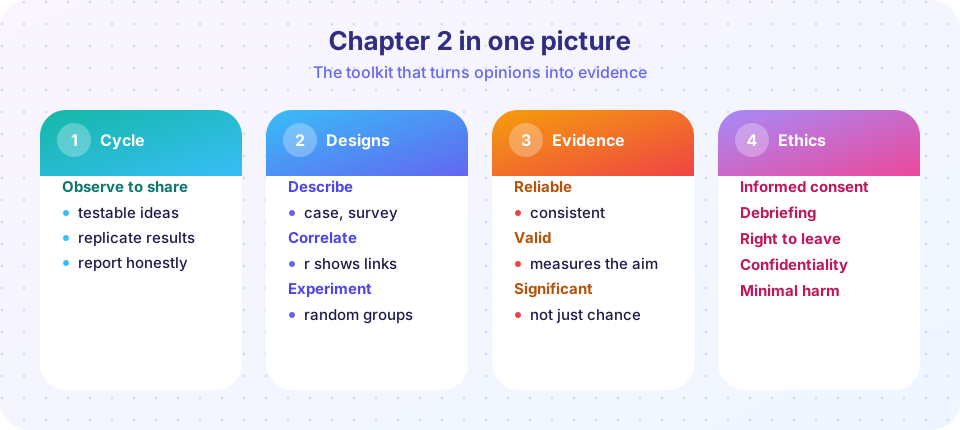
What you will learn
- How the cycle, designs, measurement, statistics and ethics fit together.
- How to pick the right design for a question.
- Which ideas in the chapter you can already explain.
Chapter at a glance
| Lesson | Key ideas | Check yourself |
|---|---|---|
| Overview | Cycle; falsifiable hypotheses; biases | Why is "everything happens for a reason" not scientific? |
| Research methods | Case study, observation, survey, experiment; IV, DV, random assignment, double-blind | What does random assignment do that random sampling does not? |
| Correlation and causation | r, scatterplots, third variables, reverse causation | Give three explanations for a correlation. |
| Measurement, sampling, ethics | Reliability, validity, WEIRD, p-values, effect size, consent | Why can a reliable measure be invalid? |
Choosing a design
Ask three questions in order:
- Do I want to describe or to test cause? If describe, choose a case study, observation or survey.
- Can I manipulate the variable and randomly assign people? If yes, run an experiment.
- If not, can I measure variables as they naturally occur? Then use a correlational or quasi-experimental study, and state conclusions carefully.
Then protect the quality: define variables operationally, choose reliable and valid measures, recruit a sample that fits the question, plan the analysis in advance (preregistration) and get ethical approval.
Reading a research headline
Practice on any news story that begins "Study finds...". Ask six questions. What kind of design was it (experiment, correlational, survey)? Who were the participants, and how were they chosen? How were the key variables measured, and are those measures reliable and valid? Was there a comparison group, and were people assigned to groups at random? How big was the effect, not only whether it was significant? Has anyone repeated it? You will often find that the headline claims more than the design can support, for instance a cause from a correlation. Doing this routinely is the single most useful skill the chapter teaches, and it applies far beyond psychology.
Common misconceptions
"A significant result is a true and important one." Significance is about chance, not about size or truth.
"Experiments are always better than other designs." They are best for cause, but some questions (descriptive ones, rare events, unethical manipulations) need other methods.
"Ethics is paperwork." Ethical rules came from real harm and protect both people and the quality of science.
Try it
First, test yourself: name the design that each scenario uses.
Second, calculate reliability yourself. Six people answer a four-item scale. The code computes the internal consistency (Cronbach's alpha) and the test-retest correlation. These are made-up numbers for demonstration.
Press Run (or Ctrl + Enter) to see the result here.
Program input · what you'd type while the program runs
Type the answers before you press Run, one per line. Each time the program reads a line (with input()), it gets the next line from this box.
Check your understanding
Quick check · 10 questions
of 10 answered You scored / 10 · perfect!
-
1. A hypothesis is falsifiable if
Science requires claims that forbid some outcomes. -
2. In an experiment testing whether exercise improves mood, mood score is the
The DV is what is measured. -
3. Why does random assignment strengthen causal conclusions?
With balanced groups, differences in the outcome are likely due to the IV. -
4. Researchers find r = -0.7 between hours on a screen late at night and hours of sleep. Which is the correct reading?
The sign is negative, the size strong. Correlation alone does not establish cause. -
5. A test gives nearly the same score every time but does not measure what it claims to. It is
Consistency does not guarantee accuracy. -
6. Which sample is best for estimating opinions of all teenagers in a country?
Random selection beats a larger biased sample. -
7. The p-value is
It speaks about the data under the no-effect assumption. -
8. A double-blind design reduces which problem?
When nobody knows the condition, expectations cannot shape behavior or scoring. -
9. Which event led directly to the Belmont Report's principles?
Public reaction to the Tuskegee study led to the 1979 report and ethical review boards. -
10. Which pair of terms does the WEIRD critique connect?
Narrow samples limit how far findings can be applied to humanity at large.
Summary
- Science is a cycle of testable hypotheses, careful measurement, analysis, sharing and replication.
- Descriptive methods describe; experiments test cause; correlational designs predict.
- Random assignment balances groups; double-blind designs control expectations.
- r measures straight-line association and never proves cause.
- Good measures are reliable and valid; good samples represent the target population.
- Statistics (p, effect size) must be read together; ethics protects participants and science.
Track your progress
Create a free account to tick off lessons and pick up where you left off on any device.
of Introduction to Psychology lessons completed