


















Lesson 34 of 45 · Motivation and Emotion
Chapter 7 review: motivation and emotion
Review theories of motivation and emotion with a chapter poster, a recap table, a practice activity and a ten-question quiz covering Maslow, SDT and emotion theories.
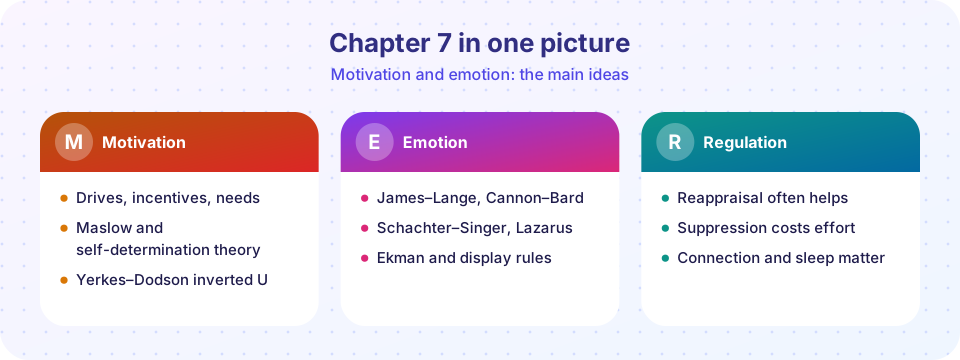
This page pulls together everything from Chapter 7. Read the poster, check the table against your memory, run the two activities, then take the quiz.
Recap table
| Topic | Key idea | Names | Caution |
|---|---|---|---|
| Drive reduction | Needs create tension that behavior reduces | Hull | Cannot explain thrill seeking |
| Incentives | Outside rewards pull behavior | Many | Wanting and liking are different |
| Arousal | Inverted U, lower peak for hard tasks | Yerkes and Dodson | A rough model, not an exact law |
| Hierarchy of needs | Five levels from physiological to self-actualization | Maslow | Strict order not supported |
| Self-determination | Autonomy, competence, relatedness | Deci and Ryan | Expected controlling rewards can lower interest |
| Goals | Specific and challenging goals help | Locke and Latham | Need feedback and commitment |
| Emotion theories | James-Lange, Cannon-Bard, two-factor, Lazarus | James, Cannon, Schachter, Lazarus | Original studies sometimes fail to replicate |
| Expression | Display rules differ across cultures | Ekman, Friesen, Barrett | Universality is debated |
| Regulation | Reappraisal beats suppression for many | Gross | Not a cure-all |
Revisit: theories of motivation, emotion theories.
Three habits to take away
- Aim for specific, achievable goals, and track progress.
- Protect interest. Prefer feedback about growth to controlling rewards.
- Name and reframe feelings rather than hiding them.
Explain it in your own words
Write brief answers, then compare with the lessons.
- When might a reward reduce someone's interest in an activity, and when might it not?
- Why is a hard exam better approached with moderate rather than very high arousal?
- Choose one emotion theory and explain what it predicts about a person who cannot feel bodily changes.
- How would you explain to a friend why some famous psychology results are now treated with caution?
- Describe one situation where reappraisal could help, and one where changing the situation is the better option.
There is rarely a single correct wording. What matters is that you use the key terms accurately.
Try it
Press Run (or Ctrl + Enter) to see the result here.
Program input · what you'd type while the program runs
Type the answers before you press Run, one per line. Each time the program reads a line (with input()), it gets the next line from this box.
Check your understanding
Quick check · 10 questions
of 10 answered You scored / 10 · perfect!
-
1. Which statement about Maslow's hierarchy is best supported?
International data suggest the needs matter everywhere but not in a fixed sequence. -
2. The overjustification effect is when:
The reward changes the reason for acting from interest to pay. -
3. Which is a feature of good goals, according to goal-setting research?
Specific, challenging goals with feedback and commitment produce better performance. -
4. Which theory says an emotion needs arousal plus a cognitive label?
This is the two-factor theory. -
5. The Yerkes-Dodson idea suggests that for a very difficult task:
The inverted U peaks at lower arousal for harder tasks. -
6. Which is the most reasonable summary of Ekman's basic emotions?
Critics such as Barrett argue that methods inflated agreement; the debate continues. -
7. A student rethinks a failed quiz as feedback for improvement. This is:
Reappraisal changes the meaning of the situation. -
8. LeDoux's 'low road' refers to:
The quick, rough route allows a fast reaction before full analysis. -
9. Why is the facial-feedback pen study a useful cautionary tale?
The 2016 Registered Replication Report did not support the original effect reliably. -
10. Display rules are:
They govern when and how emotions are expressed.
Summary
- Motivation theories explain different parts of why we act: drives, incentives, arousal, needs, self-determination and goals.
- Emotion theories differ on what comes first, and modern accounts combine fast brain circuits, bodily signals and appraisal.
- Expression is shaped by culture; reappraisal is often a healthier regulation strategy than suppression.
- Famous results should be checked for replication before being treated as settled.
Next: Chapter 8 overview: personality, development and health
Track your progress
Create a free account to tick off lessons and pick up where you left off on any device.
of Introduction to Psychology lessons completed