


















Lesson 32 of 45 · Motivation and Emotion
Theories of motivation: drives, needs, goals and arousal
Compare the main theories of motivation: instincts, drive reduction, incentives, Maslow's hierarchy, self-determination theory, goal setting and the Yerkes-Dodson law.
Why does one student stay up to finish a project while another loses interest in a day? Why do people climb mountains that have no food, shelter or money at the top? No single idea explains all motivation. Psychologists have built several theories, each explaining some behavior well and others poorly. In this lesson you will learn what each theory says, the evidence for and against it, and how they can be combined.
What you will learn
- How instinct, drive and incentive theories explain motivation.
- Maslow's hierarchy of needs and what research says about it.
- Self-determination theory and the overjustification effect.
- What goal-setting research recommends and why.
- The Yerkes–Dodson law for arousal and performance.
- Basic biology of hunger as an example of a motive.
Key terms
Drive: an internal state of tension that pushes an organism to act, such as hunger.
Incentive: an external object or event that pulls behavior toward it.
Homeostasis: keeping internal conditions, such as temperature, within a stable range.
Self-efficacy: your belief in your ability to succeed at a task.
Overjustification effect: a drop in intrinsic motivation after receiving an expected reward for an activity.
Instincts, drives and incentives
Early psychologists such as William James and William McDougall explained behavior with long lists of instincts: inborn patterns like curiosity, parenting or fighting. The lists grew silly, and naming an instinct after the behavior explains nothing (a person fights because of a fighting instinct). Instinct theory faded as a general account, though it is still useful for specific cases in animals, such as nest building.
Drive-reduction theory (Clark Hull, 1943) offered a more testable idea. A biological need, such as lack of water, creates a drive, which is unpleasant tension. Behavior aims to reduce the drive and return the body to a balanced state, or homeostasis. Thirst, hunger and temperature control fit this idea well. But people also do things that raise tension: they ride roller coasters, watch horror films and explore new places.
Incentive theory adds the pull of the outside world. A smell of baking draws you even when you are not hungry. Rewards (pleasant) and threats (unpleasant) can motivate us whatever our internal state. Modern research on the brain's dopamine system distinguishes "wanting" (motivation to pursue) from "liking" (enjoyment when you get it), and both matter.
Arousal and performance
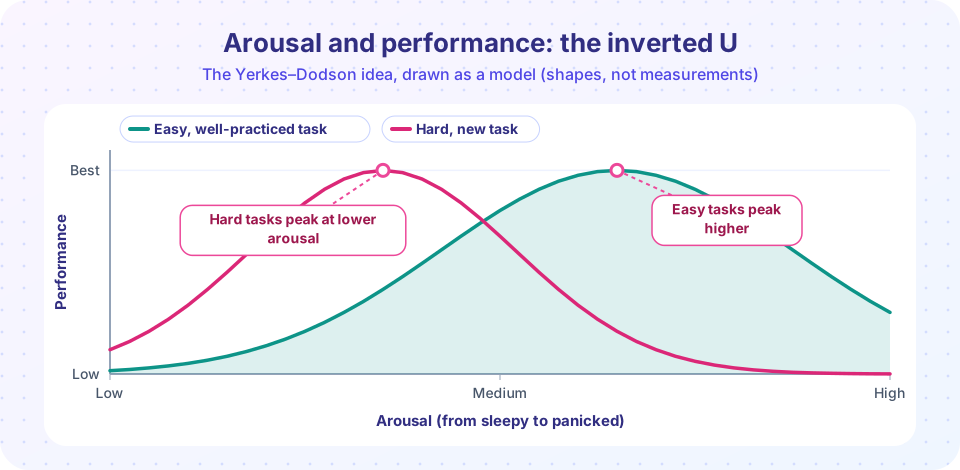
Robert Yerkes and John Dodson (1908) studied mice learning to avoid shock in a discrimination task. They found that stronger shocks improved learning only up to a point, and for the hardest task the best shock level was lower. Psychologists later generalized this as the Yerkes–Dodson law: performance rises with arousal, up to a moderate level, then falls, and the best level is lower for harder tasks. Think of a musician who is too relaxed to play with energy, or too tense to play cleanly.
It is a useful rule of thumb, but the "law" is a rough summary. The original data were thin, and later research suggests the pattern depends on the person, the task, and how arousal is measured. Treat the curve as a model of an idea, not as an equation.
Maslow's hierarchy of needs
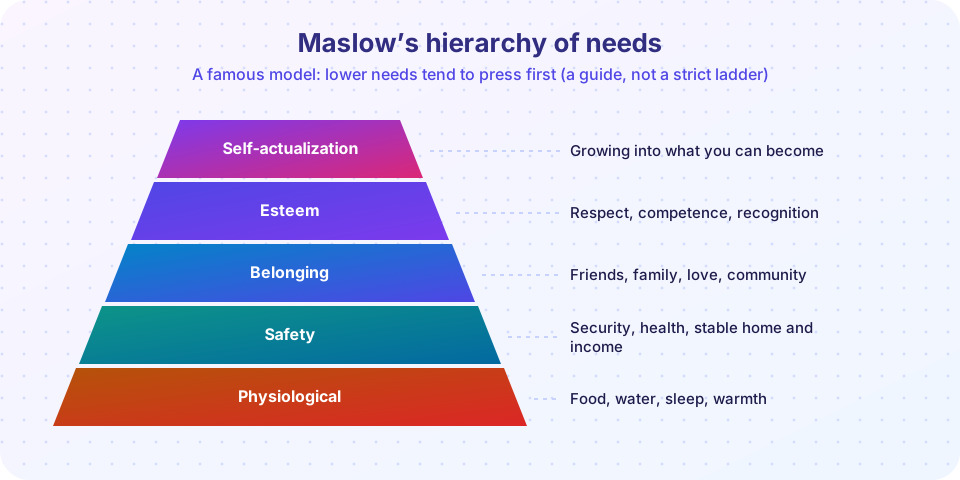
In 1943 Abraham Maslow proposed that human needs form a hierarchy. At the base are physiological needs (food, water, sleep). Next come safety, then love and belonging, then esteem, and at the top self-actualization: becoming what you are capable of becoming. Lower needs, he suggested, must be roughly satisfied before higher ones become strong.
The hierarchy is popular in business and education because it is easy to remember, and because it points to something real: someone who is starving or afraid will rarely think about creative growth. But the evidence for a strict order is weak. People pursue meaning in poverty, and many people with all basic needs met still feel lonely. In a large international survey, Louis Tay and Ed Diener (2011) found that the needs Maslow described were widespread across cultures and that each was linked to well-being, but they were not satisfied in a fixed order. Maslow's later writing also treated the levels as overlapping, not as steps. A fair way to use the model is as a checklist of human needs, not a ladder.
Self-determination theory
Edward Deci and Richard Ryan proposed three basic psychological needs.
| Need | Meaning | Example |
|---|---|---|
| Autonomy | Feeling that your actions are your own choice | Choosing your project topic |
| Competence | Feeling effective and growing in skill | Seeing your progress in a game |
| Relatedness | Feeling connected and cared for | Working in a supportive team |
According to self-determination theory (SDT), when these needs are met, people show more intrinsic motivation and better well-being. Motivation sits on a continuum from external control through internalized values to pure interest.
The best known experiment is by Mark Lepper, David Greene and Richard Nisbett (1973). Preschool children who liked drawing were sorted into three groups: one told in advance they would get a "Good Player" certificate for drawing, one who got it unexpectedly, and one who got nothing. Later, when children could freely choose to draw, those who had expected a reward spent less time drawing than the others. This is the overjustification effect: the reward reframed a fun activity as work for pay. Later studies and meta-analyses show that tangible, expected rewards can reduce intrinsic motivation, while verbal praise for competence usually does not, and effects depend on how the reward is delivered. Rewards are not bad; the lesson is that controlling rewards can undermine autonomy.
Goals and self-efficacy
Edwin Locke and Gary Latham spent decades studying goals at work. Their findings are among the most consistent in psychology:
- Specific goals beat "do your best."
- Challenging but achievable goals produce better performance than easy ones.
- People need feedback on progress.
- Commitment matters: people must accept the goal.
Albert Bandura's idea of self-efficacy helps explain why. People who believe they can do a task set higher goals and persist longer. Efficacy grows from mastery experiences, watching similar others succeed, encouragement, and managing stress. Setting small, achievable sub-goals is a practical way to build it.
Hunger as a case study
Hunger shows several theories working together. The body monitors energy: blood glucose, hormones such as ghrelin (from the stomach, rises before meals) and leptin (from fat cells, signals stored energy), and signals to the hypothalamus. But the strongest cues in daily life can be external: sight and smell of food, time of day, social setting and portion size. Food choices also reflect culture and learning. This general overview is educational and not dietary advice.
Common misconceptions
"People must reach the top of Maslow's pyramid in order." Research finds that needs are universal but not satisfied in a strict sequence.
"More pressure always means better performance." Too much arousal hurts, especially on hard or new tasks.
"Rewards and praise are the same." Controlling, expected rewards can reduce interest; informational feedback about competence usually supports it.
Try it
Press Run (or Ctrl + Enter) to see the result here.
Program input · what you'd type while the program runs
Type the answers before you press Run, one per line. Each time the program reads a line (with input()), it gets the next line from this box.
Check your understanding
Quick check · 5 questions
of 5 answered You scored / 5 · perfect!
-
1. Which theory says behavior is driven by tension from biological needs that we act to reduce?
Hull's drive-reduction theory links biological need, drive and behavior that restores balance. -
2. What did Tay and Diener's international study suggest about Maslow's needs?
Needs seemed universal, but the fixed ladder was not supported. -
3. In the Lepper, Greene and Nisbett study, which children later drew least in free play?
Expected rewards reduced later interest, the overjustification effect. -
4. Which goal is best according to goal-setting research?
Specific, challenging, achievable goals with feedback work best. -
5. The Yerkes-Dodson idea predicts that a very hard task is best done at:
The optimal arousal level is lower for harder tasks.
Summary
- Instinct, drive-reduction and incentive theories explain different parts of motivation.
- Arousal and performance follow an inverted U, with a lower peak for harder tasks.
- Maslow's hierarchy is a useful list of needs but not a strict ladder.
- Self-determination theory highlights autonomy, competence and relatedness; expected controlling rewards can reduce intrinsic motivation.
- Specific, challenging goals with feedback improve performance.
Next: Emotion theories
Track your progress
Create a free account to tick off lessons and pick up where you left off on any device.
of Introduction to Psychology lessons completed