


















Lesson 21 of 45 · Learning and Conditioning
Chapter 5 overview: how experience changes behavior
A big-picture tour of learning in psychology: habituation, classical conditioning, operant conditioning and observational learning, with a map of Chapter 5.
Think about everything you can do today that you could not do as a baby. You can read this sentence, you wince when you hear a dentist's drill, you know which route home is fastest, and you may have picked up a slang word from a friend without ever being taught it. Almost none of that was present at birth. It was learned.
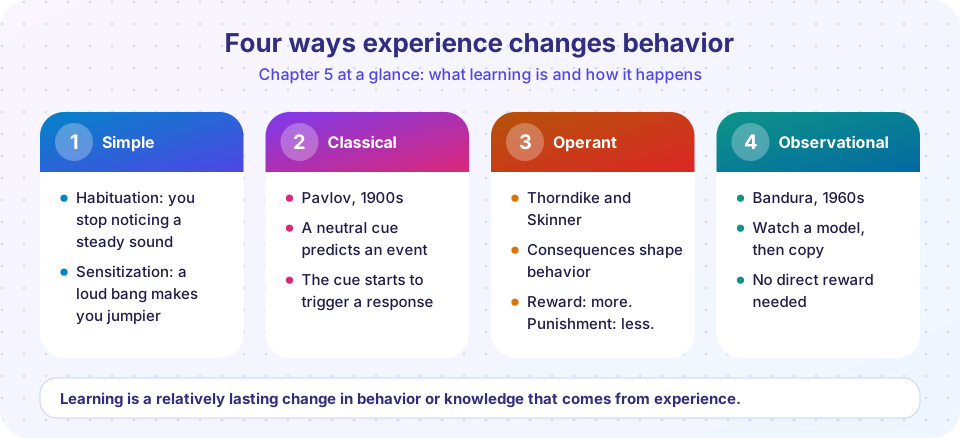
Psychologists define learning as a relatively lasting change in behavior or knowledge that comes from experience. Each part of that definition matters. "Relatively lasting" rules out a temporary change such as being tired. "Experience" rules out changes that come only from growing older or from a drug. And "behavior or knowledge" reminds us that some learning is invisible: you may know something without ever showing it.
This chapter follows one of the oldest threads in psychology: the search for the rules by which experience reshapes behavior. We start with simple changes and build up to learning by watching other people.
What you will learn
- What psychologists mean by learning, and what does not count as learning.
- The difference between simple (non-associative) learning and associative learning.
- A first look at classical conditioning, operant conditioning and observational learning.
- Why the history of learning research matters for classrooms, therapy, animal training and technology.
- How the next four lessons fit together.
Key terms
Learning: a relatively lasting change in behavior or knowledge produced by experience.
Habituation: a decrease in response to a stimulus that is repeated and harmless.
Sensitization: an increase in response after a strong or threatening stimulus.
Association: a link formed in memory between two events, or between a behavior and its result.
Behaviorism: the school of thought that studies observable behavior and how the environment shapes it.
A quick tour in slides
What is learning?
Learning without links
Learning by association
Learning from others
Modern learning theory mixes all of these.
The simplest learning: habituation and sensitization
Before anything can be linked to anything else, an animal has to decide what is worth responding to. When a refrigerator hums, you stop hearing it after a few minutes. That is habituation. It is not fatigue: if the hum changes pitch, you notice at once. Habituation is one of the most basic forms of learning, and it has been shown in animals from sea snails to humans. Newborns even habituate to a repeated picture and then look longer at a new one, which is how researchers test what babies can tell apart.
Sensitization works the opposite way. After a sudden loud noise you may jump at a sound that would normally not bother you. The strong event turned your alertness up.
The Nobel Prize winner Eric Kandel studied both processes in the sea slug Aplysia, which has a simple nervous system, and showed that these changes involve measurable changes at synapses (the connections between neurons). That was an early demonstration that learning has a physical basis in the nervous system.
Associative learning: linking events
Most of the chapter is about associative learning, in which the learner connects two things.
- In classical conditioning the learner connects two stimuli. A bell predicts food, a dentist's drill predicts discomfort, a notification sound predicts a message. The learner does not control the link; it just forms. You will meet Ivan Pavlov, John B. Watson and the ideas of Robert Rescorla.
- In operant conditioning the learner connects a behavior with its consequence. If a behavior is followed by something good, it becomes more likely; if followed by something unpleasant, less likely. Edward Thorndike and B. F. Skinner built this theory.
The two kinds often work together. A child may feel nervous in a classroom (classical) and avoid raising a hand because it was once met with laughter (operant).
Learning by observation and thought
Behaviorists tried to explain everything through stimuli and responses. In the 1930s Edward Tolman showed that rats seemed to build a mental map of a maze, and in the 1960s Albert Bandura showed that children copy what they see, even when nobody rewards them. These findings pushed psychology toward cognitive explanations: learning is not only changing behavior; it is also changing what you know and expect.
Common misconceptions
"Learning only happens in school." Learning happens whenever experience changes you, whether you are trying or not. Most of what you know about people and places was never taught on purpose.
"Conditioning is the same as brainwashing." Conditioning is a description of how associations and consequences shape behavior. People are not passive; they interpret and choose within what they have learned.
"If someone does not show it, nothing was learned." Knowledge can be learned and not performed. Tolman called this latent learning, and you will see it in lesson 4.
What each lesson covers
- Classical conditioning: Pavlov's dogs, Little Albert, taste aversion and why predicting events matters.
- Operant conditioning: reinforcement, punishment, shaping and schedules.
- Observational and cognitive learning: Bandura, Tolman, Köhler and learned helplessness.
- Chapter review: a one-page picture and a ten-question quiz.
Try it
Press Run (or Ctrl + Enter) to see the result here.
Program input · what you'd type while the program runs
Type the answers before you press Run, one per line. Each time the program reads a line (with input()), it gets the next line from this box.
Check your understanding
Quick check · 4 questions
of 4 answered You scored / 4 · perfect!
-
1. Which situation is the best example of habituation?
Habituation is a decrease in response to a repeated, harmless stimulus. The flinch is sensitization, the dance is observational learning and the bell is classical conditioning. -
2. Which of these is NOT counted as learning in the psychological sense?
Learning is a lasting change due to experience. A temporary state caused by a drug is not learning. -
3. In operant conditioning, what is connected?
Operant conditioning links a behavior with what follows it, so that the behavior becomes more or less likely. -
4. Why did Tolman's and Bandura's findings push psychology toward cognitive explanations?
Rats showed knowledge of a maze without reward and children copied models without being rewarded, which suggests learning involves internal knowledge.
Summary
- Learning is a relatively lasting change in behavior or knowledge produced by experience.
- Habituation and sensitization are the simplest forms of learning and have a clear neural basis.
- Classical conditioning links stimuli, operant conditioning links behavior and consequence, and observational learning copies models.
- Cognitive findings (maps, insight, expectations) show learners store knowledge, not just habits.
Next: Classical conditioning
Track your progress
Create a free account to tick off lessons and pick up where you left off on any device.
of Introduction to Psychology lessons completed