


















Lesson 39 of 45 · Personality, Development and Health
Chapter 8 review: personality, development and health
Review personality traits, developmental theories and health psychology with a chapter poster, recap table, a short activity and a ten-question quiz.
This review connects the three parts of the chapter: how people differ, how they change and how they cope. Use the picture to get the outline, the table to check names and cautions, and the quiz to find gaps.
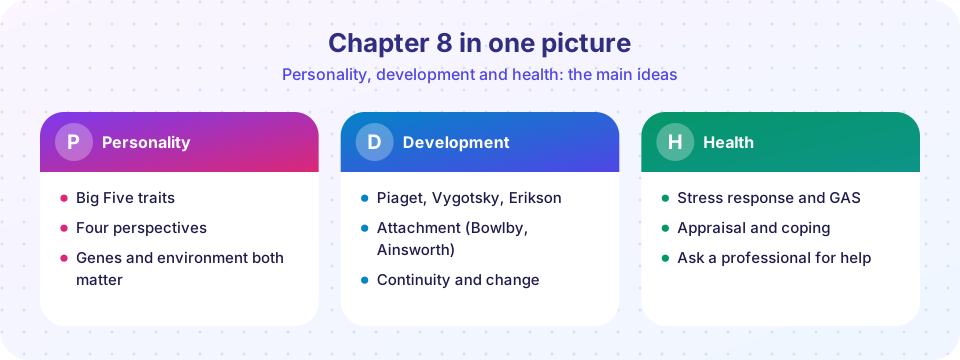
Recap table
| Area | Key ideas | Names | Cautions |
|---|---|---|---|
| Perspectives on personality | Psychodynamic, learning, humanistic, trait | Freud, Skinner, Bandura, Rogers, Allport | Each answers a different question |
| Big Five | Openness, conscientiousness, extraversion, agreeableness, neuroticism | Costa, McCrae, Goldberg | Descriptions, not explanations |
| Genes and environment | Traits moderately heritable; shared environment matters less than expected | Twin and adoption studies | Heritability is about groups |
| Test cautions | Reliability, validity, Barnum effect | Forer, MBTI critics | Scores are not labels |
| Cognitive development | Stages; schemas; ZPD; theory of mind | Piaget, Vygotsky, Baillargeon, Wimmer and Perner | Abilities appear earlier and vary |
| Attachment | Secure base; Strange Situation; temperament | Bowlby, Harlow, Ainsworth | Patterns can change |
| Psychosocial and moral | Eight challenges; three moral levels | Erikson, Kohlberg, Gilligan | Cultural variation |
| Stress | Fight-or-flight, HPA axis, GAS | Cannon, Selye | Stress is also appraisal |
| Coping | Problem-focused, emotion-focused | Lazarus, Folkman | Flexibility matters |
| Mental health | Common, multi-causal, treatable | Diathesis-stress model | Only professionals diagnose |
Revisit: personality theories, child development, stress and health.
Three ideas to carry forward
- Describe, do not label. Traits are dimensions and scores are snapshots.
- Development is a conversation between biology, relationships and culture.
- Appraisal and support change stress. The same event can be a challenge or a threat.
Explain it in your own words
Write two or three sentences for each prompt.
- Why does it make sense to call heritability a statement about groups and not about individuals?
- Choose one of Piaget's tasks and explain what later research changed about its interpretation.
- How do temperament and caregiver sensitivity both help explain attachment patterns?
- Two students face the same exam. Use appraisal theory to explain why one feels challenged and the other threatened.
- What would you say to a friend who wants to use an online quiz to decide whether they have a mental health condition?
Your answers should be careful and kind: this course gives education, and professionals assess and treat.## Try it
Press Run (or Ctrl + Enter) to see the result here.
Program input · what you'd type while the program runs
Type the answers before you press Run, one per line. Each time the program reads a line (with input()), it gets the next line from this box.
Check your understanding
Quick check · 10 questions
of 10 answered You scored / 10 · perfect!
-
1. Which Big Five trait best predicts job performance across many studies?
Conscientiousness is a consistent predictor of performance, though the effect is modest. -
2. A heritability estimate of 0.5 means:
Heritability describes variation in a population, not any single person. -
3. Which finding challenged Piaget's view of infants?
Violation-of-expectation studies suggest earlier understanding than search tasks showed. -
4. In Harlow's experiments, infant monkeys preferred:
Contact comfort mattered more than feeding for attachment behavior. -
5. Which statement about mental health diagnosis is correct?
Assessment by a professional is needed, and help is available. -
6. Which is an example of emotion-focused coping?
It aims to manage feelings about the situation, not change the situation itself. -
7. Erikson's challenge for adolescence is:
Adolescents explore who they are. -
8. The Barnum effect shows that:
Forer's students rated an identical generic description as highly accurate. -
9. What did Cohen's 1991 study suggest?
Stress was associated with greater susceptibility, supporting links between stress and immunity. -
10. What does the transactional model emphasize?
Lazarus and Folkman showed that interpretation shapes stress.
Summary
- Personality is best described by Big Five dimensions, with genes and environment both contributing.
- Developmental theories (Piaget, Vygotsky, Bowlby and Ainsworth, Erikson, Kohlberg) are useful maps with known corrections.
- Stress combines body response and appraisal; coping, support and health habits matter; help is available for mental health concerns.
Track your progress
Create a free account to tick off lessons and pick up where you left off on any device.
of Introduction to Psychology lessons completed