


















Lesson 16 of 45 · Sensation and Perception
Chapter 4 Overview: Sensation and Perception
See how the senses turn physical energy into experience, learn about thresholds, Weber's law, signal detection and adaptation, and preview the chapter.
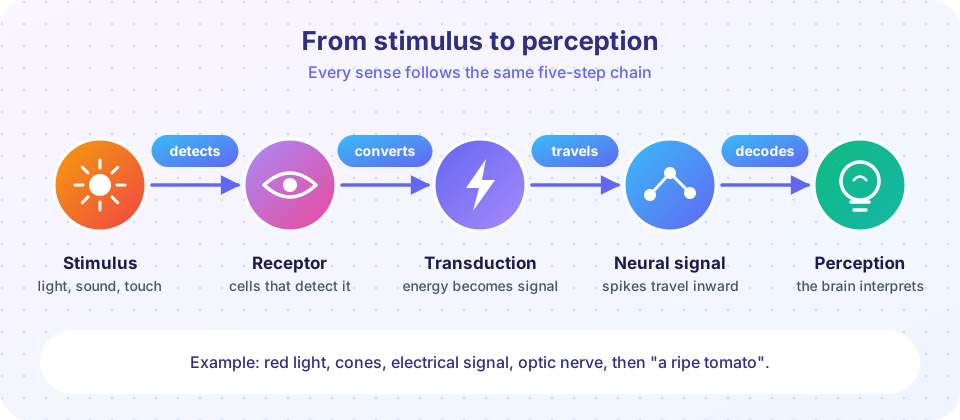
Right now, light is hitting your eyes, air pressure is vibrating in your ears and your skin is reporting the touch of your clothes. None of those physical signals is an experience. The brain has to detect them, convert them into its own language and interpret them as a screen, a hum or a soft shirt. This chapter follows that journey from the outside world to your awareness, and it will show you something startling: perception is not a recording of reality but a construction built from limited signals.
What you will learn
- The difference between sensation and perception.
- The five-step chain from stimulus to perception, including transduction.
- Absolute and difference thresholds, and Weber's law.
- Signal detection theory: why detecting a faint signal is a decision.
- Sensory adaptation, and bottom-up versus top-down processing.
Key terms
Sensation: the process of detecting physical energy from the environment and encoding it as neural signals.
Perception: organizing and interpreting sensory information to give it meaning.
Transduction: converting one form of energy (light, sound, pressure) into neural signals.
Absolute threshold: the smallest amount of a stimulus that can be detected half the time.
Just noticeable difference (JND): the smallest change in a stimulus that can be detected half the time.
Sensory adaptation: reduced response to a constant, unchanging stimulus.
The big picture
Five steps for every sense
Then the brain takes over
Sensation is the input; perception is the interpretation
Sensation and perception
Psychologists separate sensation (detecting and encoding energy) from perception (organizing and interpreting it). They are two ends of one continuous process. Two directions of processing combine:
- Bottom-up processing starts with the raw input, such as the pattern of light on the retina, and builds toward a recognized object.
- Top-down processing starts with your knowledge, expectations and context, which guide what you notice and how you interpret it. You find it easy to read a messy handwritten word in a familiar sentence, but nearly impossible alone: context fills the gaps.
Perception normally uses both, instantly. Illusions (see perception and illusions) are useful because they reveal the assumptions the brain builds in.
Thresholds and Weber's law
How faint a signal can you detect? Gustav Fechner, founder of psychophysics in the 1800s, defined the absolute threshold as the intensity detected 50 percent of the time. Detection fades smoothly, not abruptly, so the "threshold" is a statistical point.
How big must a change be to be noticed? That is the difference threshold, or JND. In the 1830s Ernst Weber found that the JND is roughly a constant fraction of the starting intensity: if you can just notice an added 2 grams on a 100-gram weight, you will need about 20 grams on a 1,000-gram weight. This is Weber's law: JND = k × I, where k (the Weber fraction) differs for each sense. It explains why a candle changes a dark room dramatically but adds nothing to a sunny day.
Signal detection: detecting is deciding
Suppose a doctor is reviewing a scan, or a lifeguard scans the water. The signal is often faint and the background noisy, so on every trial there are four outcomes:
| Signal present | Signal absent | |
|---|---|---|
| Say "yes" | Hit | False alarm |
| Say "no" | Miss | Correct rejection |
Signal detection theory shows that the result depends on two things: how well the observer can tell signal from noise (sensitivity), and how willing they are to say "yes" (the criterion, which depends on costs and rewards). A security guard who must never miss a threat sets a liberal criterion and will have many false alarms. You can have the same sensitivity and very different hit and false-alarm rates. The interactive demonstration below lets you test this.
Sensory adaptation
Walk into a room with a strong smell and you will notice it at first, but within minutes it fades. This is sensory adaptation: receptors respond mostly to change, and a steady stimulus leads to a reduced response. It frees the brain to attend to what is new, such as a movement in the corner of the eye. You cannot feel your watch or your clothes most of the time, until you attend to them.
Where the chapter goes
| Lesson | What you will learn |
|---|---|
| Vision | The eye, rods and cones, color theories, the visual pathway |
| Hearing and the other senses | Sound waves, the ear, touch, pain, taste, smell, balance |
| Perception and illusions | Gestalt principles, depth cues, constancies, illusions, attention |
| Chapter 4 review | Recap picture and ten-question quiz |
Common misconceptions
"We have five senses." That is the traditional count. Humans also sense balance and movement (the vestibular sense), body position (proprioception), temperature, pain and more.
"Our senses give us a true copy of the world." They give a selective, interpreted version, tuned by evolution to what mattered for survival.
"A person who detects less must have worse senses." Not necessarily. They may simply use a stricter criterion for saying "yes".
Try it
First, explore signal detection. Move the sliders for sensitivity (how separable signal and noise are) and criterion (how cautious the observer is). Notice that moving the criterion trades hits for false alarms, without any change in ability.
Second, Weber's law in numbers. The fraction k below is an illustrative value, not a measured one for any particular sense.
Press Run (or Ctrl + Enter) to see the result here.
Program input · what you'd type while the program runs
Type the answers before you press Run, one per line. Each time the program reads a line (with input()), it gets the next line from this box.
Check your understanding
Quick check · 5 questions
of 5 answered You scored / 5 · perfect!
-
1. Transduction means
Receptors transduce light, sound and pressure into neural signals the brain can use. -
2. You can just notice an added 5 g on 250 g. By Weber's law, about how much must be added to 1,000 g to notice it?
k = 5/250 = 0.02, so JND = 0.02 × 1,000 = 20 g. -
3. In signal detection theory, saying 'yes' when no signal was present is a
A false alarm is a 'yes' on a signal-absent trial. -
4. Reading a smudged word easily because you know the sentence is an example of
Expectations and context guide interpretation. -
5. Why does a constant smell fade from awareness?
Adaptation reduces the response to unchanging stimuli, saving attention for what is new.
Summary
- Sensation detects and encodes energy; perception organizes and interprets it.
- Every sense uses stimulus, receptor, transduction, neural signal and perception.
- Absolute thresholds and JNDs are statistical; Weber's law says JND is a fixed fraction of intensity.
- Signal detection separates sensitivity from criterion, so detection is also a decision.
- Adaptation reduces response to constant input; processing uses both bottom-up and top-down routes.
Next: Vision
Track your progress
Create a free account to tick off lessons and pick up where you left off on any device.
of Introduction to Psychology lessons completed