


















Lesson 28 of 45 · Memory and Thinking
Forgetting and false memories
Why do we forget, and how can memories be wrong? Learn about Ebbinghaus's curve, interference, cue failure, Loftus's misinformation studies and eyewitness memory.
Forgetting is usually treated as a problem, but it is also a feature. If you remembered every parking spot you ever used, finding today's car would be harder. A system that discards what is no longer useful helps you focus on what is. Still, forgetting at the wrong time, such as in an exam or when you need a name, is frustrating. And there is a stranger problem: sometimes we "remember" things that never happened, with confidence and detail.
This lesson covers both: why memories become hard to reach, and how memories can be altered or invented.
What you will learn
- What Ebbinghaus's forgetting curve shows.
- The four main explanations of forgetting and the evidence for each.
- How Bartlett and Loftus showed that memory is reconstructive.
- Why eyewitness memory and flashbulb memories can be wrong.
- Limits and debates in this area, including "repressed" memories.
Key terms
Forgetting curve: the pattern in which retention falls steeply at first, then more slowly.
Interference: forgetting caused by competition between memories.
Misinformation effect: distortion of a memory by information given after the event.
Source monitoring: judging where a memory came from.
Reconstructive memory: the idea that remembering rebuilds events from fragments and expectations.
Ebbinghaus and the forgetting curve
In the 1880s the German psychologist Hermann Ebbinghaus used himself as a subject. To avoid prior knowledge, he invented nonsense syllables such as DAX or ZOL, memorized lists of them, and tested himself after different delays. He found that forgetting was fast right after learning and then slowed down: you lose a lot in the first hours and days, and the remainder fades slowly. He also found that spreading study over several days produced better memory than massing it, the spacing effect.
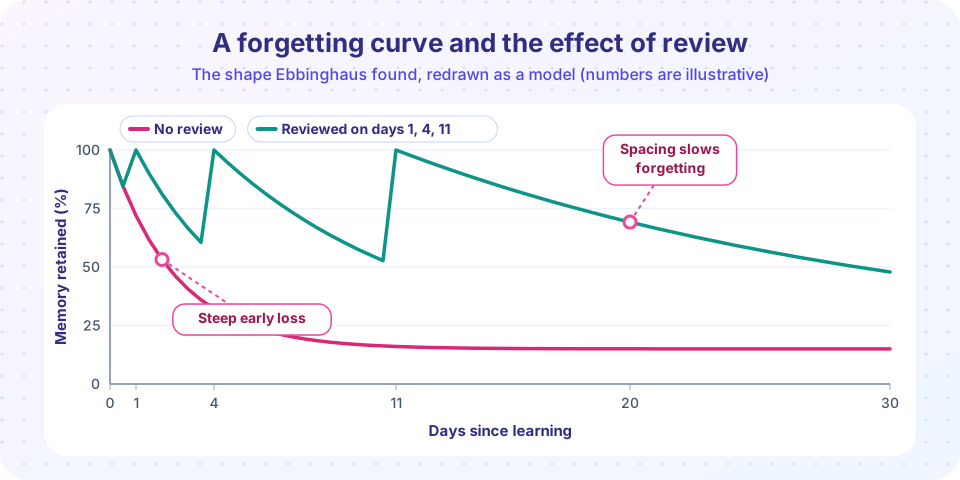
Ebbinghaus used only himself and meaningless syllables, so the exact percentages do not transfer to meaningful material. But modern studies confirm the shape of the curve and the benefit of spacing.
Why do we forget?
Decay
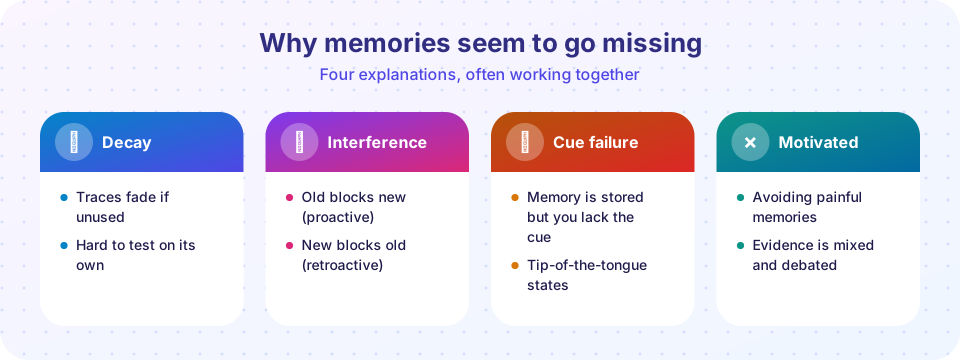
The idea is simple: unused memory traces fade with time. It is hard to test because time always brings other events. In experiments such as the Peterson and Peterson task, forgetting is better explained by interference than pure fading. Decay probably plays a role, especially for short-term memory, but it is not the whole story.
Interference
Memories compete.
- Proactive interference: old information disrupts new learning. If you move to a new phone number, you may keep giving the old one.
- Retroactive interference: new information disrupts old. After learning Spanish, you may struggle to remember a French word you once knew.
John McGeoch argued in the 1930s that interference is the main cause of forgetting. Similar items interfere most, which is why studying two similar subjects back to back can be harder than studying different ones.
Retrieval failure
Often the memory is there but you cannot find it. This is the lesson of encoding specificity: the right cue brings it back. Tip-of-the-tongue states, where you know you know a word but cannot say it, are a vivid example. Recognition is usually much easier than recall because the options act as cues.
Motivated forgetting
Sigmund Freud proposed that people repress painful memories into the unconscious. Experimental work, such as Michael Anderson and Collin Green's 2001 "think/no-think" studies, suggests that people can reduce the later recall of unwanted items by actively suppressing them. But the idea that traumatic experiences are routinely forgotten and can be recovered later in accurate detail is controversial. Many clinicians and memory researchers note that people more often have trouble forgetting trauma, and that therapy techniques which suggest events can create false memories. The debate has not been fully resolved, and the topic deserves care.
Memory is reconstructive
In 1932 Frederic Bartlett asked British students to read a Native American folk story, "The War of the Ghosts," and recall it repeatedly over weeks and months. The retellings became shorter and more conventional. Strange details dropped out or were changed to fit the readers' expectations, and some details were added. Bartlett proposed that memory uses schemas, organized knowledge about how things usually are, to fill in gaps. This is efficient most of the time and a source of error some of the time.
The misinformation effect
Elizabeth Loftus and John Palmer (1974) showed participants films of car accidents and asked how fast the cars were going when they "smashed into," "collided with," "bumped into," "hit," or "contacted" each other. Estimated speeds were higher for stronger verbs. A week later, people who had heard "smashed" were more likely to report seeing broken glass, although there was none.
Loftus and others replicated and extended this with many materials: leading questions, misleading post-event details, and suggestion. In 1995 Loftus and Jacqueline Pickrell told 24 participants that a family member recalled a childhood event of being lost in a shopping mall. Participants had received three true events and one invented one. About a quarter of them later said they remembered the invented event in whole or part. Later studies using similar methods found rates of false memories ranging from small to substantial, depending on the details and how "remembering" is defined. The takeaway is that suggestion can create memories for events, not that most people are easily fooled by every suggestion.
Word-list false memories
In the Deese–Roediger–McDermott (DRM) task, people hear a list of words such as bed, rest, awake, tired that all relate to an unlisted word (sleep). Later, many people say they remember hearing sleep and may be confident about it. The mind's tendency to extend meaning shows up even in simple lists.
Eyewitness memory
The legal system relies heavily on eyewitnesses, but research has found many ways they can be wrong:
- Stress and weapon focus: attention goes to the weapon, not the face.
- Cross-race effect: people identify faces of their own race more accurately.
- Post-event information: talking with other witnesses or seeing news can change the memory.
- Lineup procedures: pressure to choose, or biased instructions, raise errors.
Mistaken identification is one of the leading contributing factors in documented wrongful convictions. Researchers have recommended practices such as showing suspects one at a time or in properly constructed lineups, recording confidence immediately, and avoiding suggestive feedback. Confidence at the time of first identification is more informative than confidence expressed later in court.
Flashbulb memories
After a shocking public event, such as a disaster or an attack, people often have vivid memories of where they were. Roger Brown and James Kulik (1977) called these flashbulb memories. But in 1986, shortly after the Challenger explosion, Ulric Neisser and Nicole Harsch asked students to write down how they heard the news, and then asked again two and a half years later. Many gave accounts that differed from their original notes, yet were highly confident. The accounts felt vivid, but they were not especially accurate. Emotion makes us more confident in a memory, and emotional events are often better remembered at the core, but peripheral details drift like any other.
What helps
This is general information only. Studies suggest that spacing, retrieval practice, writing things down, using meaningful cues, and sleeping well all reduce everyday forgetting. For witnesses, recording what they saw as soon as possible helps. If someone has serious or worsening memory problems, a doctor is the right person to talk to.
Common misconceptions
"Forgetting means the memory is gone." Often it is still stored but cannot be reached with the available cues.
"If I can see it vividly, it must be accurate." Vividness and confidence reflect how a memory feels, not how accurate it is.
"Hypnosis unlocks perfect memory." Hypnosis can increase confidence and also the number of false details, which is why it is treated with caution in investigations.
Try it
Press Run (or Ctrl + Enter) to see the result here.
Program input · what you'd type while the program runs
Type the answers before you press Run, one per line. Each time the program reads a line (with input()), it gets the next line from this box.
Check your understanding
Quick check · 5 questions
of 5 answered You scored / 5 · perfect!
-
1. What pattern did Ebbinghaus find about forgetting?
The forgetting curve falls steeply at first, then levels off. -
2. After moving to a new locker number, you keep recalling your old one. This is:
Old learning disrupts new information, which is proactive interference. -
3. In Loftus and Palmer's study, participants who heard the verb 'smashed' were more likely to:
The wording of the question changed both the speed estimates and later reports of details. -
4. Which statement about flashbulb memories is best supported?
Neisser and Harsch found that confident memories of Challenger changed over time. -
5. Which is the best summary of the evidence on repressed memories?
The topic is debated, and suggestive techniques can create false memories.
Summary
- Forgetting is steep at first and slows; spaced review slows it more.
- Explanations include decay, interference, retrieval failure and motivated forgetting, usually in combination.
- Memory is reconstructive: schemas, suggestion and later information can change what we recall.
- Eyewitness and flashbulb memories can be vivid and confident yet partly wrong.
Track your progress
Create a free account to tick off lessons and pick up where you left off on any device.
of Introduction to Psychology lessons completed