


















Lesson 6 of 45 · The Science of Psychology
Chapter 2 Overview: The Science of Psychology
Preview chapter 2: the scientific cycle, why hypotheses must be testable, why our intuitions about chance fail, and what each lesson in this chapter covers.
Every claim in the rest of this course is only as good as the evidence behind it. Chapter 2 is about where that evidence comes from, and how to tell strong evidence from weak. It may be the most useful chapter in the course: you will use it whenever you read a headline that says "Scientists discover that people who ... are more likely to ...".
What you will learn
- The steps of the scientific cycle and what makes a hypothesis testable.
- Why intuition about chance and patterns is unreliable.
- What you will learn in each lesson of the chapter.
Key terms
Hypothesis: a testable prediction about what will be found.
Theory: a well-supported explanation that organizes many findings and generates hypotheses.
Falsifiable: able to be shown wrong by some possible observation.
Variable: anything that can take different values, such as age, sleep hours or test score.
The big picture
Ask a testable question
Collect and analyze
Share and repeat
Trust grows with repetition
Why we need a method at all
Our minds are fast, pattern-hungry and often wrong about cause. A few mental habits show up again and again.
- Confirmation bias. We notice and remember evidence that fits what we already believe, and overlook the rest.
- Hindsight bias. Once we know an outcome, it feels as if we "knew it all along".
- Overconfidence. We rate our own judgments as more accurate than they are.
- Seeing patterns in noise. We find streaks, faces and meaning in random events.
The scientific method is a set of habits built to protect us from these errors: write the prediction down first, measure with clear definitions, use comparison groups, check against chance and let other people try to break the result.
Testable and falsifiable
A hypothesis must forbid something. "Students who sleep eight hours score higher on a recall test than students who sleep four hours" forbids the opposite outcome, so a study could prove it wrong. "Everything happens for a reason" forbids nothing, because any event can be fitted afterward. The philosopher Karl Popper (1902-1994) made this point: a theory that cannot fail is not scientific. This does not make unfalsifiable ideas meaningless in life. It means that science cannot settle them.
Where the chapter goes
| Lesson | What you will learn |
|---|---|
| Research methods | Case studies, surveys, observation and experiments; variables, groups, bias and double-blind designs |
| Correlation and causation | What r means, third variables and why experiments are needed to show cause |
| Measurement, sampling and ethics | Reliability, validity, samples, statistics and the rules that protect participants |
| Chapter 2 review | The chapter in one picture and a ten-question quiz |
Common misconceptions
"Science proves things." Science accumulates evidence and rates confidence. Individual studies suggest; many studies together support; theories are never "proven" the way a theorem is.
"A theory is just a guess." In science a theory is a broad, well-supported explanation. The everyday word "theory" means something weaker.
"If a study finds an effect, it is real." Chance, small samples and flexible analysis can produce impressive-looking findings. Replication is the safeguard.
Try it
Step through the scientific cycle with an example question. Each step shows what a researcher would write for it.
Now see why intuition about chance needs a check. Most people think a fair coin that lands heads five or six times in a row must be "rigged". This simulation flips a fair coin 20 times, 10,000 times over, and counts the longest streak in each.
Press Run (or Ctrl + Enter) to see the result here.
Program input · what you'd type while the program runs
Type the answers before you press Run, one per line. Each time the program reads a line (with input()), it gets the next line from this box.
Check your understanding
Quick check · 4 questions
of 4 answered You scored / 4 · perfect!
-
1. Which hypothesis is falsifiable?
It predicts a specific measurable result that could turn out wrong. -
2. Confirmation bias is
We favor evidence that fits our beliefs, which is why science relies on rules that force us to look at everything. -
3. In science, a 'theory' is
The everyday meaning (a hunch) is different from the scientific meaning. -
4. Why does replication matter?
Results that cannot be repeated are likely to have come from chance, small samples or flexible analysis.
Summary
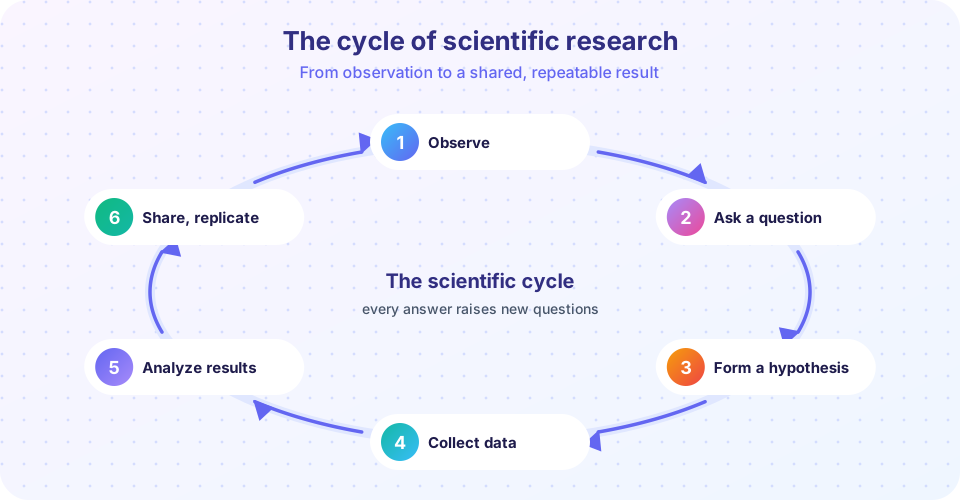
- The scientific cycle runs observe, ask, hypothesize, collect, analyze and share, then repeat.
- A good hypothesis is testable and falsifiable: it forbids some outcomes.
- Human intuition is biased by confirmation, hindsight, overconfidence and pattern-seeking, so we need method.
- Streaks occur often in random data, so impressive patterns need to be checked against chance.
- Chapter 2 covers designs, correlation, measurement and ethics.
Next: Research Methods
Track your progress
Create a free account to tick off lessons and pick up where you left off on any device.
of Introduction to Psychology lessons completed