


















Lesson 20 of 45 · Sensation and Perception
Chapter 4 Review: Sensation and Perception
Review chapter 4: the stimulus-to-perception chain, thresholds, vision, hearing, the other senses and perception, with a recap picture, sorting game and quiz.
This chapter followed the path from physical energy to conscious experience. The big lesson is that perception is not a copy of the world but a construction: your senses sample a narrow slice of reality, transduce it into spikes, and your brain interprets those spikes using expectations, context and rules that are usually right. This review pulls the chapter together before you move on to learning and memory.
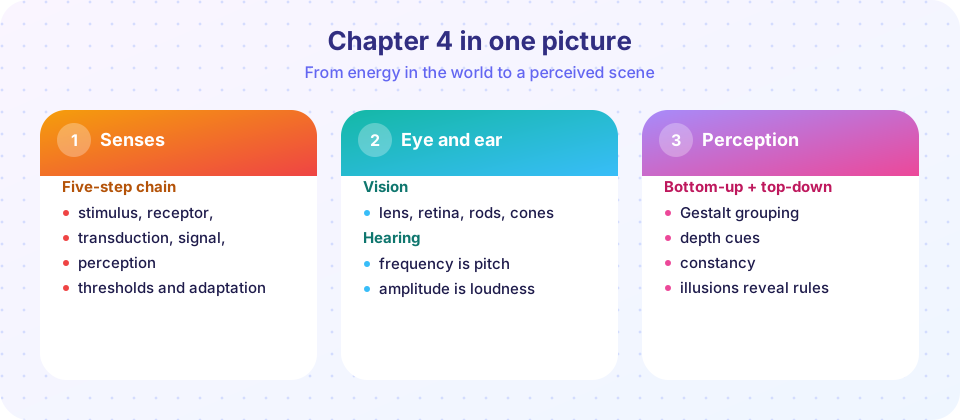
What you will learn
- How the lessons of chapter 4 connect.
- Which terms and examples you should be able to explain.
- How to sort depth cues and apply the stimulus-to-perception chain to any sense.
Chapter at a glance
| Lesson | Key ideas | Examples to know |
|---|---|---|
| Overview | Sensation vs perception; transduction; absolute and difference thresholds; signal detection; adaptation | Weber's law (JND = k × I); hits and false alarms |
| Vision | Light, cornea, lens, retina, rods and cones, fovea, blind spot; feature detectors; trichromatic and opponent-process theories | Dark adaptation; afterimages; Hubel and Wiesel |
| Hearing and other senses | Frequency and amplitude; ear path; hair cells; touch, pain, taste, smell, vestibular | Place theory; gate-control theory; tongue-map myth |
| Perception and illusions | Gestalt principles; depth cues; constancy; attention; illusions | Visual cliff; gorilla study; Müller-Lyer |
The chain applied to each sense
| Sense | Stimulus | Receptor | Transduction | Brain area |
|---|---|---|---|---|
| Vision | Light waves | Rods and cones | Pigment changes | Occipital lobe |
| Hearing | Sound waves | Hair cells in the cochlea | Bending of hairs | Temporal lobe |
| Touch | Pressure, temperature | Skin receptors | Deformation or temperature changes | Parietal lobe |
| Taste and smell | Chemicals | Taste buds and olfactory receptors | Molecule binding | Taste areas; olfactory bulb then limbic system |
| Balance | Head movement | Hair cells in canals and organs | Fluid movement | Brainstem, cerebellum, cortex |
Common misconceptions
"Sensation and perception are the same thing." Sensation detects and encodes energy; perception organizes and interprets it.
"Detecting a faint signal depends only on sensory ability." It also depends on the criterion for saying "yes".
"Perceiving the world accurately means no illusions." Illusions are by-products of the same rules that normally keep perception accurate.
Try it
First, sort the depth cues. Decide whether each cue needs both eyes (binocular) or works with one eye (monocular).
Second, rehearse the chain for each sense. Fill in your own answers before running the code, then compare.
Press Run (or Ctrl + Enter) to see the console output here.
No output.
Check your understanding
Quick check · 10 questions
of 10 answered You scored / 10 · perfect!
-
1. Transduction is
Receptors transduce light, sound, pressure and chemicals into neural signals. -
2. By Weber's law, if you notice an extra 4 g on 200 g, about how much extra do you need to notice on 500 g?
k = 4/200 = 0.02, so 0.02 × 500 = 10 g. -
3. In signal detection theory, a cautious observer who says 'yes' only when very sure will have
A stricter criterion reduces both false alarms and hits. -
4. Rods differ from cones in that rods
Rods are sensitive but colorless and mainly outside the fovea. -
5. Opponent-process theory best explains
Opponent cells fatigue and produce complementary afterimages. -
6. The place theory of pitch says pitch is coded by
Different frequencies peak at different positions along the membrane. -
7. According to the gate-control theory, pain can be reduced by
Rubbing a bumped elbow and psychological factors can reduce pain signals. -
8. Which is a monocular depth cue?
Linear perspective works with one eye; disparity and convergence need two. -
9. Missing a gorilla while counting basketball passes is called
With attention elsewhere, an unexpected object goes unnoticed. -
10. Why are illusions useful to psychologists?
Because illusions are by-products of useful perceptual rules.
Summary
- Every sense follows stimulus, receptor, transduction, neural signal and perception.
- Thresholds are statistical; Weber's law links JND to intensity; signal detection separates sensitivity from criterion.
- Vision uses rods and cones and two color theories; hearing uses the cochlea's hair cells; touch, pain, taste, smell and balance add further channels.
- Perception organizes input with Gestalt rules, depth cues and constancies, and attention limits what we notice.
- Illusions reveal the brain's built-in assumptions.
Track your progress
Create a free account to tick off lessons and pick up where you left off on any device.
of Introduction to Psychology lessons completed