


















Lesson 45 of 45 · Projects and Practice
Further study: where to go after introductory psychology
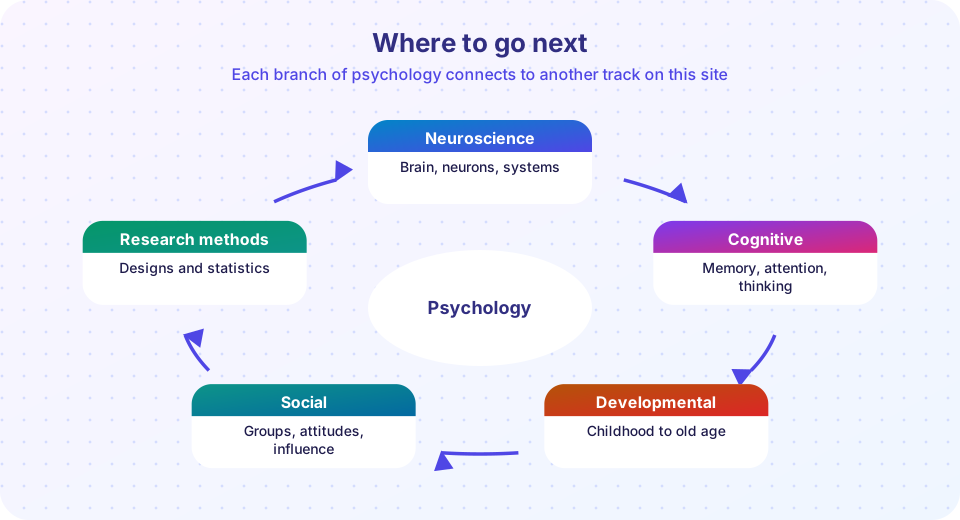
Choose your next steps after this course: branches of psychology, related tracks on this site, how to read research, careers and how to keep learning well.
You have covered a lot: how we learn, remember and think, what moves us, how we feel, how people differ and grow and how stress affects health. Introductory psychology is a map of a very large territory. This last lesson helps you decide where to explore next and how to keep learning in a way that sticks.
What you will learn
- The main branches of psychology and which topics from this course lead to each.
- Related tracks on this site that go deeper.
- How to read a research paper and judge a news story about psychology.
- What careers and further education options exist.
- A plan for continued learning.
Key terms
Subfield: a branch of psychology with its own questions and methods, such as clinical or social psychology.
Peer review: expert evaluation of research before publication.
Meta-analysis: a statistical combination of results from many studies.
Preregistration: stating a study's plan publicly before collecting data.
Branches of psychology
| If you liked... | Explore... | On this site |
|---|---|---|
| Brain and behavior, sensation, neurons | Biological psychology and neuroscience | Neuroscience |
| Memory, attention, thinking, language | Cognitive psychology and cognitive science | Cognitive psychology, Cognitive science |
| Childhood, attachment, adolescence, aging | Developmental psychology | Developmental psychology |
| Groups, attitudes, persuasion, prejudice | Social psychology and sociology | Social psychology, Sociology |
| Stress, mental health, treatment | Clinical and health psychology | Clinical psychology |
| Designing studies, data, p-values | Research methods and statistics | Research methods, Statistics and probability |
| Learning to learn | Study skills | Study skills and exam technique |
Other branches include industrial-organizational psychology (work, leadership, selection), educational psychology (how people learn in school), forensic psychology (law and crime), sport and exercise psychology, neuropsychology (brain injury and assessment) and human factors (designing technology for people). The topics in Chapters 5 to 8 feed into all of them: learning and memory into education, motivation into work and sport, personality into assessment, development into parenting and policy, stress into health.
How to read psychology research
Psychology is in the news constantly, and headlines often claim more than the studies show. A few habits help.
- Find the study type. Experiment, correlational study, survey or case study? Only well-designed experiments with random assignment can support causal claims.
- Check the sample. How many people? Who were they? A study of 40 undergraduates in one country does not speak for everyone.
- Look at the effect size, not just "significant." A tiny difference can be statistically significant in a large sample.
- Ask about replication. Has it been repeated? Large preregistered replications and meta-analyses carry more weight than a single study.
- Separate data from interpretation. The numbers are one thing; the story is another.
- Notice the incentives. Press releases are written to attract attention.
The replication crisis that began around 2011 and the large-scale "Reproducibility Project" in 2015 showed that a notable share of published psychology results did not replicate with the same strength. The field has responded with preregistration, open data, larger samples and multi-lab replications. This is a sign of a healthy science correcting itself, and it is one reason this course flagged cautions throughout.
Press Run (or Ctrl + Enter) to see the result here.
Program input · what you'd type while the program runs
Type the answers before you press Run, one per line. Each time the program reads a line (with input()), it gets the next line from this box.
Careers and education
A bachelor's degree in psychology opens paths into research assistance, human resources, marketing, education support, social services, data analysis and further study. Becoming a licensed clinical or counseling psychologist, a school psychologist or a neuropsychologist generally requires postgraduate training and supervised practice, and rules differ by country. Psychiatrists are medical doctors. Counselors and therapists have varied qualifications, so always check what training and licensing apply where you live. Many careers use psychology without being "psychologist" roles: user experience research, data science, teaching, health communication and policy.
A plan for continued learning
- Pick one branch and finish one track on this site.
- Read one primary source that interests you: for example, Bandura's Bobo doll paper or the Roediger and Karpicke testing paper. Look for the method section first.
- Do one small study of your own, such as the reaction-time project or a survey, and write a short report.
- Teach someone. Explaining an idea in your own words is one of the best ways to find the gaps.
- Keep reviewing your notes with spaced practice.
Common misconceptions
"Psychology is just common sense." Many findings are surprising, and many "common sense" beliefs (such as that venting anger always reduces it) are contradicted by evidence.
"Psychologists can read minds." They study patterns in groups; they do not read thoughts.
"Studying psychology makes you a therapist." Therapy requires specific training and licensing.
Check your understanding
Quick check · 4 questions
of 4 answered You scored / 4 · perfect!
-
1. Which type of study can best support a causal claim?
Random assignment helps rule out other explanations for a difference. -
2. What does preregistration do?
It reduces the temptation to choose analyses after seeing the data. -
3. Which branch focuses on stress, mental health and treatment?
Clinical and health psychology study and treat psychological difficulties and health behaviors. -
4. Why look at effect size as well as significance?
Significance reflects both size and sample; effect size shows how large the difference is.
Summary
- Psychology has many branches; your next step depends on what interested you most.
- Judge research by design, sample, effect size and replication.
- A bachelor's degree opens many paths; clinical practice requires specific training and licensing.
- Keep learning by doing a small study, reading a primary source and reviewing with spaced practice.
Next: back to the course overview
Track your progress
Create a free account to tick off lessons and pick up where you left off on any device.
of Introduction to Psychology lessons completed