


















Lesson 1 of 45 · Getting Started
Course Map: How This Psychology Course Works
Meet the nine chapters of this introductory psychology course, learn how to study it with proven techniques, and test the myths you already believe.
Psychology is the scientific study of mind and behavior, and it is a subject you already know a lot about from the inside. You have a memory, emotions, habits, a personality and an opinion about why people do what they do. That is both a gift and a trap. A gift, because every idea in this course connects to your own life. A trap, because "common sense" about the mind is often wrong, and psychology is the subject that checks.
This course is a complete introduction, written for learners of about 11 to 18 and for adults who want a solid refresher. It follows the common core of the international introductory curricula (Cambridge, IB and US AP-style courses), but it is not tied to one exam board. No background is needed beyond curiosity and basic arithmetic. You will meet averages and a simple correlation, and the course explains them as they appear.
Educational information only. This course teaches how psychologists study the mind. It is not medical or psychological advice and it cannot diagnose anything. If you are worried about your own mental health or someone else's, talk to a doctor, a counselor or another qualified professional. If you are in danger or in crisis, contact your local emergency number.
What you will learn
- What psychology is and what the nine chapters of this course cover.
- A study routine based on research about how memory works.
- Which common beliefs about the mind are myths, and why testing them matters.
- How the lessons, interactive demos and quizzes fit together.
Key terms
Psychology: the scientific study of behavior and mental processes.
Empirical: based on observation and measurement rather than opinion.
Retrieval practice: studying by recalling information from memory instead of rereading it.
Spacing effect: the finding that learning spread over time lasts longer than learning crammed into one sitting.
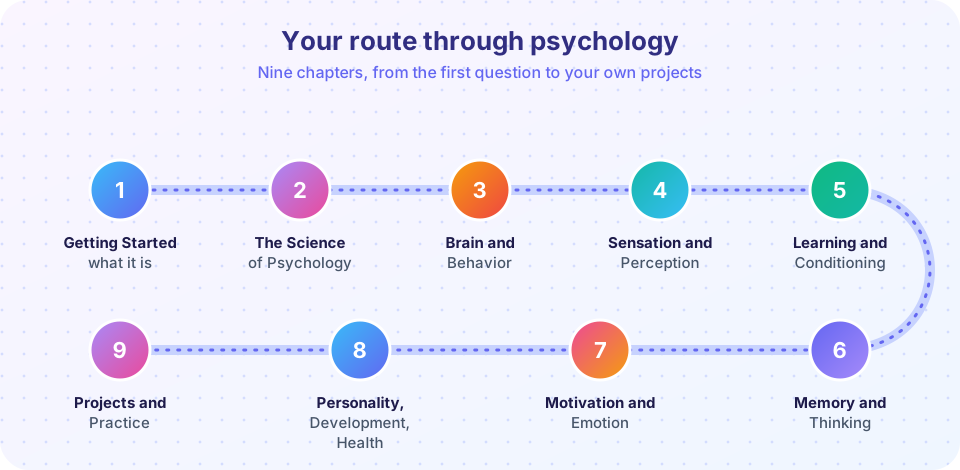
The nine chapters
The nine chapters
- Getting Started
- Science
- Brain
- Senses
Chapters five to eight
- Learning
- Memory
- Motivation
- Person
Chapter nine
- Projects
Where you use everything
Chapters 1 to 4 are the foundations. Chapter 1 defines the field and tours its history and its main ways of thinking. Chapter 2 is the most important of the whole course: it explains how psychologists collect evidence, and without it everything else is just a list of claims. Chapter 3 covers the brain, the hardware behind every thought. Chapter 4 explains how the senses turn physical energy into the experience of a world.
Chapters 5 to 8 apply those foundations to the big topics: how experience changes behavior (learning), how memory and thinking work, why we are driven and feel emotion, and how personality, development and health fit together. Chapter 9 gives you projects and practice questions, plus a glossary and a cheat sheet.
How each lesson is built
Every content lesson has the same shape so you always know where you are:
- What you will learn: three to five goals.
- Key terms: the vocabulary, each defined in one line.
- The lesson: worked examples, named studies and a picture near the top.
- Common misconceptions: wrong ideas people hold, with the correction.
- Try it: interactive demonstrations you can run and change.
- Check your understanding: a short quiz with explanations.
- Summary: the ideas to remember.
Chapter overview lessons give the big picture. Chapter review lessons end each chapter with a recap picture and a longer quiz that mixes everything from the chapter.
How to study psychology (using psychology)
The most useful thing you can do is apply the subject to itself. Decades of memory research suggest four habits.
Test yourself. After reading, close the page and write down what you remember. Recalling something strengthens the memory far more than reading it again. The quizzes are built for this: answer before you look at the explanation.
Space it out. Studying the same total hours spread over several days beats one long session. Hermann Ebbinghaus first mapped how quickly we forget in the 1880s, and later researchers showed that revisiting material just as it starts to fade makes it last. You will build a schedule in the second demonstration below.
Explain it in your own words. If you can teach an idea to a friend without notes, you understand it. If you stumble, you have found exactly what to review.
Be skeptical, kindly. In this course you will meet famous findings and also famous failures to replicate. Ask of each claim: what was measured, in whom, and how sure can we be? That habit is the real prize of the course.
Learning styles are not a shortcut. The idea that you learn best if teaching matches your "visual" or "auditory" style is popular but has weak experimental support (a well-known review by Pashler and colleagues in 2008 found little evidence). Different content suits different formats, for example maps for geography, but "I am a visual learner" is not a good reason to skip the retrieval practice.
Common misconceptions
"Psychology is just common sense." Many findings are surprising, and many things that feel obvious turn out false. Hindsight makes any result look predictable, a bias called hindsight bias. Science exists to check.
"Psychology is only about mental illness." Clinical psychology is one branch. Others study memory, babies, teams, sport, advertising, design, classrooms and the brain.
"One study proves it." A single study is a clue. Confidence comes from many studies by different teams, which is why replication matters (Chapter 2).
Try it
The first demonstration is a myth check. Decide whether each statement is true or false, then see the explanation. It is a demonstration for learning, not a test of anything about you.
The second demonstration builds a spaced-review schedule. Change lessons_per_week or the intervals and re-run.
Press Run (or Ctrl + Enter) to see the result here.
Program input · what you'd type while the program runs
Type the answers before you press Run, one per line. Each time the program reads a line (with input()), it gets the next line from this box.
Check your understanding
Quick check · 4 questions
of 4 answered You scored / 4 · perfect!
-
1. Which study habit is supported by memory research?
Retrieval practice (the testing effect) beats rereading and highlighting in many experiments. -
2. Why is Chapter 2 on research methods placed so early?
Knowing how evidence is gathered lets you judge the strength of every later finding. -
3. Psychology is best described as
Psychology covers behavior and mental processes in health and in illness, with the brain as one level of explanation. -
4. Hindsight bias is the tendency to
After the fact, results look obvious, which is one reason 'it is just common sense' is misleading.
Summary
- The course has nine chapters: foundations (1 to 4), big topics (5 to 8) and projects (9).
- Every lesson follows the same shape, ending in a quiz.
- Use retrieval practice, spacing and self-explanation to study.
- Treat claims about the mind as hypotheses to be tested.
- The course is educational and gives no diagnosis or treatment advice.
Next: What Is Psychology?
Track your progress
Create a free account to tick off lessons and pick up where you left off on any device.
of Introduction to Psychology lessons completed