


















Lesson 15 of 45 · The Brain and Behavior
Chapter 3 Review: The Brain and Behavior
Review chapter 3: neurons and synapses, brain regions, the nervous and endocrine systems, genes and plasticity, with a recap picture, matching game and quiz.
Chapter 3 moved from single cells to whole systems. The key idea running through it is that behavior emerges from many levels working together: signals in neurons, chemistry at synapses, networks across brain regions, hormones in the blood and genes shaped by experience. Use this review to check that you can move between those levels without getting lost.
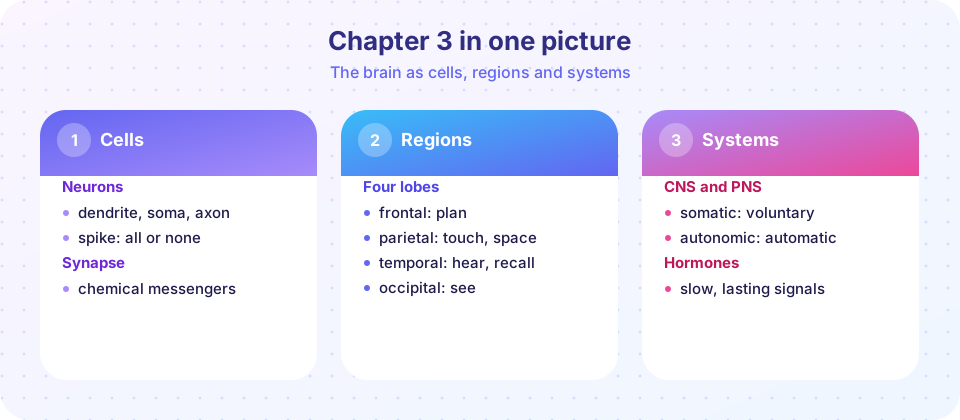
What you will learn
- How the chapter's three levels connect.
- Which terms and examples you should be able to explain.
- Where your understanding needs another look.
Chapter at a glance
| Level | Key ideas | Examples to know |
|---|---|---|
| Cells | Dendrite, axon, myelin, resting potential, threshold, all-or-none, synapse | Dopamine and Parkinson's; GABA inhibits; SSRIs and reuptake |
| Regions | Four lobes, hippocampus, amygdala, cerebellum, brainstem, imaging methods | Broca, Wernicke, Gage, H.M., split-brain |
| Systems | CNS and PNS, sympathetic and parasympathetic, hormones, genes, plasticity | Reflex arc, cortisol, twin studies, critical periods |
How the levels connect: one example
Imagine you hear a loud bang behind you. Within a fraction of a second: sound waves are converted into neural signals; the temporal lobe's auditory cortex and the thalamus relay the information; the amygdala flags a possible threat; the hypothalamus and pituitary trigger the adrenal glands to release adrenaline; the sympathetic nervous system speeds your heart; motor neurons make you jump. Then the prefrontal cortex, a moment later, evaluates the situation and says "just a dropped tray". Every item in that story was in this chapter, and the story only makes sense when they are connected.
Study tips for this chapter
Biological psychology has a lot of vocabulary, so use active methods. Draw a neuron from memory and label it, then draw a synapse and label the vesicles, cleft and receptors. Sketch the brain from the side and color the four lobes with one function each. Make a table of the main neurotransmitters from memory, then check it. Finally, explain to someone else, in plain language, why a stronger stimulus makes a neuron fire faster, not harder. Teaching is one of the best tests of understanding, and the places where you stumble are your next study targets.
Common misconceptions
"One neurotransmitter equals one feeling." Each transmitter takes part in many functions, and each function involves many transmitters.
"Each brain area has a single job." Specializations exist, but behavior comes from networks.
"Genes decide, so training is pointless." Heritability is a statement about variation in populations, and brains and behavior change with experience.
Try it
First, a matching game for neurotransmitters. Choose the best description for each.
Second, trace the path of the "loud bang" story. List the structures in order and the code shows each step, a simple way to rehearse the sequence from memory (cover the right-hand column first).
Press Run (or Ctrl + Enter) to see the console output here.
No output.
Check your understanding
Quick check · 10 questions
of 10 answered You scored / 10 · perfect!
-
1. What happens when a neuron's input stays below threshold?
Action potentials are all-or-none: below threshold, nothing fires. -
2. A signal crosses the gap between two neurons by
Chemical messengers cross the synaptic cleft. -
3. Which brain region is most important for forming new long-term memories of events?
H.M. could not form new event memories after hippocampal removal. -
4. The occipital lobe is best known for
The primary visual cortex is in the occipital lobe. -
5. Which imaging method records electrical activity with millisecond timing?
EEG has excellent timing but limited spatial detail. -
6. The sympathetic nervous system
It produces the fight-or-flight response. -
7. Which is true of hormones compared with neural signals?
Hormones are slower, broader and longer lasting. -
8. Fraternal twins share on average about what portion of their varying genes?
Like ordinary siblings, they share about half; identical twins share essentially all. -
9. The phrase 'left-brained person' is best described as
Brain scan studies do not support stable left- or right-dominant types. -
10. A critical period is
Hubel and Wiesel's work on vision in kittens is a classic example.
Summary
- Neurons fire all-or-none spikes and talk across synapses with neurotransmitters; strength is coded by rate.
- The lobes and deeper structures divide up the work but cooperate in networks.
- The nervous system's branches, the endocrine system and genes work together; heritability is a population statistic.
- The brain is plastic, and experience shapes it throughout life, especially early.
- Scans and case studies are informative but need careful interpretation.
Track your progress
Create a free account to tick off lessons and pick up where you left off on any device.
of Introduction to Psychology lessons completed