


















Lesson 37 of 45 · Personality, Development and Health
Child development: Piaget, Vygotsky, attachment and Erikson
Learn the major theories of development: Piaget's stages, Vygotsky's zone of proximal development, theory of mind, Bowlby and Ainsworth on attachment, Erikson and Kohlberg.
A newborn cannot hold up its own head. Within five years the same child speaks in sentences, tells jokes, understands that other people can believe things that are false, and has favorite people. Developmental psychologists try to describe these changes and explain them: what is inborn, what is learned, which changes happen in steps, and which are gradual?
The theories in this lesson are classics. Each captured something real, and each has been revised by later evidence, so read them as maps with known errors, not as laws.
What you will learn
- Piaget's four stages and the evidence that revised them.
- Vygotsky's zone of proximal development and scaffolding.
- What theory of mind is and how it is tested.
- Attachment: Bowlby, Harlow, Ainsworth and the Strange Situation.
- Erikson's eight psychosocial stages and Kohlberg's levels of moral reasoning.
Key terms
Schema: a mental framework that organizes knowledge; Piaget said children build and revise schemas.
Object permanence: understanding that objects continue to exist when out of sight.
Zone of proximal development (ZPD): the gap between what a learner can do alone and what they can do with help.
Attachment: a lasting emotional bond between a child and a caregiver.
Theory of mind: understanding that others have beliefs, desires and knowledge different from your own.
Piaget: children as little scientists
The Swiss psychologist Jean Piaget watched children closely, including his own, and concluded that they build knowledge actively. They use assimilation (fitting new experience into existing schemas) and accommodation (changing schemas when experience does not fit). His four stages are summarized below.
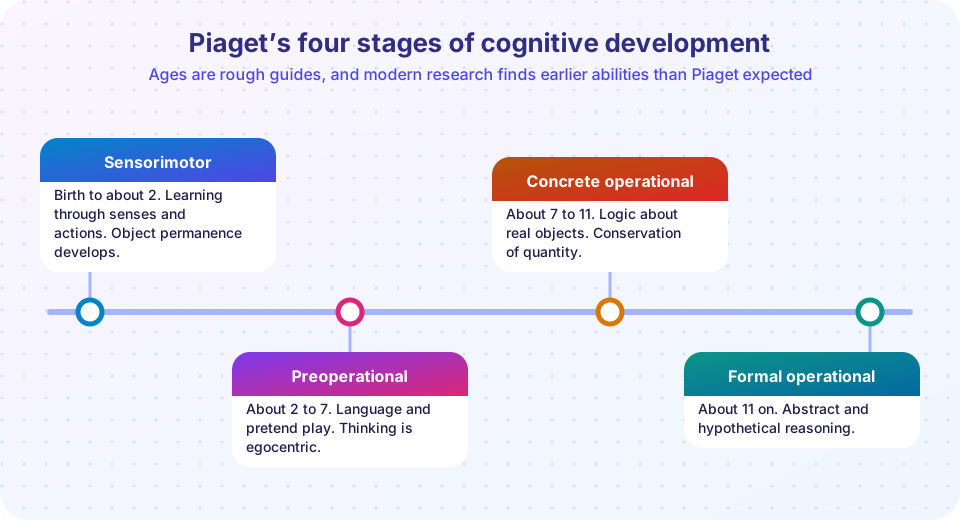
| Stage | Approx. age | Key features | Classic task |
|---|---|---|---|
| Sensorimotor | 0 to 2 | Learning through senses and actions; object permanence | Hiding a toy under a cloth |
| Preoperational | 2 to 7 | Symbols, language, pretend play; egocentrism; lacks conservation | Pouring liquid into a taller glass |
| Concrete operational | 7 to 11 | Logical thinking about real objects; conservation | Sorting by several features |
| Formal operational | 11 and up | Abstract, hypothetical and systematic reasoning | "What if" problems |
In the conservation task, a child sees two identical glasses with equal water. The water from one is poured into a tall, thin glass. A preoperational child often says that the tall glass now holds more. A concrete operational child knows the amount is the same.
What later research changed
- Renée Baillargeon's "violation-of-expectation" studies show that infants as young as about three to five months look longer at events that seem to break physical laws, such as an object appearing to pass through another. Babies may understand more about objects than Piaget's search tasks suggested, because those tasks also require movement planning.
- Preschoolers can pass simplified versions of conservation tasks when the question is worded carefully.
- Adolescents and adults do not always reach formal operations, and culture and schooling affect who does.
- Development is more continuous and varied than strict stages imply.
Piaget's lasting contributions are the idea of the child as an active builder of understanding and a wealth of careful observations.
Vygotsky: learning in a social world
Lev Vygotsky, working in the Soviet Union in the 1920s and 1930s, stressed that thinking develops through social interaction and culture. His central idea is the zone of proximal development: tasks a child cannot yet do alone but can do with help. Teaching works best inside this zone. Scaffolding (a term from later researchers Wood, Bruner and Ross) is the temporary support an adult or peer gives, then gradually withdraws, as when a parent holds a bicycle seat and then lets go. Vygotsky also saw language as a tool for thought: young children often talk to themselves while solving problems, and this "private speech" later becomes inner speech.
Theory of mind
Around age four, children come to understand that people can hold false beliefs. In the Sally–Anne task (Wimmer and Perner, 1983, adapted by Baron-Cohen, Leslie and Frith in 1985), Sally puts a marble in her basket and leaves. Anne moves it to a box. The child is asked where Sally will look when she returns. Three-year-olds usually point to the box (where it really is); most four- and five-year-olds say the basket, because Sally does not know it moved. Passing shows an understanding of mind. Simplified versions, with looking-time measures, suggest some sensitivity to others' beliefs earlier, and the interpretation is debated. Theory of mind differs among children and is studied in relation to autism, where some children find false-belief tasks more difficult. This is general information, not a diagnostic tool.
Attachment
John Bowlby, a British psychiatrist, argued that infants are biologically prepared to form a bond with a caregiver, which provides a "secure base" for exploring. Harry Harlow's 1958 experiments with infant rhesus monkeys, who preferred a soft cloth surrogate to a wire one that provided milk, challenged the idea that attachment forms simply because the caregiver provides food, and showed the importance of contact comfort. The studies caused serious distress to the animals, and are now regarded as ethically troubling.
Mary Ainsworth developed the Strange Situation, a roughly 20-minute laboratory procedure in which a toddler is briefly left with a stranger and then reunited with the caregiver. She identified patterns:
| Pattern | Behavior in the procedure |
|---|---|
| Secure | Uses caregiver as a base; upset at separation; quickly comforted at reunion |
| Insecure-avoidant | Little distress at separation; avoids or ignores the caregiver at reunion |
| Insecure-resistant (ambivalent) | Very distressed; seeks contact at reunion but also resists |
| Disorganized (added later by Main and Solomon) | Confused or contradictory behavior |
Most children in the original studies in the United States were classed as secure. Cultures differ in the proportions, partly because child-rearing practices and what counts as typical behavior differ. Caregiver sensitivity and responsiveness predict security. Temperament (Thomas and Chess), the child's inborn style, also matters, so attachment is not only a matter of parenting. Attachment patterns tend to be moderately stable but can change with life experience. Severe early neglect, as seen in studies of children raised in some institutions, is linked to lasting difficulties, though many show recovery when placed in caring families.
Erikson: eight psychosocial stages
Erik Erikson proposed that life is a series of crises in which a person must balance two tendencies.
| Age (approx.) | Challenge | Healthy outcome |
|---|---|---|
| Infancy | Trust vs. mistrust | Hope: trusting the world is reliable |
| Toddler | Autonomy vs. shame and doubt | Will: a sense of independence |
| Preschool | Initiative vs. guilt | Purpose: planning and starting activities |
| School age | Industry vs. inferiority | Competence: mastery of skills |
| Adolescence | Identity vs. role confusion | Fidelity: a sense of who I am |
| Young adulthood | Intimacy vs. isolation | Love: close relationships |
| Middle adulthood | Generativity vs. stagnation | Care: contributing to the next generation |
| Late adulthood | Integrity vs. despair | Wisdom: accepting one's life |
Erikson's ideas are rich and widely used, but they are descriptive and hard to test. Research supports the importance of identity formation in adolescence (James Marcia developed a way to study identity statuses) and the idea that people grow in concern for others in midlife. The order and timing vary across people and cultures.
Moral development
Lawrence Kohlberg presented moral dilemmas, such as a man who steals a drug to save his wife, and classified the reasoning people gave. He proposed three levels: preconventional (avoiding punishment, gaining reward), conventional (following rules and social expectations) and postconventional (principles of justice and rights). Carol Gilligan criticized the approach for giving less weight to caring and relationships, and later research found that cultures differ in their moral priorities. Reasoning and behavior are also not the same: people who can argue at a high level sometimes act otherwise.
Adolescence and later life
Adolescence brings puberty, rapid brain changes and growing independence. It is often said that the prefrontal cortex finishes maturing in the mid-twenties; this is a rough simplification, since different brain systems mature at different rates. Across adulthood, fluid intelligence (solving novel problems) declines slowly from early adulthood, while crystallized intelligence (knowledge and vocabulary) holds steady or grows into later life. Many older adults report higher emotional well-being than younger adults.
Common misconceptions
"Children go through stages like climbing stairs." Development is often gradual and uneven, and a child can show different levels on different tasks.
"Attachment style is fixed in infancy." Patterns have moderate stability and can change with relationships and experiences.
"The first three years decide everything." Early experience matters, but later experiences and supportive relationships also shape outcomes.
Try it
Press Run (or Ctrl + Enter) to see the result here.
Program input · what you'd type while the program runs
Type the answers before you press Run, one per line. Each time the program reads a line (with input()), it gets the next line from this box.
Check your understanding
Quick check · 5 questions
of 5 answered You scored / 5 · perfect!
-
1. A child who thinks a tall thin glass holds more water than a short wide glass after pouring lacks:
Conservation is the understanding that quantity stays the same despite changes in appearance. -
2. Vygotsky's zone of proximal development is:
Teaching is most effective just beyond current ability with support. -
3. In the Sally-Anne task, a child who says Sally will look in the basket shows:
Passing means the child understands that Sally's belief differs from reality. -
4. In the Strange Situation, which behavior is typical of secure attachment?
Secure infants use the caregiver as a base and are soothed when they return. -
5. Which of Erikson's challenges is most associated with adolescence?
Adolescents explore who they are and what they value.
Summary
- Piaget described four stages of thinking; later research found earlier and more variable abilities but kept his view of the active learner.
- Vygotsky stressed social interaction, the zone of proximal development and scaffolding.
- Theory of mind and attachment show how thinking and relationships develop; temperament and context also matter.
- Erikson and Kohlberg offer maps of identity and moral growth, with cultural and individual variation.
Next: Stress and health
Track your progress
Create a free account to tick off lessons and pick up where you left off on any device.
of Introduction to Psychology lessons completed