


















Lesson 25 of 45 · Learning and Conditioning
Chapter 5 review: learning and conditioning
Review classical conditioning, operant conditioning and observational learning with a one-page picture, a comparison table and a ten-question quiz.
This review pulls the chapter into one page. Read the picture first, scan the table, then test yourself. If a term feels shaky, jump back to the lesson linked beside it.
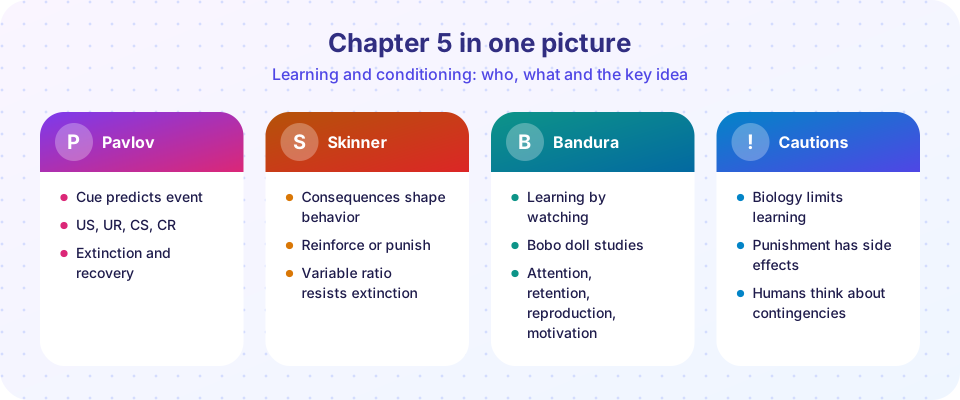
Recap table
| Type of learning | What is linked | Key people | Core idea | Lesson |
|---|---|---|---|---|
| Habituation and sensitization | One stimulus and your response | Kandel (sea slug studies) | Responses shrink or grow with repeated exposure | Overview |
| Classical conditioning | Two stimuli | Pavlov, Watson, Garcia, Rescorla | A cue that predicts an event comes to trigger a response | Classical |
| Operant conditioning | Behavior and consequence | Thorndike, Skinner | Reinforcement raises and punishment lowers behavior | Operant |
| Observational learning | Model and observer | Bandura | We learn by watching, depending on attention, retention, reproduction, motivation | Observational |
| Cognitive learning | Knowledge and expectation | Tolman, Köhler, Seligman | Learners build maps, gain insight, and form expectations about control | Observational |
Three ideas that unify the chapter
- Prediction drives learning. Rescorla and Wagner showed that cues are learned when they tell you something new, and the same logic of surprise runs through reinforcement and modern machine learning.
- Biology sets limits. Taste aversion and the Brelands' raccoons show that not everything can be linked equally easily.
- Learning is not performance. Bandura and Tolman showed that people and animals can know more than they show.
Where to be careful
- Case studies like Little Albert are small and ethically troubling; use them for the idea, not as proof.
- Many classic findings were in animals or in artificial labs; real life is messier.
- Evidence on punishment and media violence is largely correlational and debated, so state it cautiously.
Explain it in your own words
Write two or three sentences for each prompt, without looking back. Then check against the lessons.
- Why does a cue that is paired with food often still fail to produce learning? (Think about blocking and contingency.)
- A video game gives random loot after a variable number of plays. Which schedule is this, and why is it so hard to stop playing?
- What is the difference between what Bandura's children learned and what they performed?
- Give one example from your own life of habituation and one of latent learning.
- Why should you describe the Little Albert study as an illustration and not as proof?
If you can answer these in plain language, you understand the chapter, not just the vocabulary.
Try it
Press Run (or Ctrl + Enter) to see the result here.
Program input · what you'd type while the program runs
Type the answers before you press Run, one per line. Each time the program reads a line (with input()), it gets the next line from this box.
Check your understanding
Quick check · 10 questions
of 10 answered You scored / 10 · perfect!
-
1. A dog whines when it hears the leash jingle, because walks follow the jingle. The leash jingle is the:
The jingle began as neutral and now predicts the walk, so it is a conditioned stimulus. -
2. A parent stops nagging when a child cleans a room, and the child cleans more often. This is:
Removing an unpleasant event (nagging) increased the behavior. -
3. Which schedule is most resistant to extinction?
Variable-ratio schedules keep responding high and are slow to extinguish. -
4. Blocking in classical conditioning shows that:
If a cue already predicts the US, a second cue adds nothing new and is learned little. -
5. What does Bandura's work add to conditioning?
Observational learning is influenced by cognitive steps and does not require direct reward. -
6. Tolman's rats that suddenly improved once rewarded demonstrate:
They learned the maze earlier but did not show it until there was a reason. -
7. Which finding supports biological preparedness?
Taste aversion forms after a single pairing, showing some links are easier. -
8. Why is the evidence on spanking and media violence described cautiously?
Correlational designs cannot prove cause, and methods and effect sizes are debated. -
9. Which pairing is correct?
Bandura studied observational learning; Pavlov studied salivation conditioning; Skinner built operant chambers; Thorndike studied puzzle boxes. -
10. In the Rescorla-Wagner model, learning shrinks as:
The update depends on the difference between the outcome and the prediction, so it fades as prediction improves.
Summary
- Classical conditioning links stimuli, operant conditioning links behavior with consequences, observational learning links models and observers.
- Prediction and surprise run through all of them.
- Biology limits what is easy to learn, and learning is not the same as performance.
- Be cautious about small, correlational and ethically problematic studies.
Track your progress
Create a free account to tick off lessons and pick up where you left off on any device.
of Introduction to Psychology lessons completed