


















Lesson 42 of 45 · Projects and Practice
Practice set: apply the ideas from chapters 5 to 8
Twelve scenario questions on learning, memory, motivation, emotion, personality, development and health, with worked answers and a study-design critique exercise.
You learn psychology best by applying it. Exams and real life both ask you to look at a scenario and say what is going on. This lesson gives you twelve short scenarios, then a design-critique exercise and an interactive sorter. Try each one on your own before reading the answer.
What you will learn
- How to identify the concept at work in a short real-world scenario.
- How to justify an answer in two sentences using the right terms.
- How to critique a simple study design.
- How to spot common errors, such as confusing negative reinforcement with punishment.
Key terms
Scenario question: a short story where you name the concept and explain your choice.
Operational definition: a precise description of how a variable is measured.
Confound: an uncontrolled variable that offers an alternative explanation for a result.
Random assignment: using chance to place participants in conditions.
How to answer a scenario
- Underline what happens first and what follows.
- Ask: is it two stimuli (classical), a behavior and consequence (operant), watching a model (observational), a memory process, an emotion theory, a trait, a developmental stage or a coping style?
- Name the concept.
- Justify it in one sentence using the definition.
Twelve scenarios
1. Every time Maya hears the dentist's drill, her shoulders tense. She had a painful filling last year.
2. A toddler says "please" and gets a cookie. She starts saying "please" much more often.
3. A teenager sees an older cousin ace a driving test after practicing in an empty parking lot, and decides to practice there too.
4. After studying a list of 20 chores, you remember the first three and the last two best.
5. A student uses flashcards to quiz herself instead of rereading notes, and does better on a test a week later.
6. A manager sets a goal: "Answer all customer emails within 4 hours," and posts the weekly results.
7. A friend's heart is pounding on stage. She tells herself, "This energy is helping me focus," and feels calmer.
8. A questionnaire gives the same person very different scores each week, although nothing in their life changed.
9. A one-year-old crawls to the spot where a toy vanished under a cushion; when it disappears again, she searches in the same spot even after seeing it hidden somewhere else.
10. A person at a new job feels overwhelmed and writes a list of tasks ranked by urgency.
11. A student expects an upcoming exam to be a threat and avoids opening the textbook.
12. A vague horoscope fits you perfectly, as do your friends'.
Worked answers
- Classical conditioning. The drill is the conditioned stimulus (it predicts pain); tensing is the conditioned response.
- Positive reinforcement. A pleasant consequence (cookie) was added and the behavior increased.
- Observational learning, with motivation (seeing success) and attention. Bandura's conditions apply.
- Serial position effect: primacy (first items, more rehearsal) and recency (last items still in working memory).
- Retrieval practice (the testing effect), supported by Roediger and Karpicke.
- Goal-setting theory. The goal is specific, has a time limit and includes feedback.
- Reappraisal of arousal, an emotion-regulation strategy (Gross), related to challenge appraisal (Lazarus).
- Low reliability. The test is not consistent over time.
- A-not-B error, linked to Piaget's sensorimotor stage and object permanence. Later research debates its cause, including memory and motor inhibition.
- Problem-focused coping (planning, prioritizing).
- Threat appraisal with avoidance coping. Avoidance may reduce anxiety briefly but tends to raise stress later.
- Barnum (Forer) effect: vague statements feel personally accurate.
Critique a study design
Read this plan and find the flaws.
A teacher wants to know whether background music improves homework quality. She gives music to her morning class and no music to her afternoon class for a week, then compares marks on one worksheet. She tells the students her hypothesis.
Problems you should spot:
- Confounds. Morning and afternoon classes may differ in energy, age or ability. Assign conditions randomly, or have each class do both conditions in counterbalanced order.
- Single measure. One worksheet is a weak measure. Use several tasks.
- Demand characteristics. Telling students the hypothesis may change how hard they try. Use a neutral description.
- Operational definition. "Quality" is vague. Define it, such as the number of correct answers or a scoring rubric used by a rater who does not know the condition (blind scoring).
- Small, single-group sample. Say so and avoid broad claims.
Press Run (or Ctrl + Enter) to see the result here.
Program input · what you'd type while the program runs
Type the answers before you press Run, one per line. Each time the program reads a line (with input()), it gets the next line from this box.
Common misconceptions
"If I name the term, I am done." Exams reward the justification: link the scenario to the definition.
"Negative reinforcement is a punishment." It increases behavior by removing something unpleasant.
"Any quiz result diagnoses a condition." Questionnaires in a course are demonstrations only.
Check your understanding
Quick check · 5 questions
of 5 answered You scored / 5 · perfect!
-
1. A student stops nagging when her brother cleans his room, and he cleans more often. Which concept applies?
Removing something unpleasant (nagging) increased the behavior. -
2. A teacher compares her morning and afternoon classes in a music experiment. What is the main problem?
The groups differ in more than music, so results cannot be attributed to music alone. -
3. Why might blind scoring help?
Scorers who do not know the condition cannot unconsciously favor one. -
4. Which is the strongest justification for 'observational learning'?
The key feature is learning from watching a model. -
5. A search error in the A-not-B task is linked to:
Infants search where they last found the object, a classic Piagetian task.
Summary
- Scenario questions ask you to name the concept and justify it with its definition.
- Look for what comes first, what follows and who is learning from whom.
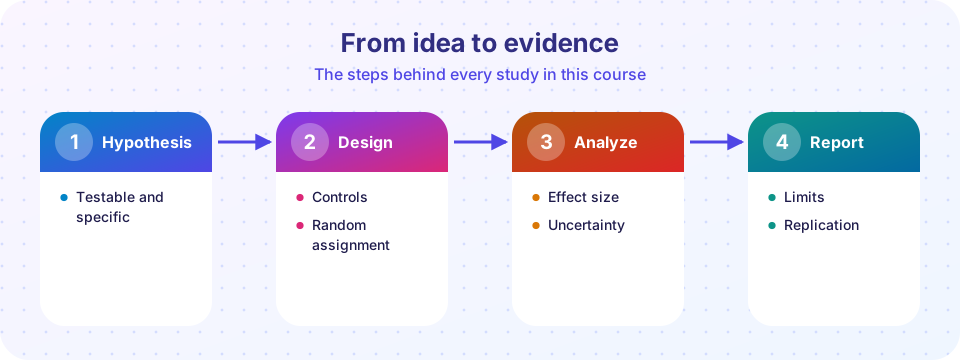
- Study-design critiques check for confounds, random assignment, clear measures, blinding and ethics.
- Practice with the sorter and the checklist until the terms feel automatic.
Next: Glossary of key terms
Track your progress
Create a free account to tick off lessons and pick up where you left off on any device.
of Introduction to Psychology lessons completed