


















Lesson 2 of 49 · Getting Started
What physical chemistry studies
Learn what physical chemistry is, how it links molecules to bulk matter, and how thermodynamics, kinetics and quantum theory answer different questions.
A chemist can describe a reaction in one line: reactants go in, products come out. A physical chemist asks what that line leaves out. How much heat is released? Is the reaction reversible? How long will it take at 40 °C compared with 20 °C? What do the molecules look like, and how can light tell us?
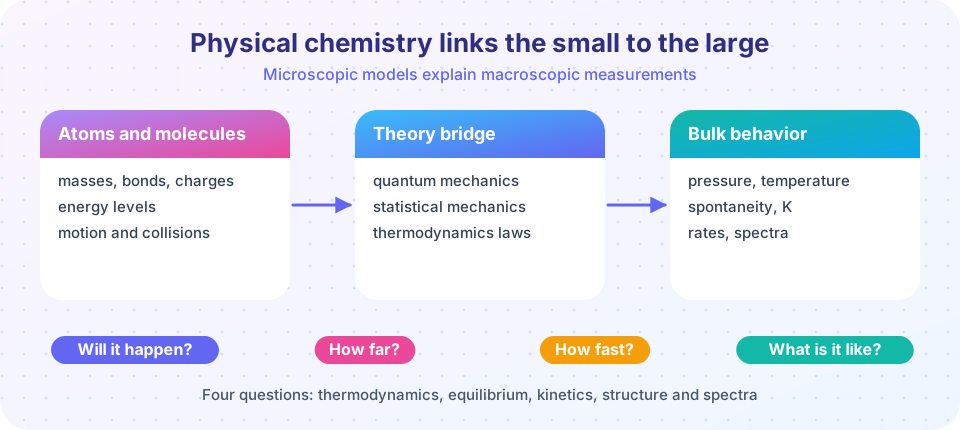
Physical chemistry is the part of chemistry that uses the methods of physics, mathematics and measurement to answer those questions. It is the bridge between the properties of individual atoms and molecules and the properties of the samples we hold in our hands.
What you will learn
- The scope of physical chemistry and its main branches.
- The difference between the microscopic and macroscopic descriptions.
- Which branch answers which question.
- What makes a good model, with the ideal gas as an example.
Key terms
Macroscopic: described by quantities we can measure on a whole sample: pressure, volume, temperature, composition.
Microscopic: described by the behavior of individual atoms and molecules: positions, speeds, energy levels.
Thermodynamics: the theory of energy, heat, work and the direction of change, built from a few laws and independent of molecular detail.
Kinetics: the study of reaction rates and the steps by which reactions occur.
Statistical mechanics: the theory that derives bulk properties from the behavior of enormous numbers of molecules.
Two ways of looking at the same thing
Take one liter of air in a closed flask. The macroscopic description needs only a handful of numbers: say 1.0 bar, 298 K, 1.0 L. These are enough to predict what happens when you compress it or warm it.
The microscopic description is of a different size entirely. The flask holds about 2.5 x 10²² molecules, each moving at hundreds of meters per second and colliding billions of times a second. Nobody tracks them individually. Yet the average behavior of those molecules produces the pressure and temperature you read on gauges.
Physical chemistry works in both directions:
- Thermodynamics starts from measurable quantities and derives relations that hold for every substance, without knowing any molecular detail.
- Quantum chemistry and spectroscopy determine molecular structure and energy levels.
- Statistical thermodynamics connects the two, computing thermodynamic quantities from molecular energy levels.
- Kinetics adds time: how quickly a system approaches equilibrium.
A short history
The field took shape in the second half of the nineteenth century. Clausius, Maxwell and Boltzmann explained gas behavior with molecules in motion. Gibbs developed the mathematical foundations of chemical thermodynamics and the phase rule. Van 't Hoff, Arrhenius and Ostwald showed that reaction rates, equilibria and solution behavior could be described quantitatively; Ostwald and van 't Hoff founded the first journal devoted to the subject in 1887. In the twentieth century quantum mechanics (Planck, Bohr, Schrödinger, Heisenberg) gave a theory of atoms and bonds, and spectroscopy turned light into a molecular microscope.
Which branch answers which question
| Question | Branch | Key quantities |
|---|---|---|
| Will it happen? | Thermodynamics | ΔG, ΔH, ΔS |
| How far will it go? | Equilibrium | K, Q, activity |
| How fast? | Kinetics | rate constant k, activation energy Ea |
| What does it look like? | Quantum chemistry, spectroscopy | energy levels, wave functions, spectra |
| Why those numbers? | Statistical thermodynamics | partition function q |
A single chemical question often needs several. Making ammonia from nitrogen and hydrogen is a good example. Thermodynamics says the reaction is favorable at low temperature but gives a poor yield at high temperature. Kinetics says it is hopelessly slow at low temperature without a catalyst. The industrial process is a compromise between the two, which you will recognise when we study equilibrium and rates.
Models: wrong on purpose
The physical chemist's main tool is the model. A model is a simplified picture whose consequences you can calculate. The ideal gas assumes molecules are points that never attract each other. No real gas fits that picture, yet the resulting law PV = nRT predicts pressures of air at room conditions to within a fraction of a percent.
Models are used in a cycle:
- Build a simple model and calculate its predictions.
- Compare with measurements.
- Where they disagree, ask which assumption failed.
- Improve the model (give molecules a size and an attraction and you get the van der Waals gas).
This is why we study the failures of the ideal gas just as carefully as its successes.
Worked example: how many molecules in a breath?
A breath of about 0.5 L at 37 °C (310 K) and 1.01 bar. How many molecules?
- Convert volume: 0.5 L = 5.0 x 10⁻⁴ m³; pressure: 1.01 bar = 1.01 x 10⁵ Pa.
- Moles:
n = PV/RT = (1.01e5 x 5.0e-4) / (8.3145 x 310) = 0.0196 mol. - Molecules:
N = n x NA = 0.0196 x 6.022e23 = 1.18e22.
Around 10²² molecules in one breath, which shows why only averages make sense.
Common misconceptions
"Thermodynamics says how fast a reaction goes." It says nothing about time. A favorable ΔG does not guarantee a quick reaction.
"Macroscopic laws are only approximations of molecular laws." Thermodynamic laws are exact consequences of very general principles, valid even when we know nothing about molecules.
"A model that fails is bad science." A failing model is the start of a better one.
Try it
Compare the number of molecules in different samples. Change the values and see how large the numbers stay.
Press Run (or Ctrl + Enter) to see the result here.
Program input · what you'd type while the program runs
Type the answers before you press Run, one per line. Each time the program reads a line (with input()), it gets the next line from this box.
The second block shows how different branches predict different pieces of the picture. The numbers are schematic: it plots how a quantity might respond to temperature to show the shape each branch cares about.
Press Run (or Ctrl + Enter) to see the result here.
Program input · what you'd type while the program runs
Type the answers before you press Run, one per line. Each time the program reads a line (with input()), it gets the next line from this box.
Check your understanding
Quick check · 5 questions
of 5 answered You scored / 5 · perfect!
-
1. Which branch connects molecular energy levels to bulk thermodynamic properties?
Statistical thermodynamics computes bulk quantities from molecular energy levels using the partition function. -
2. A reaction has a very negative ΔG but takes years at room temperature. What explains this?
ΔG says nothing about speed. Kinetic barriers control how fast a spontaneous change proceeds. -
3. Why is the ideal gas model still taught?
The model is useful because it is simple and because understanding its failures leads to improved models like van der Waals. -
4. Roughly how many molecules are in 1 L of air at room conditions?
n is about 0.04 mol, so N = 0.04 x 6.02e23, about 2.5e22. -
5. A quantity measured on a whole sample (pressure, temperature) is called
Macroscopic properties describe whole samples; microscopic ones describe individual molecules.
Summary
- Physical chemistry applies physics and mathematics to chemical systems, linking molecular and bulk properties.
- Thermodynamics says what is possible and how far; kinetics says how fast; quantum chemistry and spectroscopy describe molecules; statistical mechanics links them.
- Real problems need several branches together, as ammonia synthesis shows.
- Models are simplified on purpose; their failures drive improvement.
- Molecular counts are huge (about 10²² in a breath), which is why averages work.
Next: Units and constants
Track your progress
Create a free account to tick off lessons and pick up where you left off on any device.
of Physical Chemistry lessons completed