


















Lesson 41 of 49 · Statistical Thermodynamics and Surfaces
The Partition Function and Thermodynamic Properties
Learn the molecular partition function, how Q gives U, S, A and p, the translational, rotational and vibrational contributions, equipartition, heat capacity and the Sackur-Tetrode entropy.
If statistical thermodynamics has a master tool, it is the partition function. It is a sum over all energy levels of a molecule, each weighted by its Boltzmann factor, and it counts how many states are thermally accessible at a given temperature. At absolute zero only the ground state counts and q = 1. At high temperature, many states count and q is large. Once you know q (or its relative Q for a whole system), every thermodynamic property follows by differentiation.
This lesson defines q, derives the formulas for each type of motion, and uses them to compute an entropy from molecular constants.
What you will learn
- Define q and Q and use them to obtain U, S and A
- Write q for translation, rotation and vibration
- Explain equipartition and why heat capacity depends on temperature
- Calculate the Sackur-Tetrode entropy of a monatomic gas
Key terms
Molecular partition function: q = Σ gᵢ e^(−εᵢ/kT), a sum over the energy levels of one molecule.
Canonical partition function (Q): the same sum over the states of a whole system; for N independent identical molecules Q = qᴺ/N!.
Characteristic temperature (θ): the temperature at which kT equals the level spacing of a motion: θ_rot = hcB/k, θ_vib = hcν̃/k.
Thermal wavelength (Λ): Λ = h/√(2πmkT), roughly the de Broglie wavelength of a molecule with thermal energy.
From Q to thermodynamics
Let β = 1/kT. For a system at fixed N, V, T:
U = −(∂ ln Q/∂β)_V, S = U/T + k ln Q, A = −kT ln Q, p = kT (∂ ln Q/∂V)_T
Enthalpy, Gibbs energy and the heat capacity follow (H = U + pV, G = A + pV, C_V = (∂U/∂T)_V). For N independent, indistinguishable molecules the system partition function factorizes: Q = qᴺ/N!. The division by N! prevents overcounting identical particles; without it the entropy of a gas would not be extensive.
Because energies of different kinds of motion add, ε = ε_trans + ε_rot + ε_vib + ε_elec, the sum factorizes too:
q = q_trans · q_rot · q_vib · q_elec
and the contributions to ln Q, and hence to U, S and A, simply add up. This is why each motion can be treated separately.
Translation
For a particle in a three-dimensional box of volume V (Chapter 6),
q_trans = V / Λ³, Λ = h / √(2πmkT)
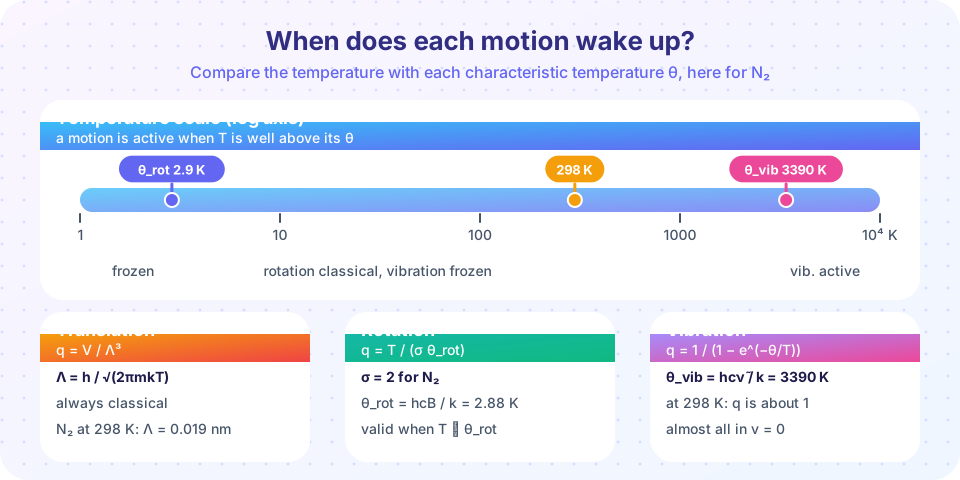
For N₂ at 298.15 K, m = 4.652 × 10⁻²⁶ kg and Λ = 1.91 × 10⁻¹¹ m = 0.019 nm. Since V/Λ³ is huge (at 1 bar a molecule has about 4 × 10⁻²⁶ m³ to itself, divided by a Λ³ of 7 × 10⁻³³ m³, giving roughly 6 × 10⁶ states per molecule), translation is always effectively classical, and the average translational energy is 3/2 kT per molecule. Q grows with V and mass and temperature, which produces the pressure p = NkT/V of an ideal gas and its famous equation of state.
Rotation
For a linear molecule, with θ_rot = hcB/k:
q_rot = T / (σ θ_rot) (valid when T ≫ θ_rot)
σ is the symmetry number: 1 for a heteronuclear diatomic such as CO, 2 for a homonuclear one such as N₂. It corrects for the fact that rotating N₂ by 180° gives an indistinguishable arrangement, halving the number of distinct states. For N₂, θ_rot = 2.88 K, so at 298 K q_rot = 298.15 / (2 × 2.88) ≈ 52: about 52 rotational states are thermally accessible. The rotational energy is kT per molecule (two quadratic terms).
Vibration
The harmonic oscillator has equally spaced levels, so the sum is a geometric series. Measuring energies from the ground state,
q_vib = 1 / (1 − e^(−θ_vib/T)), θ_vib = hcν̃/k
For N₂ with ν̃ = 2359 cm⁻¹, θ_vib = 3390 K, and at 298 K q_vib = 1.00001: all molecules sit in v = 0. The vibrational heat capacity is
C_V,vib / R = (θ/T)² e^(θ/T) / (e^(θ/T) − 1)²
which is nearly 0 for T ≪ θ and approaches R (the classical equipartition value) for T ≫ θ. At T = θ it already reaches 0.92 R.
Equipartition and heat capacity
Classically, each quadratic term in the energy contributes ½kT per molecule once it is thermally active. For a diatomic gas at room temperature: 3 translational + 2 rotational terms give U_m = 5/2 RT and C_V,m = 5/2 R, as measured. Vibration, with its large θ, adds nothing until a few thousand kelvin. As the temperature rises, the heat capacity steps up in stages: that is the experimental fingerprint of quantization. Hydrogen's heat capacity even falls toward 3/2 R at very low temperature, where rotation freezes out.
Entropy of a monatomic gas: Sackur–Tetrode
Putting Q = (V/Λ³)ᴺ/N! into S = U/T + k ln Q and using Stirling's approximation gives
S = Nk [ ln( V / (NΛ³) ) + 5/2 ]
or for the molar entropy at pressure p, S_m = R [ ln( kT / (pΛ³) ) + 5/2 ]. This is one of the great results of the theory: the entropy of an atomic gas, calculated from nothing but its mass, temperature and pressure, agrees with calorimetric measurements. The calculation for argon at 298.15 K and 1 bar gives about 154.8 J K⁻¹ mol⁻¹, the measured value. Note that the entropy grows with ln m and ln T, and falls with pressure as −R ln p.
Common misconceptions
"The partition function is a probability." It is a normalizing sum; it is large (not ≤ 1) when many states are accessible.
"Vibrations always contribute RT to the energy." Only when T ≫ θ_vib; at room temperature the contribution is tiny.
"Dividing by N! is a mathematical trick." It reflects a physical fact: identical molecules cannot be told apart, so permuting them does not create new states.
Try it
First, the Sackur–Tetrode entropy for the noble gases at 298.15 K and 1 bar. The standard molar entropies from calorimetry are tabulated next to the calculated values for comparison.
Press Run (or Ctrl + Enter) to see the result here.
Program input · what you'd type while the program runs
Type the answers before you press Run, one per line. Each time the program reads a line (with input()), it gets the next line from this box.
Second, the heat capacity of nitrogen as the temperature rises, built from the partition-function results (translation 3/2 R, rotation R once T is well above θ_rot, and the vibrational Einstein term). The plot shows rotation fully active from low temperatures, with vibration switching on above about 1000 K.
Press Run (or Ctrl + Enter) to see the result here.
Program input · what you'd type while the program runs
Type the answers before you press Run, one per line. Each time the program reads a line (with input()), it gets the next line from this box.
Check your understanding
Quick check · 5 questions
of 5 answered You scored / 5 · perfect!
-
1. For a heteronuclear diatomic molecule at high temperature, q_rot is
σ = 1 for heteronuclear molecules. -
2. Why does q_vib ≈ 1 for N₂ at room temperature?
The geometric series terms e^(−θ/T) are negligible. -
3. The molar heat capacity C_V,m of a diatomic gas at room temperature is closest to
Translation (3/2 R) plus rotation (R); vibration is frozen. -
4. The Sackur–Tetrode entropy of a monatomic gas at fixed T and p increases when
S depends on ln(kT/pΛ³) and Λ falls with mass, so S rises with mass. -
5. In Q = qᴺ/N!, the N! accounts for
Permuting identical molecules gives the same state.
Summary
q = Σ gᵢ e^(−εᵢ/kT); for independent moleculesQ = qᴺ/N!;U,S,A,pfollow from ln Q.q_trans = V/Λ³,q_rot = T/(σθ_rot),q_vib = 1/(1 − e^(−θ/T)); each contribution adds to the thermodynamic functions.- Equipartition works when T ≫ θ; the staged rise in heat capacity shows quantization.
- The Sackur–Tetrode equation gives absolute entropies of monatomic gases.
Next: Surfaces and adsorption
Track your progress
Create a free account to tick off lessons and pick up where you left off on any device.
of Physical Chemistry lessons completed