


















Lesson 28 of 49 · Chemical Kinetics
Chapter 5 Review: Chemical Kinetics
Review chemical kinetics in one page: rate laws, integrated laws, half-lives, the Arrhenius equation, mechanisms and catalysis, plus a ten-question mixed quiz.
You have now covered the main toolkit of kinetics. This review ties the four lessons into one picture and gives you a mixed quiz that resembles an exam.
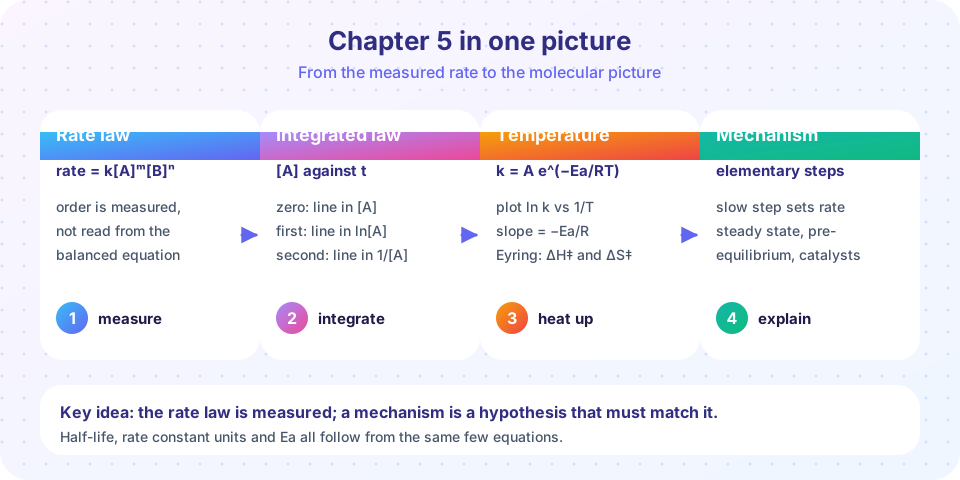
Recap table
| Topic | Key equations | Remember |
|---|---|---|
| Rate law | rate = k[A]ᵐ[B]ⁿ |
orders come from experiment |
| Zero order | [A] = [A]₀ − kt; t½ = [A]₀/2k |
straight line in [A] |
| First order | ln[A] = ln[A]₀ − kt; t½ = ln 2/k |
constant half-life |
| Second order | 1/[A] = 1/[A]₀ + kt; t½ = 1/k[A]₀ |
half-life grows |
| Arrhenius | ln k = ln A − Ea/RT |
slope of ln k vs 1/T is −Ea/R |
| Eyring | k = (kBT/h) e^(ΔS‡/R) e^(−ΔH‡/RT) |
ΔG‡ of 5.7 kJ/mol is a factor of 10 |
| Steady state | d[I]/dt = 0 |
gives the rate law with no slow step |
| Michaelis-Menten | v = V_max[S]/(K_M + [S]) |
v = V_max/2 at [S] = K_M |
How experts reason
When confronted with new kinetic data, a physical chemist asks three questions in order. First, what is the order in each reactant? Initial rates or linear plots answer this. Second, how does k vary with temperature? That gives Ea, A or ΔH‡ and ΔS‡. Third, what mechanism reproduces both? A tiny or negative A hints at an ordered transition state. A negative Ea hints at a pre-equilibrium step. A fractional order hints at a chain or radical mechanism.
Try it
Use the calculator below to check half-life and fraction-remaining answers while you work through the quiz. It is a calculator that applies the first-order equations, nothing more.
Press Run (or Ctrl + Enter) to see the result here.
Program input · what you'd type while the program runs
Type the answers before you press Run, one per line. Each time the program reads a line (with input()), it gets the next line from this box.
Check your understanding
Quick check · 10 questions
of 10 answered You scored / 10 · perfect!
-
1. For a reaction with rate = k[A][B]², what are the units of k?
Third order overall: k = (M s⁻¹)/M³ = M⁻² s⁻¹. -
2. A first-order reaction is 75 % complete after 40 min. What is its half-life?
75 % complete leaves 25 % = (1/2)², two half-lives in 40 min, so 20 min. -
3. Successive half-lives of a reaction are 10 s, 20 s, 40 s. The order is
Doubling half-lives is the signature of second order. -
4. Which plot is linear for a first-order reaction?
ln[A] = ln[A]₀ − kt. -
5. An Arrhenius plot has a slope of −6000 K. What is Ea?
Ea = −slope × R = 6000 × 8.314 = 49,900 J/mol. -
6. Which statement about a catalyst is correct?
Equal speed-up of both directions leaves K unchanged. -
7. A mechanism has a fast equilibrium step followed by a slow step. Which approximation gives the rate law?
The intermediate's concentration is fixed by the equilibrium constant of the fast step. -
8. Doubling the absolute temperature (300 K to 600 K) doubles the rate constant:
The factor is exp[(Ea/R)(1/T₁ − 1/T₂)], which depends on Ea. -
9. In Michaelis-Menten kinetics, a very large [S] gives
The enzyme is saturated, so the rate levels off at V_max. -
10. Which is an intermediate in the mechanism NO₂ + F₂ → NO₂F + F; NO₂ + F → NO₂F?
F atoms are formed in step 1 and consumed in step 2, and are absent from the overall equation.
Summary
- Rate laws are measured; integrated laws and half-lives reveal the order.
ln kagainst1/Tgives Ea; Eyring links rates to ΔH‡ and ΔS‡.- Mechanisms are tested by the rate laws they predict; catalysts change the route, not the equilibrium.
Track your progress
Create a free account to tick off lessons and pick up where you left off on any device.
of Physical Chemistry lessons completed