


















Lesson 32 of 49 · Quantum Chemistry
The Hydrogen Atom and Atomic Orbitals
Learn the exact quantum solution for hydrogen: energy levels, spectral series, quantum numbers, orbital shapes, nodes and radial distributions, and how many-electron atoms differ.
Hydrogen is the one atom for which the Schrödinger equation can be solved exactly: a single electron moving in the Coulomb attraction of a single proton. The solution is not just a textbook exercise. It explains the colored lines in hydrogen's emission spectrum, provides the shapes (s, p, d, f) from which every chemist's picture of atoms and bonds is built, and acts as the template for approximate treatments of heavier atoms.
What you will learn
- Write the hydrogen energy levels and compute spectral line wavelengths
- Name the quantum numbers n, l, m_l and m_s and their allowed values
- Count radial and angular nodes and sketch s, p and d orbitals
- Explain why orbital energies in many-electron atoms depend on l
Key terms
Orbital: a one-electron wavefunction, specified by n, l and m_l.
Quantum numbers: n (shell, size and energy), l (shape, 0 … n−1), m_l (orientation, −l … +l), m_s (spin, ±½).
Bohr radius (a₀): a₀ = 52.918 pm, the most probable distance in the 1s orbital.
Effective nuclear charge (Z_eff): the nuclear attraction felt by an electron after shielding by other electrons.
Energy levels
Solving the Schrödinger equation in spherical coordinates gives
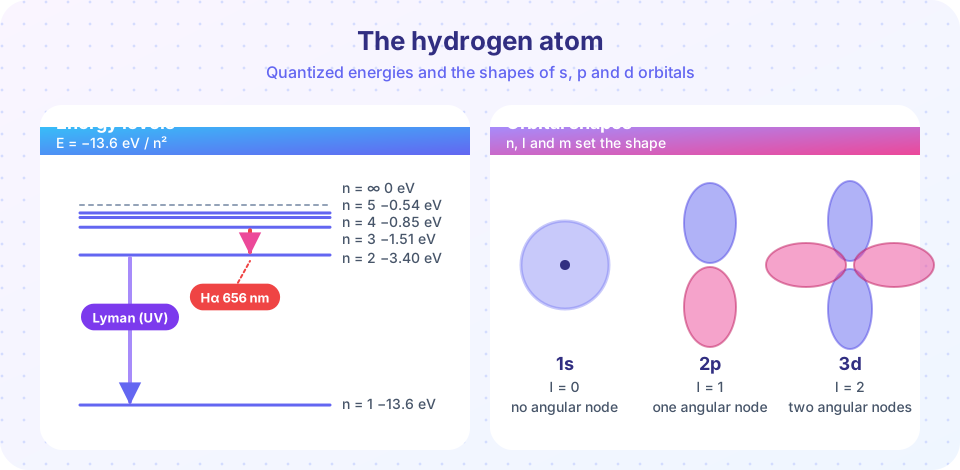
Eₙ = −R_H hc / n² = −13.6057 eV / n², n = 1, 2, 3, …
The negative sign means that the electron is bound; E = 0 corresponds to the separated electron and proton (ionization). The ground state has E₁ = −13.6 eV, so the ionization energy of hydrogen is 13.6 eV. The Rydberg constant for hydrogen, R_H = 109 678 cm⁻¹, gives the wavenumber of any spectral line as
ν̃ = R_H (1/n₁² − 1/n₂²), with n₂ > n₁
Transitions to n₁ = 1 form the Lyman series (ultraviolet), to n₁ = 2 the Balmer series (visible, historically the first found), to n₁ = 3 the Paschen series (infrared).
Worked example: H-alpha and Lyman-alpha
For the Balmer H-α line, n = 3 → 2: ν̃ = 109 678 (1/4 − 1/9) = 15 233 cm⁻¹, so λ = 1/ν̃ = 656.5 nm, the red line that gives many nebulae their pink glow. For Lyman-α, n = 2 → 1: ΔE = 13.606 × (1 − ¼) = 10.20 eV, λ = 1239.84 / 10.20 = 121.5 nm, deep ultraviolet.
Quantum numbers and degeneracy
| Number | Name | Allowed values | Controls |
|---|---|---|---|
| n | principal | 1, 2, 3, … | energy and size |
| l | angular momentum | 0, 1, …, n − 1 | shape (s, p, d, f for 0, 1, 2, 3) |
| m_l | magnetic | −l, …, +l | orientation |
| m_s | spin | +½ or −½ | electron spin |
A shell n contains n² orbitals, which hold 2n² electrons: 2, 8, 18, 32. In hydrogen, all orbitals of the same n have the same energy: this is an accidental degeneracy of the Coulomb potential, so 2s and 2p have the same energy.
Shapes and nodes
Every orbital factorizes into a radial part R(r) and an angular part (spherical harmonic). The number of nodes is fixed:
- Angular nodes (planes or cones through the nucleus):
l - Radial nodes (spherical shells):
n − l − 1 - Total nodes:
n − 1
So 1s has none, 2s has one spherical node, 2p has one nodal plane, 3d has two nodal planes. The 1s wavefunction is ψ = (π a₀³)^(−1/2) e^(−r/a₀): largest at the nucleus and decaying exponentially.
The radial distribution function P(r) = 4π r² |ψ|² is the probability of finding the electron at distance r in a thin shell. It is zero at r = 0 (the shell has no volume there), peaks at r = a₀ for 1s and is much broader for higher n. The most probable distance is not where the density is highest: density |ψ|² is highest at the nucleus, but the volume of a shell grows as r².
Many-electron atoms
With two or more electrons, electron repulsion destroys the l-degeneracy. An electron in a 2s orbital penetrates close to the nucleus more than one in 2p, so it feels a larger Z_eff and has lower energy: the order within a shell is s < p < d < f. Together with the Pauli exclusion principle (no two electrons share all four quantum numbers) and Hund's rule (degenerate orbitals fill singly with parallel spins first), this gives the Aufbau filling order and the structure of the periodic table. Carbon is 1s² 2s² 2p², with two unpaired electrons in different 2p orbitals. A few transition metals, such as chromium ([Ar] 3d⁵ 4s¹), take a half-filled d subshell as an exception.
Common misconceptions
"Electrons orbit the nucleus like planets." An orbital is a probability distribution, not a path.
"Orbital shapes are boundaries." The surfaces drawn in books enclose, say, 90 % of the probability; the cloud has no sharp edge.
"The 1s orbital has its maximum probability at the nucleus, so the electron is most likely found there." The density is highest at the nucleus, but the most probable distance, which counts volume, is a₀.
Try it
First, radial distribution functions for 1s, 2s and 2p, computed from the exact radial wavefunctions (in units of a₀). The code also checks that each is normalized.
Press Run (or Ctrl + Enter) to see the result here.
Program input · what you'd type while the program runs
Type the answers before you press Run, one per line. Each time the program reads a line (with input()), it gets the next line from this box.
Second, a spectral series calculator. The Balmer lines are shown with approximate display colors (a rough wavelength-to-color map, only meant for illustration).
Press Run (or Ctrl + Enter) to see the result here.
Program input · what you'd type while the program runs
Type the answers before you press Run, one per line. Each time the program reads a line (with input()), it gets the next line from this box.
Check your understanding
Quick check · 5 questions
of 5 answered You scored / 5 · perfect!
-
1. How many radial nodes does a 3p orbital have?
n − l − 1 = 3 − 1 − 1 = 1. -
2. How many orbitals are in the n = 3 shell?
n² = 9 orbitals (one 3s, three 3p, five 3d), holding 18 electrons. -
3. What is the energy of the n = 2 level of hydrogen?
−13.6 / 4 = −3.40 eV. -
4. In multi-electron atoms the 2s orbital lies below 2p because
Penetration reduces shielding for s electrons. -
5. The most probable distance of a 1s electron from the nucleus is
P(r) = 4πr²|ψ|² peaks at r = a₀ even though |ψ|² is largest at r = 0.
Summary
Eₙ = −13.6 eV / n²; spectral lines come from differences,ν̃ = R_H(1/n₁² − 1/n₂²).- Orbitals are labeled by n, l, m_l (plus spin m_s) and have l angular and n − l − 1 radial nodes.
- The most probable distance in 1s is a₀ = 52.9 pm; densities and radial distributions differ.
- Shielding and penetration split orbitals by l in many-electron atoms.
Track your progress
Create a free account to tick off lessons and pick up where you left off on any device.
of Physical Chemistry lessons completed