


















Lesson 7 of 49 · Gases and Thermodynamics Review
The ideal gas and kinetic theory
From Boyle and Charles to PV = nRT, then derive pressure from molecular collisions and calculate rms, mean and most probable speeds with the Maxwell-Boltzmann distribution.
By the late 1800s experimenters had found three simple relations between the pressure, volume and temperature of a gas. Put together they give one equation, PV = nRT, which works for air, helium, chlorine and almost any gas at modest pressure. The equation tells you what happens. Kinetic theory tells you why, by imagining a gas as a swarm of tiny molecules, and it gives a molecular meaning to temperature.
This lesson derives the connection and uses it to calculate how fast molecules actually move.
What you will learn
- How Boyle's, Charles's and Avogadro's laws combine into
PV = nRT. - How to use Dalton's law for mixtures.
- How kinetic theory links pressure and temperature to molecular motion.
- How to calculate rms, mean and most probable speeds, and use Graham's law.
Key terms
Ideal gas law: PV = nRT, valid when molecules are far apart and non-interacting.
Partial pressure: the pressure a gas would exert if it alone filled the container; p_i = x_i P.
Root-mean-square speed: c_rms = sqrt(3RT/M), the square root of the mean squared speed.
Maxwell-Boltzmann distribution: the probability distribution of molecular speeds in a gas at equilibrium.
Effusion: escape of gas through a tiny hole.
The experimental laws
- Boyle (1662): at fixed T and n,
PVis constant. - Charles and Gay-Lussac (about 1800): at fixed P and n,
Vis proportional to absoluteT. - Avogadro (1811): equal volumes of gas at the same T and P contain equal numbers of molecules, so at fixed T and P,
Vis proportional ton.
Combining: V ∝ nT/P, or
PV = nRT (R = 8.3145 J mol⁻¹ K⁻¹)
At 273.15 K and 1 bar (the IUPAC "standard temperature and pressure") one mole occupies RT/P = 22.71 L.
Dalton's law. In a mixture of ideal gases each component behaves as if alone: P = Σ p_i, with p_i = x_i P where x_i is the mole fraction. Dry air at 1.013 bar is about 78 % N₂, 21 % O₂ and 0.9 % Ar by mole, so oxygen's partial pressure is about 0.21 bar.
Mass density. Because n = m/M, PV = (m/M)RT gives ρ = PM/RT. At 298 K and 1 bar, air (M = 0.02897 kg/mol) has a density of 1e5 x 0.02897 / (8.3145 x 298) = 1.17 kg/m³.
Kinetic theory of gases
Assume:
- The gas is made of a large number N of identical molecules of mass m.
- Molecules are points whose size is negligible compared to their separation.
- They move randomly and collide elastically with the walls.
- There are no forces between molecules except in collisions.
Take a cubic box of side L. A molecule moving with velocity component v_x toward a wall hits it every 2L/v_x, transferring momentum 2m v_x each time. The force from one molecule is m v_x² / L. Summing over N molecules and using the fact that the average of v_x² is one third of the mean square speed <c²> (the directions are equivalent) gives
P V = (1/3) N m <c²>
Compare this with the experimental PV = nRT = N kB T. The two agree only if
(1/2) m <c²> = (3/2) kB T
So the average translational kinetic energy per molecule is (3/2) kB T, independent of the gas. Temperature is a measure of average molecular kinetic energy. For one mole: (3/2)RT, about 3.7 kJ at 298 K.
Solving for the rms speed:
c_rms = sqrt(3 kB T / m) = sqrt(3 R T / M)
with M in kg/mol. Lighter molecules move faster at the same temperature.
Worked example
Find c_rms of N₂ (M = 0.028013 kg/mol) and H₂ (M = 0.002016 kg/mol) at 300 K.
- N₂:
sqrt(3 x 8.3145 x 300 / 0.028013) = sqrt(2.671e5) = 517 m/s - H₂:
sqrt(3 x 8.3145 x 300 / 0.002016) = sqrt(3.712e6) = 1927 m/s
Fast: more than the speed of sound in air (about 343 m/s), yet molecules do not cross a room in a second, because they collide about 10¹⁰ times per second and travel only 10⁻⁷ m between collisions (the mean free path).
The distribution of speeds
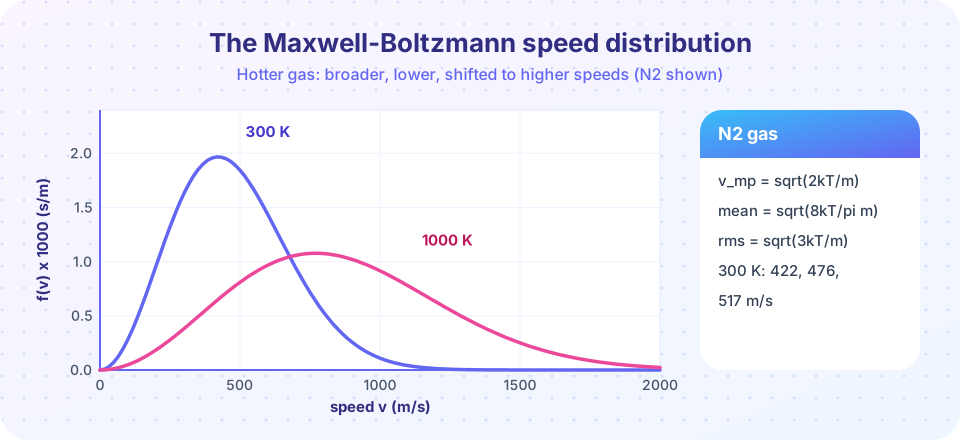
Not every molecule moves at c_rms. Maxwell (1860) and Boltzmann showed that the speeds follow
f(v) = 4π (m / 2π kB T)^(3/2) v² exp(-m v² / 2 kB T)
The v² factor suppresses very small speeds (few ways to have small velocity), and the exponential kills very large ones. Three useful averages:
| Speed | Formula | N₂ at 300 K |
|---|---|---|
| most probable | sqrt(2RT/M) |
422 m/s |
| mean | sqrt(8RT/πM) |
476 m/s |
| rms | sqrt(3RT/M) |
517 m/s |
The ratios are fixed: c_p : c_mean : c_rms = 1 : 1.128 : 1.225.
Graham's law of effusion
Effusion rate is proportional to the mean speed, so rate₁/rate₂ = sqrt(M₂/M₁). Hydrogen effuses sqrt(32.0/2.016) = 3.98 times faster than oxygen. This principle was used to separate uranium isotopes as gaseous UF₆, where the mass difference gives a factor of only 1.0043 per stage, so thousands of stages are needed.
Limits of the model
Kinetic theory assumes point molecules. It predicts that a monatomic gas has internal energy U = (3/2)nRT. That is correct for argon or helium. For molecules that can rotate and vibrate, extra energy goes into those motions, so U is larger. We return to this with heat capacities.
Common misconceptions
"Temperature is the speed of molecules." It is proportional to the average kinetic energy, which depends on mass and speed squared.
"All molecules have the same speed." There is a wide distribution; some are many times faster than the average.
"At the same temperature heavier molecules have more energy." The average translational kinetic energy is (3/2)kT for every gas; heavier molecules are just slower.
"PV = nRT works at any pressure." It fails when molecules interact or take up space (next lesson).
Try it
Compute speeds for several gases and the effusion ratios. Edit the temperature.
Press Run (or Ctrl + Enter) to see the result here.
Program input · what you'd type while the program runs
Type the answers before you press Run, one per line. Each time the program reads a line (with input()), it gets the next line from this box.
Now check the distribution numerically: the fraction of N₂ molecules faster than 1000 m/s at several temperatures, by integrating f(v) with SciPy.
Press Run (or Ctrl + Enter) to see the result here.
Program input · what you'd type while the program runs
Type the answers before you press Run, one per line. Each time the program reads a line (with input()), it gets the next line from this box.
Check your understanding
Quick check · 5 questions
of 5 answered You scored / 5 · perfect!
-
1. The average translational kinetic energy of one molecule of an ideal gas is
Kinetic theory gives (1/2) m <c^2> = (3/2) kB T per molecule; (3/2) R T is per mole. -
2. Which gas has the greater rms speed at 300 K?
c_rms = sqrt(3RT/M) is larger for the lighter molecule. -
3. At 1.00 bar, what is the partial pressure of oxygen in air that is 21 percent O2 by mole?
Dalton's law: p = x P = 0.21 x 1.00 = 0.21 bar. -
4. How does the speed distribution change when temperature rises?
The peak moves right as the square root of T and its height falls because the area stays 1. -
5. Hydrogen effuses faster than oxygen by a factor of about
Graham's law: sqrt(32.0/2.016) = 3.98.
Summary
PV = nRTcombines the laws of Boyle, Charles and Avogadro;R = 8.3145 J mol⁻¹ K⁻¹.- Dalton: partial pressure is
x_i P; density isρ = PM/RT. - Kinetic theory:
PV = (1/3)N m <c²>and average kinetic energy per molecule is(3/2) kB T. c_rms = sqrt(3RT/M); the Maxwell-Boltzmann distribution hasc_p : c_mean : c_rms = 1 : 1.128 : 1.225.- Effusion rate scales as
1/sqrt(M)(Graham).
Track your progress
Create a free account to tick off lessons and pick up where you left off on any device.
of Physical Chemistry lessons completed