


















Lesson 49 of 49 · Projects and Practice
Further Study: Where to Go After Physical Chemistry
Plan your next steps after physical chemistry: computational chemistry, electrochemistry, photochemistry, advanced spectroscopy, soft matter, and the maths and programming tracks that support them.
You now have the central toolkit of physical chemistry: rates and mechanisms, quantum models, spectroscopy and the bridge from molecules to thermodynamics. This closing page shows what lies beyond, which skills to strengthen first and how this material connects to other tracks on this site.
What you will learn
- The main directions that extend physical chemistry
- Which maths and programming skills make the next step easier
- A realistic study plan
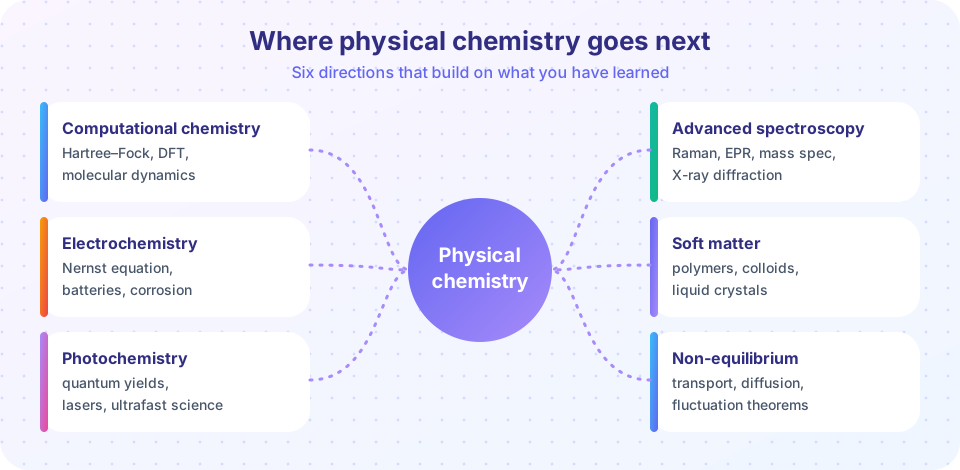
Six directions
Computational chemistry. Solving the Schrödinger equation for real molecules uses the ideas of the LCAO lesson on a large scale: basis sets, the Hartree–Fock method and density functional theory (DFT) compute orbitals, geometries and energies. Molecular dynamics instead integrates Newton's equations for thousands of atoms and averages over the trajectories, a direct application of statistical thermodynamics. Monte Carlo methods sample the Boltzmann distribution. The little simulation below is the seed of all of them.
Electrochemistry. Redox reactions connect chemical energy to electrical work: ΔG = −nFE, and the Nernst equation E = E° − (RT/nF) ln Q tells you how the cell voltage depends on concentrations. Batteries, fuel cells, corrosion and electroanalysis all rest on it, with kinetics (Butler–Volmer) joining the thermodynamics.
Photochemistry. The Jablonski diagram generalizes to photochemical reactions: quantum yields, energy transfer, photosynthesis, photocatalysis and ultrafast lasers that watch bonds break on femtosecond timescales.
Advanced spectroscopy and structure. Raman spectroscopy, electron spin resonance (EPR), mass spectrometry, photoelectron spectroscopy and X-ray diffraction extend the selection-rule thinking of Chapter 7. Two-dimensional NMR assembles the full structure of proteins.
Soft matter. Polymers, colloids, gels, liquid crystals and membranes use statistical thermodynamics of large, flexible molecules and the surface chemistry of Chapter 8.
Non-equilibrium processes. Diffusion, viscosity, thermal conductivity and chemical reaction networks go beyond equilibrium, linking to the kinetics of Chapter 5 and the study of fluctuations.
Strengthen these supports first
| Skill | Why it helps | On this site |
|---|---|---|
| Calculus and differential equations | rate laws, wave equations, diffusion | Differential equations |
| Linear algebra | molecular orbitals as eigenvalue problems | Linear algebra |
| Probability and statistics | Boltzmann distribution, error analysis | Statistics and probability |
| Python for science | fitting, simulation, plots | NumPy, SciPy, Matplotlib |
| Quantum mechanics in depth | angular momentum, perturbation theory | Quantum mechanics |
| Thermodynamics review | the macroscopic side of Chapter 8 | Physics: thermal and modern, Chemistry: energy and equilibrium |
| Neighboring chemistry | where the models are applied | Analytical chemistry, Inorganic chemistry, Materials science |
A study plan
- Weeks 1–2: redo the practice set without looking at the solutions; write your own cheat sheet.
- Weeks 3–4: reproduce the two projects with different molecules (O₂, HCl) and a different data set.
- Weeks 5–8: pick one direction above, read a first chapter of an introductory text and code one example in Python.
- Ongoing: read the original papers of the great results (Planck, Einstein, Arrhenius, Langmuir) once you are comfortable; they are shorter and clearer than you expect.
Standard textbooks that go deeper include Physical Chemistry by Atkins and de Paula, Quantum Chemistry by McQuarrie and Introduction to Modern Statistical Mechanics by Chandler.
Try it
First, electrochemistry in a few lines: the Nernst equation applied to the zinc–copper cell, where Q = [Zn²⁺]/[Cu²⁺]. The standard potential used is the usual textbook value of 1.10 V.
Press Run (or Ctrl + Enter) to see the result here.
Program input · what you'd type while the program runs
Type the answers before you press Run, one per line. Each time the program reads a line (with input()), it gets the next line from this box.
Second, the idea behind Monte Carlo simulation: sample the Boltzmann distribution with the Metropolis algorithm, for a particle in a harmonic well in reduced units (kT = 1, force constant 1). The histogram should approach the exact Gaussian exp(−x²/2)/√(2π).
Press Run (or Ctrl + Enter) to see the result here.
Program input · what you'd type while the program runs
Type the answers before you press Run, one per line. Each time the program reads a line (with input()), it gets the next line from this box.
Check your understanding
Quick check · 3 questions
of 3 answered You scored / 3 · perfect!
-
1. Which method samples the Boltzmann distribution by accepting moves with probability min(1, e^(−ΔE/kT))?
That is the Metropolis acceptance rule. -
2. The Nernst equation links cell voltage to
E = E° − (RT/nF) ln Q. -
3. Which skill most directly supports solving for molecular orbitals?
LCAO leads to matrix eigenvalue equations.
Summary
- Physical chemistry extends into computation, electrochemistry, photochemistry, advanced spectroscopy, soft matter and non-equilibrium processes.
- Strengthen differential equations, linear algebra, statistics and scientific Python first.
- Reproduce the course's projects with new molecules, then pick one direction and build a small program.
Back to the course page: Physical Chemistry
Track your progress
Create a free account to tick off lessons and pick up where you left off on any device.
of Physical Chemistry lessons completed