


















Lesson 13 of 49 · Entropy, Free Energy and Equilibrium
Entropy and the second law
Understand entropy as a count of microstates, define dS = q_rev/T, calculate entropy changes for heating, expansion, phase changes and mixing, and meet the third law.
A ball dropped on the floor stops bouncing, and its kinetic energy turns into thermal energy of the floor and the air. The reverse, a floor spontaneously cooling and throwing the ball up, would not violate energy conservation. Yet nobody has seen it. The reason is that the number of ways to spread energy among countless molecules of the floor vastly exceeds the number of ways to concentrate it in one ball.
Entropy is the quantity that measures this. In this lesson you will define it in two equivalent ways, calculate it for the common processes of chemistry, and use it to decide the direction of change.
What you will learn
- The statistical definition
S = kB ln Wand the thermodynamic definitiondS = δq_rev/T. - How to calculate ΔS for heating, expansion, mixing and phase changes.
- How to use the second law with the surroundings to test spontaneity.
- What the third law and standard molar entropies mean.
Key terms
Microstate: one specific assignment of the positions and energies of all molecules.
Macrostate: a description by macroscopic variables (P, V, T); it contains many microstates.
Entropy S: a state function; S = kB ln W, in J/K.
Reversible process: one that proceeds through a continuous sequence of equilibrium states.
Third law: the entropy of a perfect crystal is zero at 0 K.
Counting microstates
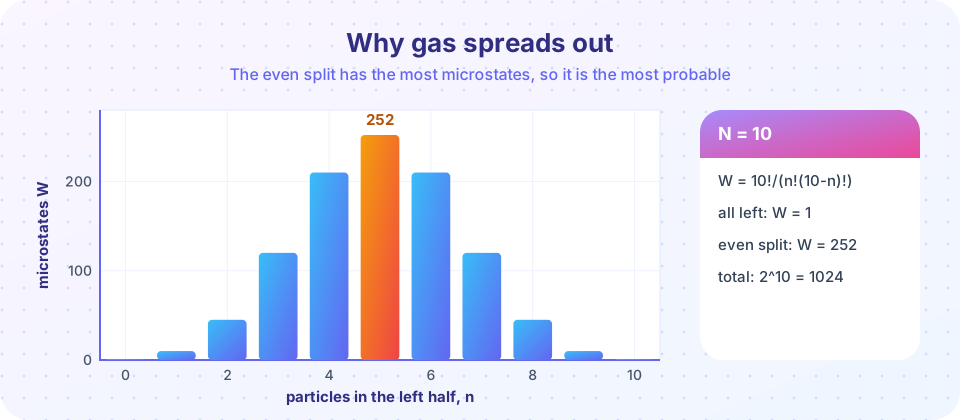
Put N distinguishable particles in a box with two halves. A macrostate is "n particles on the left". The number of microstates in that macrostate is
W(n) = N! / (n! (N - n)!)
For N = 10: W(0) = 1, W(5) = 252, total 2^10 = 1024. For N near Avogadro's number the even split is overwhelmingly favored: the probability of a noticeable deviation is astronomically small. A gas does not spread out because it is pushed to, but because there are overwhelmingly more spread-out arrangements.
Boltzmann's formula (carved on his tombstone) makes this precise:
S = kB ln W
If a gas doubles its volume, each of the N molecules has twice as many positions, so W is multiplied by 2^N and
ΔS = kB ln 2^N = N kB ln 2 = n R ln 2 = 5.76 J K⁻¹ for one mole.
The thermodynamic definition
Before atoms were accepted, Clausius (1865) defined entropy by heat transfer:
dS = δq_rev / T
The heat must be exchanged reversibly. Because S is a state function, you can compute ΔS for any process between two states by finding a convenient reversible path between them.
Heating
At constant pressure δq_rev = n C_P,m dT, so ΔS = ∫ n C_P,m dT/T. For constant C_P: ΔS = n C_P,m ln(T₂/T₁).
Example: heating 1.00 mol of liquid water (C_P,m = 75.3 J K⁻¹ mol⁻¹) from 298 K to 348 K: ΔS = 75.3 ln(348/298) = 11.7 J/K.
Isothermal expansion of an ideal gas
ΔS = nR ln(V₂/V₁), independent of whether the path was reversible. Doubling the volume of one mole gives 5.76 J/K, the same as the counting argument.
Phase changes
At the transition temperature the process is reversible: ΔS = ΔH_trans / T_trans.
- Melting ice:
6010 J mol⁻¹ / 273.15 K = 22.0 J K⁻¹ mol⁻¹. - Boiling water:
40 660 / 373.15 = 109.0 J K⁻¹ mol⁻¹.
Boiling raises entropy far more than melting, because a gas has many more accessible microstates. Many liquids have ΔS_vap ≈ 85 to 88 J K⁻¹ mol⁻¹ (Trouton's rule); water exceeds it because liquid water is unusually ordered by hydrogen bonds.
Mixing
When ideal gases mix at constant T and P: ΔS_mix = -nR Σ x_i ln x_i. Always positive, because each x_i < 1. Mixing 1 mol of A with 1 mol of B (n = 2, both x = 0.5) gives 2R ln 2 = 11.5 J/K.
The second law
For any process in an isolated system ΔS ≥ 0, with equality only for reversible processes. A non-isolated system must be combined with its surroundings:
ΔS_total = ΔS_system + ΔS_surroundings ≥ 0
and the heat that the system takes in is the heat the surroundings lose, so at constant T and P ΔS_surr = -ΔH_system / T.
Worked example: does ice melt at 10 °C?
At 283.15 K: ΔS_sys ≈ 22.0 J/K (using the value at the melting point). Surroundings give up 6010 J at 283.15 K: ΔS_surr = -6010/283.15 = -21.2 J/K. Total = +0.8 J/K > 0: spontaneous. At 263.15 K (-10 °C): ΔS_surr = -6010/263.15 = -22.8 J/K, total -0.8 J/K < 0: melting is not spontaneous, but freezing is. At 273.15 K the total is zero: equilibrium. (We ignore small changes of ΔH and ΔS with temperature.)
Heat engines
Kelvin and Clausius showed that no cycle can turn heat from a single reservoir entirely into work. The maximum efficiency of an engine between T_hot and T_cold is the Carnot value η = 1 - T_cold/T_hot. A steam turbine at 800 K discharging to 300 K cannot exceed 62.5 percent, however well it is built.
The third law and standard entropies
Unlike energy, entropy has a natural zero. The third law: the entropy of a perfect crystalline substance is zero at 0 K, where only one microstate remains. So we can tabulate absolute standard molar entropies S°:
| Substance | S° (J K⁻¹ mol⁻¹, 298 K) |
|---|---|
| C (diamond) | 2.4 |
| C (graphite) | 5.7 |
| H₂O(l) | 69.9 |
| H₂O(g) | 188.8 |
| H₂(g) | 130.7 |
| N₂(g) | 191.6 |
| O₂(g) | 205.2 |
| CO₂(g) | 213.8 |
| NH₃(g) | 192.8 |
Patterns: gases have much higher S° than liquids and solids; larger and more complex molecules have more; stiffer, harder solids (diamond) have the least.
ΔrS° = Σν S°(products) - Σν S°(reactants). For N₂ + 3H₂ → 2NH₃: 2(192.8) - (191.6 + 3 x 130.7) = -198.1 J K⁻¹. Four moles of gas become two, so the system's entropy falls steeply. That reaction therefore needs the exothermic ΔH to pay for it: the subject of the next lesson.
Common misconceptions
"Entropy always increases." Only the total (system plus surroundings). The system's entropy can fall if the surroundings gain more, as in freezing water.
"Entropy is just disorder." It is the logarithm of the number of microstates; "disorder" can mislead, for example for hard spheres that crystallize at high density and gain freedom of motion.
"ΔS_sys = q/T for any process." Only for a reversible path; for irreversible processes calculate ΔS along a reversible path between the same states.
"The third law gives S = 0 for every substance at 0 K." Only for perfect crystals; glassy or disordered solids keep a residual entropy.
Try it
A calculator for common entropy changes. Try your own numbers.
Press Run (or Ctrl + Enter) to see the result here.
Program input · what you'd type while the program runs
Type the answers before you press Run, one per line. Each time the program reads a line (with input()), it gets the next line from this box.
The second block builds the entropy of one mole of water from 250 K to 450 K at 1 atm out of its pieces: heating, melting, heating, boiling, heating. Heat capacities are rounded textbook values, so the curve is approximate and relative to the start.
Press Run (or Ctrl + Enter) to see the result here.
Program input · what you'd type while the program runs
Type the answers before you press Run, one per line. Each time the program reads a line (with input()), it gets the next line from this box.
Check your understanding
Quick check · 5 questions
of 5 answered You scored / 5 · perfect!
-
1. What is ΔS for one mole of ideal gas expanding isothermally to twice its volume?
ΔS = nR ln 2 = 8.3145 x 0.693 = 5.76 J/K. -
2. Water boils at 373.15 K with ΔH_vap = 40.66 kJ/mol. ΔS_vap is
ΔS = ΔH/T = 40660/373.15 = 109.0 J/(K mol). -
3. The total entropy change when ice melts at -10 °C is
The surroundings lose more entropy (-22.8 J/K) than the system gains (+22.0 J/K). -
4. The third law states that
That gives entropy an absolute zero. -
5. Which has the highest standard molar entropy at 298 K?
Gases have far higher S° than liquids and solids.
Summary
S = kB ln Wcounts microstates;dS = δq_rev/Tmeasures reversible heat flow.- ΔS formulas: heating
nC ln(T₂/T₁), expansionnR ln(V₂/V₁), phase changeΔH/T, mixing-nRΣ x ln x. - Second law:
ΔS_total = ΔS_sys + ΔS_surr ≥ 0, withΔS_surr = -ΔH/Tat constant T and P. - Third law gives absolute standard entropies; gases have the most.
- Carnot efficiency
1 - T_c/T_hlimits every heat engine.
Next: Gibbs free energy
Track your progress
Create a free account to tick off lessons and pick up where you left off on any device.
of Physical Chemistry lessons completed