


















Lesson 42 of 49 · Statistical Thermodynamics and Surfaces
Surfaces, Adsorption and Heterogeneous Catalysis
Understand surface tension and capillarity, physisorption versus chemisorption, the Langmuir isotherm and its derivation, BET surface area and Langmuir-Hinshelwood catalysis.
Molecules at an interface behave differently from molecules in the bulk. They are missing some neighbors, so they have extra energy, and they can stick to a solid. That simple fact explains why droplets are round, why water climbs up a narrow tube, why activated charcoal removes odors and why a platinum catalyst can convert exhaust gases into harmless ones. Surface chemistry also connects to this chapter's theme: adsorption equilibrium is a competition between the energy gained by sticking and the entropy lost by being confined to a surface.
What you will learn
- Define surface tension and use the Young–Laplace and capillary rise equations
- Distinguish physisorption from chemisorption
- Derive and use the Langmuir isotherm
- Describe BET surface-area measurement
- Write rate laws for surface reactions (Langmuir–Hinshelwood)
Key terms
Surface tension (γ): the energy needed to increase a surface by one unit of area, in J m⁻² (equivalently N m⁻¹).
Adsorption: the accumulation of molecules on a surface (not to be confused with absorption into the bulk).
Coverage (θ): the fraction of surface sites occupied.
Isotherm: the equilibrium amount adsorbed as a function of pressure at constant temperature.
Surfactant: a molecule that lowers surface tension by collecting at the interface.
Surface tension
A molecule inside a liquid is attracted equally in all directions. A molecule at the surface lacks neighbors on one side, so it sits in a state of higher energy. The liquid therefore tends to minimize its area: the free energy of a surface of area A is γA. For water at 25 °C, γ = 0.072 N m⁻¹; for mercury it is about 0.49 N m⁻¹ (strong metallic bonding) and for most organic liquids 0.02–0.04.
Excess pressure. A curved surface is held by tension, so the pressure inside a spherical drop or bubble of radius r exceeds that outside:
ΔP = 2γ / r (a single liquid–gas surface; a soap bubble has two surfaces and ΔP = 4γ/r)
For a bubble of water of radius 1 µm, ΔP = 2 × 0.072 / 10⁻⁶ = 1.44 × 10⁵ Pa, about 1.4 atmospheres: tiny bubbles are under large pressure, which is why they dissolve and why nucleating bubbles in boiling takes effort.
Capillary rise. If a liquid wets a narrow tube (contact angle θ_c), it rises to a height where the weight of the column balances the surface tension pull:
h = 2γ cos θ_c / (ρ g r)
For water in a clean glass tube of radius 0.50 mm (θ_c ≈ 0, ρ = 997 kg m⁻³), h = 2 × 0.072 / (997 × 9.81 × 5.0×10⁻⁴) ≈ 0.029 m, about 3 cm. Capillarity helps water rise through soil, paper towels and the fine channels of plants.
Surfactants (soaps, detergents) have a water-loving head and an oily tail. They collect at the surface and lower γ, and above the critical micelle concentration they assemble into micelles that dissolve grease.
Adsorption on solids
When a gas touches a clean solid, some molecules stick. Two limits are distinguished:
| Property | Physisorption | Chemisorption |
|---|---|---|
| Forces | van der Waals | chemical bonds |
| Enthalpy of adsorption | about −20 to −40 kJ mol⁻¹ | about −100 to −400 kJ mol⁻¹ |
| Layers | monolayer or multilayer | monolayer only |
| Temperature | low (near the boiling point of the gas) | often needs activation energy |
| Reversible? | easily | often not |
| Specificity | low | high |
Adsorption is nearly always exothermic: sticking reduces freedom, so ΔS < 0 and ΔG = ΔH − TΔS can be negative only if ΔH is negative enough. By Le Chatelier's principle, raising temperature therefore lowers the amount adsorbed at equilibrium.
The Langmuir isotherm
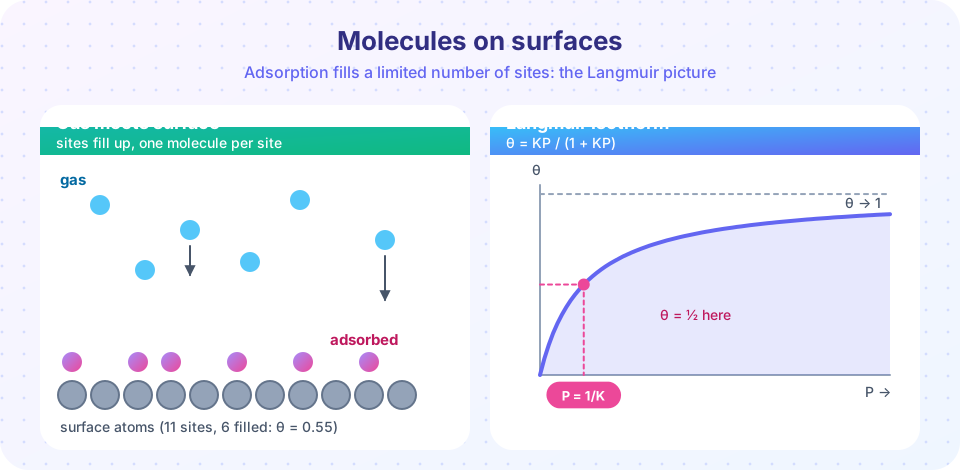
Assume a surface with a fixed number of equivalent sites, each holding at most one molecule (monolayer), with no interaction between adsorbed molecules. The rate of adsorption is proportional to the gas pressure and the number of vacant sites, k_a P (1 − θ). The rate of desorption is proportional to the occupied sites, k_d θ. At equilibrium they are equal:
k_a P (1 − θ) = k_d θ, so θ = KP / (1 + KP), with K = k_a/k_d
This is the Langmuir isotherm. Two limits are important:
- Low pressure,
KP ≪ 1:θ ≈ KP, coverage proportional to pressure (Henry's law regime). - High pressure,
KP ≫ 1:θ → 1, the surface is saturated; more gas does not help.
At P = 1/K the coverage is exactly one half, so K can be read from the half-coverage pressure. K has the form of an equilibrium constant, K ∝ e^(−ΔG_ads/RT), and falls with temperature when adsorption is exothermic.
To fit data, measure the volume adsorbed V and rearrange:
P / V = P / V_m + 1 / (K V_m)
A plot of P/V against P is a straight line with slope 1/V_m and intercept 1/(K V_m), where V_m is the volume of a full monolayer.
Variations. If a diatomic molecule dissociates into two atoms on the surface, each needing a site, then θ = (KP)^(1/2) / (1 + (KP)^(1/2)). For two gases A and B competing for the same sites, θ_A = K_A P_A / (1 + K_A P_A + K_B P_B): a strongly bound gas can block the others (carbon monoxide poisons many catalysts). Real surfaces are rarely uniform, and the empirical Freundlich isotherm, θ ∝ P^(1/n), is often used instead.
BET isotherm. Brunauer, Emmett and Teller extended the idea to multilayers. Plotting P/[V(P₀ − P)] against P/P₀ over the range 0.05–0.35 gives the monolayer volume, and, knowing the area each molecule covers (0.162 nm² for N₂ at 77 K), the specific surface area of powders and catalysts, often hundreds of m² per gram.
Heterogeneous catalysis
In the Langmuir–Hinshelwood mechanism, both reactants adsorb and the reaction occurs between neighbors on the surface. With rate = k θ_A θ_B,
rate = k K_A P_A K_B P_B / (1 + K_A P_A + K_B P_B)²
Rate rises with pressure at first, then passes through a maximum and falls, because at high pressure one reactant crowds out the other. This is why catalytic reactions can slow down when you raise the pressure of one reagent. In the Eley–Rideal mechanism one reactant reacts directly from the gas phase with an adsorbed partner.
Examples: the Haber process (N₂ + 3 H₂ → 2 NH₃ on iron), where dissociative adsorption of N₂ is the slow step; the three-way catalytic converter (platinum, palladium and rhodium convert CO, hydrocarbons and NOₓ into CO₂, H₂O and N₂); and hydrogenation of alkenes on nickel. The Sabatier principle says that the best catalyst binds the reactants strongly enough to activate them, but not so strongly that the products cannot leave, giving a volcano-shaped plot of activity against binding strength.
Common misconceptions
"Adsorption and absorption are the same." Adsorption is a surface phenomenon; absorption is uptake into the bulk, as in a sponge.
"More pressure always means more reaction on a surface." In Langmuir–Hinshelwood kinetics the rate has a maximum.
"Surface tension is a force that acts across the whole liquid." It is the energy per area (or force per length) at the interface.
Try it
First, a stochastic sketch of the Langmuir picture. Each site is filled with the Langmuir probability for the pressure you choose (K = 1 per unit pressure); the sampled coverage fluctuates around the theoretical value. This is a demonstration of the model, not a molecular simulation.
Second, fit a Langmuir isotherm to adsorption data. The data are invented (true V_m = 22.0 cm³/g, K = 0.05 kPa⁻¹, 2 % noise); the code recovers the parameters both with the linear form and with a direct nonlinear fit.
Press Run (or Ctrl + Enter) to see the result here.
Program input · what you'd type while the program runs
Type the answers before you press Run, one per line. Each time the program reads a line (with input()), it gets the next line from this box.
Third, the Langmuir–Hinshelwood rate. The volcano shape appears when one reactant's pressure is raised while the other is held constant.
Press Run (or Ctrl + Enter) to see the result here.
Program input · what you'd type while the program runs
Type the answers before you press Run, one per line. Each time the program reads a line (with input()), it gets the next line from this box.
Check your understanding
Quick check · 6 questions
of 6 answered You scored / 6 · perfect!
-
1. A bubble of radius 2 µm in water (γ = 0.072 N/m) has an excess pressure of about
ΔP = 2γ/r = 0.144 / 2×10⁻⁶ = 7.2 × 10⁴ Pa. -
2. In the Langmuir isotherm, the coverage is one half when
θ = KP/(1 + KP) = ½ when KP = 1. -
3. Which is characteristic of chemisorption?
Chemisorption forms chemical bonds with a surface. -
4. Why does raising the temperature usually reduce the amount adsorbed?
By Le Chatelier's principle heating favors the endothermic direction, desorption. -
5. A plot of P/V against P is linear for a Langmuir isotherm. What gives V_m?
P/V = P/V_m + 1/(K V_m): slope = 1/V_m. -
6. In Langmuir–Hinshelwood kinetics, raising the pressure of A far enough can slow the reaction because
At high P_A, θ_B becomes small, so the product θ_A θ_B falls.
Summary
- Surface tension gives
ΔP = 2γ/rand capillary riseh = 2γ cos θ_c/(ρgr). - Physisorption is weak and multilayer; chemisorption is strong and monolayer.
- Langmuir:
θ = KP/(1 + KP), from balancing adsorption and desorption rates; BET gives surface areas. - Surface reactions (Langmuir–Hinshelwood) have rate maxima; good catalysts bind reactants neither too weakly nor too strongly.
Next: Chapter review
Track your progress
Create a free account to tick off lessons and pick up where you left off on any device.
of Physical Chemistry lessons completed