


















Lesson 10 of 49 · Gases and Thermodynamics Review
Thermochemistry, enthalpies of formation and Hess's law
Calculate heats of reaction from standard enthalpies of formation, use Hess's law and calorimetry, and adjust reaction enthalpies with temperature using Kirchhoff's law.
How much heat does a reaction release? You could measure it in a calorimeter for every reaction ever written, or you could build a table of a few thousand numbers and calculate the rest. Thermochemistry takes the second route. Because enthalpy is a state function, the heat of any reaction can be assembled from tabulated values for individual substances.
This lesson shows how: standard states, enthalpies of formation, Hess's law, calorimetry, and how reaction enthalpies change with temperature.
What you will learn
- What a standard state and a standard enthalpy of formation are.
- How to calculate
ΔrH°from a table of formation enthalpies. - How to combine reactions with Hess's law.
- How a calorimeter measures heat, and how
ΔHvaries with temperature.
Key terms
Standard state: for a substance, its pure form at 1 bar (for solutes, 1 mol/kg ideal solution); the temperature is stated, usually 298.15 K.
Standard enthalpy of formation, ΔfH°: the enthalpy change when one mole of a compound forms from its elements in their reference states.
Standard reaction enthalpy, ΔrH°: the enthalpy change for the reaction with reactants and products in their standard states, per mole of reaction as written.
Exothermic / endothermic: ΔH < 0 (heat released) / ΔH > 0 (heat absorbed).
Calorimeter: a device that measures heat from a temperature change.
Standard enthalpies of formation
By convention ΔfH° of an element in its most stable form at 1 bar is zero (for carbon this is graphite; for oxygen, O₂(g)). Compounds then have formation enthalpies relative to that zero. Selected values at 298 K, in kJ/mol:
| Substance | ΔfH° | Substance | ΔfH° |
|---|---|---|---|
| CO₂(g) | -393.5 | CH₄(g) | -74.6 |
| CO(g) | -110.5 | NH₃(g) | -45.9 |
| H₂O(l) | -285.8 | C₂H₅OH(l) | -277.6 |
| H₂O(g) | -241.8 | C₆H₁₂O₆(s) | -1273.3 |
(Values from standard tables; small differences between sources are normal.)
The reaction enthalpy follows from
ΔrH° = Σ ν_products ΔfH°(products) - Σ ν_reactants ΔfH°(reactants)
where ν are the stoichiometric coefficients.
Worked example: combustion of methane
CH₄(g) + 2 O₂(g) → CO₂(g) + 2 H₂O(l)
ΔrH° = [(-393.5) + 2(-285.8)] - [(-74.6) + 2(0)]
     = -965.1 + 74.6 = -890.5 kJ/mol
Burning one mole of methane (16.04 g) releases about 890 kJ. If water leaves as vapor instead, ΔrH° is -802 kJ/mol: the difference is the heat of condensing two moles of water (2 x 44 kJ). This is why "higher" and "lower" heating values are quoted for fuels.
Hess's law
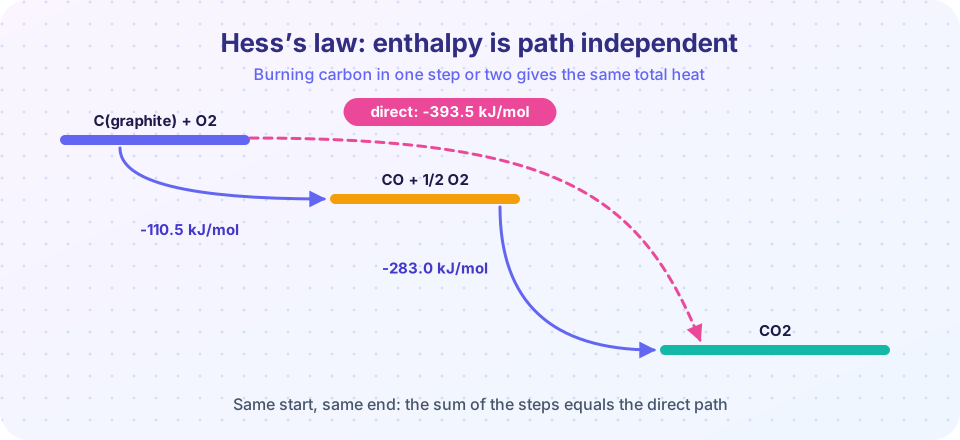
Because H is a state function, the enthalpy change for a reaction is the same whether it takes one step or many (Hess, 1840). To use it, add the equations of known reactions so that unwanted species cancel, and add their ΔH values accordingly. Reversing a reaction flips the sign of ΔH; multiplying by a factor multiplies ΔH by it.
Example (the diagram above). The enthalpy of formation of CO is hard to measure directly because carbon burning always makes some CO₂. Use
C(graphite) + O₂ → CO₂,ΔH = -393.5 kJCO + ½O₂ → CO₂,ΔH = -283.0 kJ
Subtract (2) from (1): C + ½O₂ → CO, ΔH = -393.5 + 283.0 = -110.5 kJ.
Bond enthalpies
A rough estimate is possible from average bond enthalpies: break bonds in the reactants (costs energy) and make bonds in the products (releases energy). ΔH ≈ Σ(bonds broken) - Σ(bonds formed). Averages ignore environment, so results are good to maybe 10 to 20 kJ/mol; use formation enthalpies when you have them.
Calorimetry
At constant pressure q_P = ΔH. In a simple "coffee-cup" calorimeter the heat released by a reaction warms the solution:
q = m c ΔT
with c the specific heat capacity (4.184 J g⁻¹ K⁻¹ for dilute aqueous solutions).
Example. 50.0 mL of 1.00 M HCl is mixed with 50.0 mL of 1.00 M NaOH, both at 22.0 °C, and the temperature rises by 6.7 K. Taking the solution as 100 g of water-like liquid and ignoring the cup:
q = 100 x 4.184 x 6.7 = 2.80 kJ, released by 0.0500 mol of water formed, so ΔH = -2.80/0.0500 = -56 kJ/mol. The tabulated enthalpy of neutralization of a strong acid with a strong base is about -57 kJ/mol.
Bomb calorimeters work at constant volume and measure ΔU; convert with ΔH = ΔU + Δn_gas RT.
Temperature dependence: Kirchhoff's law
Tables are at 298 K. To get ΔrH at another temperature, integrate the heat capacities:
ΔrH(T₂) = ΔrH(T₁) + ∫ ΔrC_P dT (from T₁ to T₂)
where ΔrC_P = Σ ν C_P,m(products) - Σ ν C_P,m(reactants). If ΔrC_P is roughly constant, ΔrH(T₂) = ΔrH(T₁) + ΔrC_P (T₂ - T₁). Usually the change is small because the heat capacities of products and reactants nearly cancel.
Common misconceptions
"Formation enthalpies of elements are zero because they have no energy." They are zero by convention, as a reference level; only differences matter.
"Exothermic means spontaneous." Enthalpy is only half the story; entropy decides too (next chapter).
"ΔH per mole means per mole of substance." It means per mole of reaction as written; doubling the equation doubles ΔH.
"Bond breaking releases energy." Breaking bonds always costs energy; forming bonds releases it.
Try it
A reusable calculator for reaction enthalpies from the table. Edit the reaction by changing the dictionaries.
Press Run (or Ctrl + Enter) to see the result here.
Program input · what you'd type while the program runs
Type the answers before you press Run, one per line. Each time the program reads a line (with input()), it gets the next line from this box.
The next block compares fuels by energy per gram. It reuses the table above (plus molar masses) and plots the result, showing why hydrogen is attractive per mass but awkward per volume.
Press Run (or Ctrl + Enter) to see the result here.
Program input · what you'd type while the program runs
Type the answers before you press Run, one per line. Each time the program reads a line (with input()), it gets the next line from this box.
Check your understanding
Quick check · 5 questions
of 5 answered You scored / 5 · perfect!
-
1. The standard enthalpy of formation of O2(g) is
Elements in their reference state have ΔfH° = 0 by convention. -
2. Using ΔfH°(CO2) = -393.5, ΔfH°(CO) = -110.5, what is ΔH for CO + 1/2 O2 -> CO2?
-393.5 - (-110.5) = -283.0 kJ. -
3. You double a balanced equation. What happens to ΔrH°?
ΔH is for the reaction as written, so it scales with the coefficients. -
4. Which is true of a reaction with ΔH = +50 kJ in a coffee-cup calorimeter?
An endothermic reaction absorbs heat from the solution, so it cools. -
5. Kirchhoff's law relates ΔrH at two temperatures through
ΔrH(T2) = ΔrH(T1) + integral of ΔrC_P dT.
Summary
- Elements in standard states have
ΔfH° = 0; compounds have tabulated formation enthalpies. ΔrH° = Σν ΔfH°(products) - Σν ΔfH°(reactants).- Hess's law: enthalpy changes add along any path; reverse flips sign, scaling multiplies.
- Calorimetry:
q = m c ΔT; at constant pressureq = ΔH. - Kirchhoff:
ΔrH(T₂) = ΔrH(T₁) + ∫ΔrC_P dT.
Next: Chapter 2 review
Track your progress
Create a free account to tick off lessons and pick up where you left off on any device.
of Physical Chemistry lessons completed