


















Lesson 31 of 49 · Quantum Chemistry
Vibration and Rotation: Oscillator and Rigid Rotor
Quantum models of molecular vibration and rotation: the harmonic oscillator, zero-point energy, the rigid rotor, rotational constant and the isotope effect, with worked HCl and CO examples.
A diatomic molecule such as HCl does two things besides moving through space: it stretches and compresses like a spring, and it tumbles end over end. Quantum mechanics gives each motion a ladder of allowed energies, and the spacing of the rungs tells you about the molecule: stiffness of the bond for vibration, bond length for rotation. These are the energy levels that infrared and microwave spectroscopy measure in the next chapter.
What you will learn
- Write the energy levels of the harmonic oscillator and the rigid rotor
- Compute a vibrational frequency from a force constant, and a bond length from B
- Explain zero-point energy and the isotope effect
- Estimate which rotational level is most populated
Key terms
Reduced mass (μ): μ = m₁m₂/(m₁ + m₂), the effective mass for relative motion of two bodies.
Force constant (k): the stiffness of a bond; F = −kx, in N m⁻¹.
Moment of inertia (I): I = μr² for a diatomic molecule.
Rotational constant (B): B = h / (8π² c I), usually in cm⁻¹.
Wavenumber (ν̃): 1/λ, in cm⁻¹, proportional to energy: E = hcν̃.
The harmonic oscillator
Model a bond as a spring: V(x) = ½ k x², where x is the displacement of the bond length from equilibrium. A diatomic molecule behaves as one particle of reduced mass μ. Solving the Schrödinger equation gives
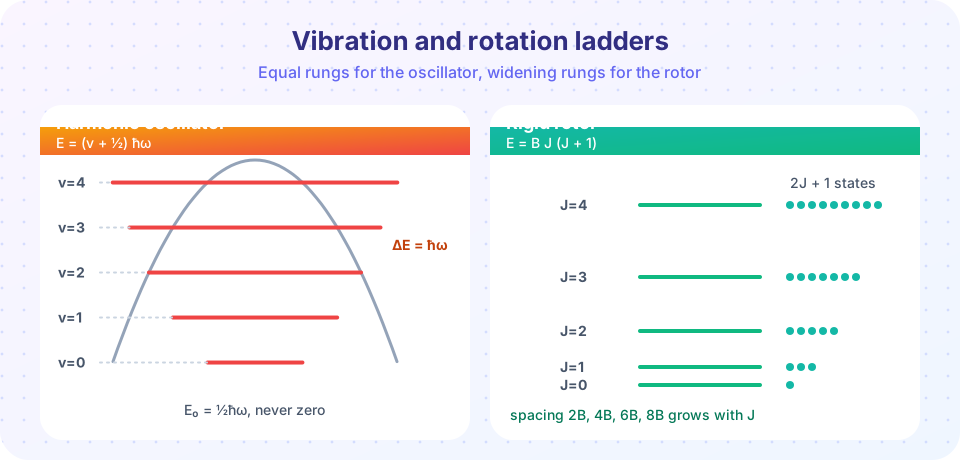
E_v = (v + ½) ħω, ω = √(k/μ), v = 0, 1, 2, …
Equivalently E_v = (v + ½) hν with ν = ω/2π. In spectroscopy this is written with the wavenumber ν̃ = (1/2πc) √(k/μ).
Key features:
- Equal spacing
ħωbetween neighbors, a ladder with identical rungs. - Zero-point energy
E₀ = ½ħω. Even at absolute zero a bond vibrates. This is why the zero-point energy of a C–H bond is larger than that of a C–D bond, which matters in kinetics. - Wavefunctions are Gaussian-shaped for v = 0 and extend slightly beyond the classical turning points (tunneling into the forbidden region).
Worked example: the HCl stretch
For HCl, k ≈ 516 N m⁻¹ and μ = (1.008 × 34.97)/(1.008 + 34.97) u = 0.980 u = 1.627 × 10⁻²⁷ kg. Then ω = √(516 / 1.627×10⁻²⁷) = 5.63 × 10¹⁴ rad s⁻¹, and
ν̃ = ω / (2πc) = 5.63×10¹⁴ / (2π × 2.998×10¹⁰ cm s⁻¹) ≈ 2990 cm⁻¹
The measured fundamental of HCl is close to 2886 cm⁻¹ at the band origin, because real bonds are anharmonic (the Morse potential flattens at large stretch and narrows the spacings). The harmonic wavenumber the experiment extrapolates to is near 2990 cm⁻¹, in line with the calculation.
The isotope effect
Replace H by deuterium: k is the same (it depends on electrons, not nuclear mass), but μ roughly doubles from 0.980 u to 1.904 u. So
ν̃(DCl) / ν̃(HCl) = √(0.980 / 1.904) = 0.717, giving about 2145 cm⁻¹.
The zero-point energy drops by the same factor, so it takes more energy to break a C–D bond than a C–H bond, and C–D bonds react more slowly. This kinetic isotope effect is a sensitive tool for finding out whether a C–H bond breaks in the rate-determining step.
The rigid rotor
A diatomic molecule rotating about its center of mass is equivalent to a particle of mass μ on a sphere of radius r. Its energy is
E_J = ħ² J(J + 1) / (2I) = h c B J(J + 1), J = 0, 1, 2, …
with I = μr². In wavenumber units the energies are B J(J+1) and the rotational constant is
B = h / (8π² c I)
Each level has degeneracy 2J + 1 (the orientation quantum number M_J runs from −J to +J). Gaps between neighbors are E_{J+1} − E_J = 2B(J + 1), so spacings grow linearly with J: 2B, 4B, 6B, … This is the pattern in the picture.
Worked example: carbon monoxide
For CO, r = 112.8 pm and μ = 6.856 u = 1.1385 × 10⁻²⁶ kg. Then I = μr² = 1.449 × 10⁻⁴⁶ kg m² and
B = 6.626×10⁻³⁴ / (8π² × 2.998×10¹⁰ cm s⁻¹ × 1.449×10⁻⁴⁶) = 1.93 cm⁻¹
Rotational spacings are tiny (a few cm⁻¹, or about 0.24 meV), much less than kT at room temperature (207 cm⁻¹). Many rotational levels are therefore populated, unlike vibrational levels, where ħω ≫ kT and almost all molecules are in v = 0.
Which J is most populated?
The Boltzmann population of level J is N_J ∝ (2J + 1) exp(−B J(J+1) hc / kT): the degeneracy pushes it up and the exponential pulls it down, so there is a maximum at
J_max ≈ √(kT / 2hcB) − ½
For CO at 298 K, kT/hc = 207.2 cm⁻¹, so J_max ≈ √(207.2 / 3.86) − 0.5 ≈ 6.8, close to 7.
Common misconceptions
"The bond can stop vibrating at absolute zero." The zero-point motion is required by quantum mechanics.
"Heavier isotopes have stiffer bonds." The force constant is practically identical; the frequency changes because of the larger reduced mass.
"A bigger B means a bigger molecule." B is inversely proportional to I, so a smaller, lighter molecule has the larger B. H₂ has B about 60 cm⁻¹; CO has 1.93 cm⁻¹.
Try it
First, compute the vibrational frequency of several diatomics from textbook force constants and plot the harmonic ladder for HCl and DCl. The force constants are approximate round values, used here for illustration.
Press Run (or Ctrl + Enter) to see the result here.
Program input · what you'd type while the program runs
Type the answers before you press Run, one per line. Each time the program reads a line (with input()), it gets the next line from this box.
Second, the rotational constant and thermal populations of CO. The bond length is the textbook value; the populations are a Boltzmann calculation at the chosen temperature.
Press Run (or Ctrl + Enter) to see the result here.
Program input · what you'd type while the program runs
Type the answers before you press Run, one per line. Each time the program reads a line (with input()), it gets the next line from this box.
Check your understanding
Quick check · 5 questions
of 5 answered You scored / 5 · perfect!
-
1. The harmonic oscillator energy levels E_v = (v + ½)ħω are
Spacing is ħω for all v, and E₀ = ½ħω. -
2. If a bond's force constant is quadrupled and the reduced mass is unchanged, the vibrational frequency
ω ∝ √k, so a factor of 4 in k gives a factor of 2. -
3. Replacing H by D in HCl lowers the vibrational wavenumber mainly because
Isotopes share the same electronic structure and k; μ is larger for DCl. -
4. How many degenerate states does J = 3 have?
2J + 1 = 7. -
5. Rotational energy levels E = BJ(J+1) have a gap between J = 2 and J = 3 of
E₃ − E₂ = 12B − 6B = 6B, which equals 2B(J+1) with J = 2.
Summary
- Vibration:
E_v = (v + ½)ħω,ω = √(k/μ); equal rungs, zero-point energy½ħω. - Rotation:
E_J = BJ(J + 1),B = h/(8π²cI), degeneracy2J + 1, spacings2B(J+1). - Isotopes change μ, hence frequencies and zero-point energies, but not force constants.
- Many rotational levels are occupied at room temperature; almost only v = 0 is occupied for vibration.
Track your progress
Create a free account to tick off lessons and pick up where you left off on any device.
of Physical Chemistry lessons completed