


















Lesson 26 of 49 · Chemical Kinetics
Temperature, Arrhenius and Collision Theory
Understand why rates rise steeply with temperature: the Arrhenius equation, activation energy from a plot, collision theory and the Eyring transition-state equation.
Cooking at higher temperature is quicker, milk sours faster on a warm counter, and a fever speeds up body chemistry only a little. These everyday observations share one feature: for most reactions, a rise of about 10 K roughly doubles or triples the rate. Svante Arrhenius turned that observation into an equation in 1889, and it is still the first tool anyone reaches for.
This lesson derives its meaning from molecular behavior, shows how to extract an activation energy from data, and takes a first look at the transition-state (Eyring) version that connects kinetics to thermodynamics.
What you will learn
- Use the Arrhenius equation in its exponential, logarithmic and two-point forms
- Extract Ea and A from a plot of ln k against 1/T
- Explain the equation with collision theory
- Relate Ea to the enthalpy and entropy of activation in the Eyring equation
Key terms
Activation energy (Ea): the energy barrier, in J mol⁻¹, in the Arrhenius equation.
Pre-exponential factor (A): the rate constant at infinite temperature; it contains the collision frequency and orientation requirements.
Steric factor (p): the fraction of sufficiently energetic collisions that also have the right orientation.
Transition state: the highest-energy arrangement along the reaction path; the Eyring equation treats it as a species in quasi-equilibrium with the reactants.
The Arrhenius equation
k = A · e^(−Ea / RT)
R = 8.314 J mol⁻¹ K⁻¹ and T must be in kelvin. Taking natural logarithms gives a straight line:
ln k = ln A − (Ea / R) · (1 / T)
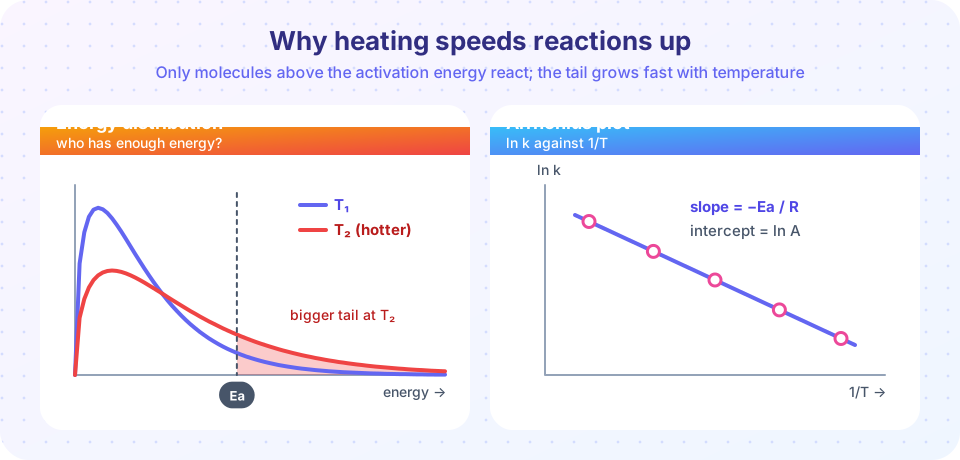
If you measure k at several temperatures and plot ln k against 1/T, the slope is −Ea/R and the intercept is ln A. This is the Arrhenius plot. For two temperatures only,
ln(k₂ / k₁) = (Ea / R) · (1/T₁ − 1/T₂)
Worked example 1: finding Ea from two rate constants
A reaction has k₁ = 1.2 × 10⁻³ s⁻¹ at 300 K and k₂ = 4.8 × 10⁻³ s⁻¹ at 320 K. The ratio is exactly 4, so ln 4 = 1.386. The temperature term is 1/300 − 1/320 = 2.083 × 10⁻⁴ K⁻¹. Then
Ea = 8.314 × 1.386 / 2.083×10⁻⁴ = 5.53 × 10⁴ J mol⁻¹ ≈ 55 kJ mol⁻¹
Worked example 2: how much does 10 K help?
For Ea = 50 kJ mol⁻¹ going from 298 K to 308 K:
ln(k₂/k₁) = (50000 / 8.314) × (10 / (298 × 308)) = 6014 × 1.0895×10⁻⁴ = 0.655
so k₂/k₁ = e^0.655 = 1.93. The familiar "doubles per 10 K" corresponds to an Ea of about 50 kJ mol⁻¹ near room temperature. Barriers of 100 kJ mol⁻¹ give a factor of about 3.7, which is why high-barrier reactions are so temperature sensitive.
Collision theory: where the exponential comes from
In a gas, molecules collide with enormous frequency, about 10⁹ to 10¹⁰ collisions per second per molecule at atmospheric pressure. If every collision led to reaction, everything would be over in nanoseconds. It does not, for two reasons:
- Energy. The collision must carry at least Ea. Since molecular energies follow the Boltzmann distribution, the fraction of collisions above Ea is about
e^(−Ea/RT). This is the exponential factor, and it is the shaded tail in the picture above. - Orientation. Molecules must meet the right way round. The steric factor p (between 0 and 1, often 10⁻² or smaller for large molecules) accounts for this.
So A ≈ p × Z, where Z is the collision frequency factor. Collision theory predicts A for simple gas reactions reasonably well. For reactions in solution, the solvent cages molecules and changes the picture, which motivates the transition-state view.
Transition-state theory and the Eyring equation
Imagine reactants in rapid pre-equilibrium with an activated complex ‡ that falls apart at a universal frequency kBT/h. Then
k = κ (kBT / h) · e^(ΔS‡/R) · e^(−ΔH‡/RT)
where ΔH‡ is the enthalpy of activation, ΔS‡ the entropy of activation and κ (kappa, close to 1) the transmission coefficient. The equivalent form uses the Gibbs energy of activation: k = (kBT/h) e^(−ΔG‡/RT). At 298.15 K, kBT/h = 6.21 × 10¹² s⁻¹.
For a reaction in solution, Ea ≈ ΔH‡ + RT. An Eyring plot, ln(k/T) against 1/T, has slope −ΔH‡/R and intercept ln(kB/h) + ΔS‡/R. A very negative ΔS‡ means that the transition state is far more ordered than the reactants, as when two molecules must join into a tight complex. This is why A is small for such reactions.
A handy figure to remember: at 298 K, every 5.7 kJ mol⁻¹ change in ΔG‡ changes the rate by a factor of 10, since RT ln 10 = 5.71 kJ mol⁻¹.
Common misconceptions
"Heating raises the average molecular energy a lot." The average rises only slightly. What matters is the small high-energy tail, which grows disproportionately.
"Activation energy depends on temperature." In the simple Arrhenius model Ea is a constant over a modest range. Curvature in an Arrhenius plot points to a change of mechanism or tunneling.
"A catalyst raises A." A catalyst mainly lowers the effective barrier by a new pathway.
Try it
First an interactive explorer. Move the sliders to change Ea and the temperature, and watch the rate constant relative to 298 K. This is a calculator that applies the Arrhenius equation, not a simulation of real chemistry.
Second, a complete analysis workflow. The rate constants are invented for the exercise (true Ea 75 kJ/mol, 2 % scatter); in a real lab they would come from fits such as those in the last lesson.
Press Run (or Ctrl + Enter) to see the result here.
Program input · what you'd type while the program runs
Type the answers before you press Run, one per line. Each time the program reads a line (with input()), it gets the next line from this box.
Check your understanding
Quick check · 5 questions
of 5 answered You scored / 5 · perfect!
-
1. In an Arrhenius plot, what does the slope equal?
ln k = ln A − (Ea/R)(1/T): slope −Ea/R, intercept ln A. -
2. Why does the rate rise so steeply with temperature?
Collision frequency rises only as √T; the exponential tail fraction is what changes strongly. -
3. k doubles when T rises from 300 K to 310 K. Roughly what is Ea?
Ea = R ln2 / (1/300 − 1/310) = 8.314 × 0.693 / 1.075×10⁻⁴ ≈ 5.4×10⁴ J/mol. -
4. In the Eyring equation a very negative ΔS‡ implies
Tying molecules into an ordered complex costs entropy and lowers the prefactor. -
5. At 298 K, lowering ΔG‡ by 5.7 kJ/mol changes the rate by about
RT ln 10 = 5.7 kJ/mol at 298 K.
Summary
k = A e^(−Ea/RT); plotln kagainst1/Tto get Ea and A.- Only the energetic tail of the Boltzmann distribution can cross the barrier.
- Collision theory:
A ≈ p × Z. Transition-state theory:k = (kBT/h) e^(−ΔG‡/RT). - About 5.7 kJ/mol at 298 K is one factor of ten in the rate.
Next: Mechanisms and catalysis
Track your progress
Create a free account to tick off lessons and pick up where you left off on any device.
of Physical Chemistry lessons completed