


















Lesson 21 of 49 · Phase Equilibria and Solutions
Colligative properties: vapor pressure, boiling, freezing and osmosis
Derive vapor pressure lowering, boiling point elevation, freezing point depression and osmotic pressure from the chemical potential, with the van 't Hoff factor and worked examples.
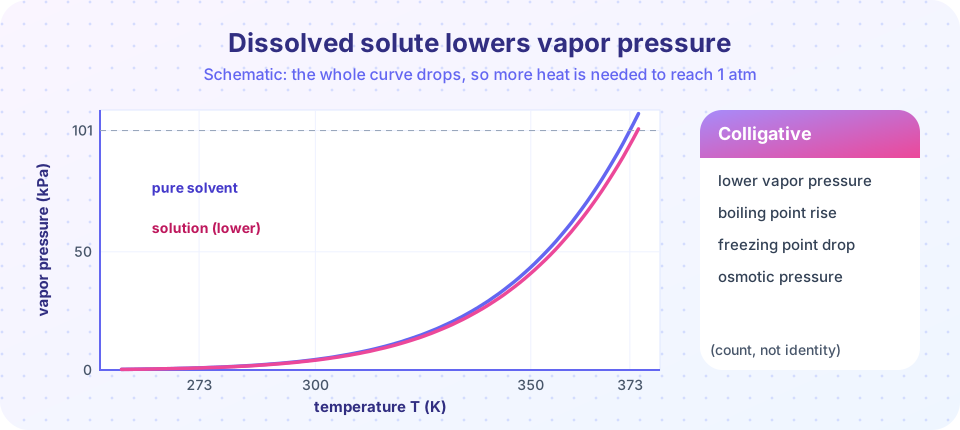
Why do we salt icy roads, add antifreeze to a car radiator, and cook pasta in salted water? Why does a cell burst in pure water, and why can a membrane filter turn seawater into drinking water? These are the same effect seen in different places. Dissolve something in a solvent, and the solvent's properties change by an amount that depends on how many solute particles you add, and almost not at all on what they are.
Properties of this kind are called colligative (from the Latin for "bound together"). They follow directly from the chemical potential of the solvent in an ideal solution.
What you will learn
- Why a non-volatile solute lowers the vapor pressure of the solvent.
- The formulas for boiling point elevation and freezing point depression.
- How osmotic pressure arises and how to calculate it.
- How to use the van 't Hoff factor for ionic solutes and to find molar masses.
Key terms
Molality (m): moles of solute per kilogram of solvent; independent of temperature.
Colligative property: depends on the number of solute particles, not their identity.
Ebullioscopic and cryoscopic constants (Kb, Kf): properties of the solvent that relate the shift in boiling or freezing point to molality.
Osmosis: net flow of solvent through a semipermeable membrane toward the more concentrated solution.
van 't Hoff factor (i): the effective number of particles per formula unit (ideal: 2 for NaCl, 3 for CaCl₂).
The origin: chemical potential of the solvent
In an ideal solution the chemical potential of the solvent A is lowered:
μ_A = μ*_A + RT ln x_A (x_A < 1, so ln x_A < 0)
Everything below comes from this single fact. A lower chemical potential means the solvent in solution is more stable than pure solvent, so it is less inclined to escape into the vapor (or to freeze).
Vapor pressure lowering
From Raoult's law with a non-volatile solute B:
P = x_A P*_A so ΔP = P*_A - P = x_B P*_A
The lowering is proportional to the mole fraction of the solute, whatever it is. For 1.00 mol of sucrose in 1.00 kg of water (55.5 mol): x_B = 0.0177 and at 25 °C (P* = 3.17 kPa), ΔP = 0.056 kPa.
Boiling point elevation
The solution boils when its vapor pressure reaches the external pressure, so it must be heated higher than the pure solvent. For dilute solutions
ΔT_b = K_b m, K_b = R T_b*² M_A / ΔH_vap
where M_A is the solvent's molar mass in kg/mol. For water, K_b = 0.512 K kg/mol. A 1.00 molal solution of a non-electrolyte boils only 0.51 K higher, a small effect: salting pasta water mostly adds flavor.
Freezing point depression
Solid solvent (pure ice) is in equilibrium with the solvent in solution when their chemical potentials match. The solution therefore freezes at a lower temperature:
ΔT_f = K_f m, K_f = R T_f*² M_A / ΔH_fus
For water, K_f = 1.86 K kg/mol. Typical values: benzene 5.12, acetic acid 3.90, camphor about 40 (so camphor is used in lab molar-mass work because it gives large shifts).
Example: finding a molar mass. 5.00 g of an unknown non-electrolyte dissolved in 100.0 g of water lowers the freezing point by 0.465 K. Then m = 0.465/1.86 = 0.250 mol/kg, so n = 0.250 x 0.1000 kg = 0.0250 mol and M = 5.00 g/0.0250 mol = 200 g/mol.
Osmosis and osmotic pressure
A semipermeable membrane lets solvent pass but not solute. If pure solvent is on one side and a solution on the other, solvent flows into the solution because its chemical potential there is lower. The flow stops when the extra pressure on the solution side raises its chemical potential back to that of the pure solvent. That extra pressure is the osmotic pressure π. For a dilute solution:
π = c R T (van 't Hoff, 1887)
with c the molar concentration of particles in mol/m³. It looks like the ideal gas law P = (n/V)RT, with solute particles playing the role of gas molecules.
Example. A 0.100 mol/L sucrose solution at 25 °C: c = 100 mol/m³, so π = 100 x 8.3145 x 298.15 = 2.48 x 10⁵ Pa = 2.45 atm. A 10 m column of water exerts only about 1 atm; osmosis is powerful. A red blood cell placed in pure water takes in water and bursts (lysis), and in strong salt solution it loses water and shrinks. Intravenous fluids are made isotonic: with the same osmotic pressure as blood (about 7.6 atm, equivalent to 0.9 percent NaCl).
Reverse osmosis applies a pressure larger than π to the salt side, pushing water through the membrane against its natural direction. Seawater (about 0.6 mol/kg NaCl, roughly 1.2 mol of particles per kg) has π ≈ 30 bar, so desalination plants operate at 50 to 80 bar.
Electrolytes: the van 't Hoff factor
Ionic solutes give more particles than formula units. Multiply by i:
ΔT_f = i K_f m ΔT_b = i K_b m π = i c R T
Ideally i = 2 for NaCl and 3 for CaCl₂. Measured values are smaller (for NaCl about 1.9 at 0.1 m, and nearer 1.8 at 1 m) because ions attract each other, so the solution is not ideal; activities (next lesson) refine this. Ion pairing and incomplete dissociation also lower i. For weak acids i is just above 1.
Common misconceptions
"The shift depends on the kind of solute." Only on the number of particles (and the solvent).
"Salt raises the boiling point enough to cook faster." 1 m NaCl raises it by about 1 K.
"Osmosis moves solute." The membrane blocks solute; solvent moves.
"Colligative formulas work at any concentration." They are limiting laws for dilute, ideal solutions.
"Molality and molarity are the same." They coincide only for dilute aqueous solutions; molality uses kilograms of solvent.
Try it
A calculator for all four colligative effects and for molar mass by freezing point depression.
Press Run (or Ctrl + Enter) to see the result here.
Program input · what you'd type while the program runs
Type the answers before you press Run, one per line. Each time the program reads a line (with input()), it gets the next line from this box.
The next plot shows the ideal freezing point depression of water for solutes that give 1, 2 or 3 particles per formula unit. Real electrolytes fall below the ideal lines at high molality, a hint at the non-ideal behavior of the next lesson.
Press Run (or Ctrl + Enter) to see the result here.
Program input · what you'd type while the program runs
Type the answers before you press Run, one per line. Each time the program reads a line (with input()), it gets the next line from this box.
Check your understanding
Quick check · 5 questions
of 5 answered You scored / 5 · perfect!
-
1. Which solution has the lowest freezing point?
CaCl2 gives the most particles (about 3 per formula unit). -
2. A solution of 0.50 m non-electrolyte in water has ΔTf of
ΔTf = Kf m = 1.86 x 0.50 = 0.93 K. -
3. The osmotic pressure of 0.0500 mol/L glucose at 300 K is about
π = cRT = 50 x 8.3145 x 300 = 1.25 x 10^5 Pa. -
4. In reverse osmosis one must apply a pressure
Only an applied pressure above π drives solvent against its natural flow. -
5. Why is the measured i for NaCl below 2?
Interactions between ions lower the effective particle count.
Summary
- A solute lowers the solvent's chemical potential:
μ_A = μ*_A + RT ln x_A. ΔP = x_B P*_A;ΔT_b = K_b m;ΔT_f = K_f m;π = cRT; multiply byifor ions.- For water
K_b = 0.512andK_f = 1.86 K kg/mol. - Colligative data give molar masses; osmosis explains cells, IV fluids and desalination.
- These are limiting laws for dilute ideal solutions.
Track your progress
Create a free account to tick off lessons and pick up where you left off on any device.
of Physical Chemistry lessons completed