


















Lesson 29 of 49 · Quantum Chemistry
Chapter 6 Overview: From Photons to Orbitals
Why classical physics fails for atoms, how Planck, Einstein, de Broglie and Schrödinger built quantum theory, and a map of the lessons in this quantum chemistry chapter.
Classical physics works wonderfully for baseballs and bridges, and fails for electrons in atoms. It predicts that hot objects should radiate infinite energy, that atoms should collapse in a fraction of a nanosecond, and that light's energy should depend on brightness alone. Experiments say otherwise. Quantum mechanics replaced classical ideas in the first three decades of the twentieth century, and chemistry has used it ever since to explain why atoms have shells, why bonds form and why molecules absorb particular colors.
This chapter introduces the physics you need, then applies it to four model systems in order of increasing realism: the particle in a box, the harmonic oscillator, the rigid rotor and the hydrogen atom, before building molecules from atomic orbitals.
What you will learn
- The experimental failures of classical physics that forced quantization
- The relations
E = hνandλ = h/pand how to use them - What the Schrödinger equation and a wavefunction mean
- A map of the whole chapter
Key terms
Quantum: the smallest indivisible packet of an energy exchange. For light it is a photon with E = hν.
Wavefunction (ψ): a function whose square, |ψ|², is the probability density of finding the particle.
Operator: a rule that acts on a function; the Hamiltonian Ĥ is the energy operator.
Eigenvalue equation: Ĥψ = Eψ; solutions give the allowed energies E.
Chapter at a glance
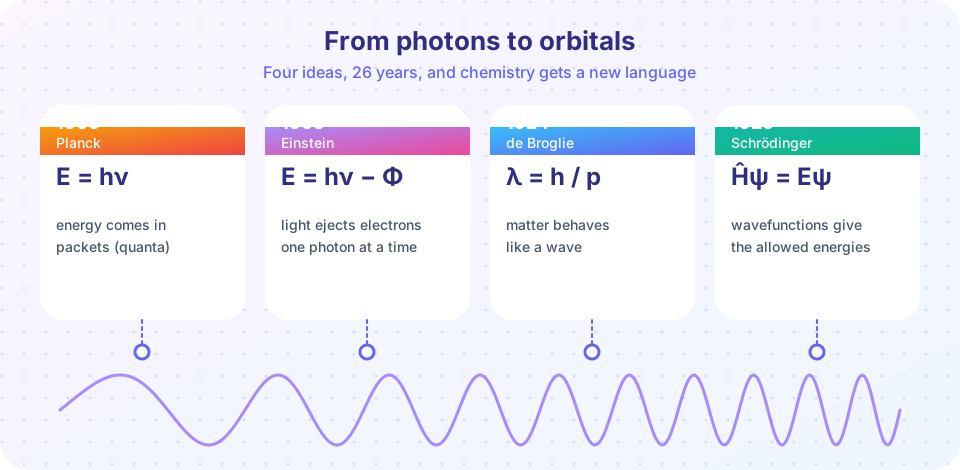
Light comes in packets
Planck 1900, Einstein 1905.
Matter is wavelike
The wave equation
Model systems
Atoms and bonds
Failure 1: blackbody radiation
A glowing metal changes color from red to white as it heats up. Classical electromagnetism (the Rayleigh–Jeans law) predicted that intensity should grow without limit as wavelength shrinks, the "ultraviolet catastrophe". In 1900 Max Planck fitted the true spectrum by assuming that an oscillator of frequency ν can only exchange energy in lumps of size
E = hν, with h = 6.62607015 × 10⁻³⁴ J s
High-frequency lumps are expensive, so they are rarely excited, and the spectrum falls off at short wavelengths. The peak wavelength obeys Wien's law, λ_max T = 2.898 × 10⁻³ m K. The Sun's surface (about 5800 K) peaks near 500 nm, in the visible.
Failure 2: the photoelectric effect
Shine light on a clean metal and electrons come out, but only if the frequency exceeds a threshold that depends on the metal. Brighter light of too low a frequency ejects nothing, however intense. Einstein explained it in 1905 by treating light as photons: each photon gives all its energy to one electron, so
KE_max = hν − Φ
where Φ is the work function. Sodium has Φ of roughly 2.3 eV, so a green photon (about 2.3 eV near 540 nm) is near its threshold.
Matter waves
In 1924 Louis de Broglie proposed that a particle of momentum p has a wavelength
λ = h / p
An electron accelerated through 100 V has p = √(2 m e V) and a wavelength of about 0.12 nm, the size of atomic spacings, which is why electrons diffract from crystals (Davisson and Germer, 1927). A baseball has a wavelength around 10⁻³⁴ m, and its wave nature is utterly undetectable.
The Schrödinger equation
In 1926 Erwin Schrödinger gave the wave equation for matter. In one dimension, the time-independent form is
−(ħ²/2m) d²ψ/dx² + V(x) ψ = E ψ
with ħ = h/2π. Max Born interpreted |ψ(x)|² dx as the probability of finding the particle between x and x + dx. Solutions must be well-behaved: continuous, finite and normalizable, and these boundary requirements are what quantize the energy. Heisenberg's uncertainty principle, Δx Δp ≥ ħ/2, summarizes the price of wave behavior: sharp position means blurred momentum.
What each lesson covers
- Particle in a box: the simplest quantization, with a model for conjugated dyes.
- Vibration and rotation: the harmonic oscillator and the rigid rotor, applied to diatomic molecules.
- The hydrogen atom: energy levels, quantum numbers and orbital shapes.
- Molecular orbitals: LCAO, bond order and why O₂ is paramagnetic.
- Chapter review.
Try it
First, how classical physics fails: the Planck spectrum against the Rayleigh–Jeans prediction at 5000 K.
Press Run (or Ctrl + Enter) to see the result here.
Program input · what you'd type while the program runs
Type the answers before you press Run, one per line. Each time the program reads a line (with input()), it gets the next line from this box.
Second, a calculator for photon energies, the photoelectric effect and de Broglie wavelengths. It simply applies the formulas.
Press Run (or Ctrl + Enter) to see the result here.
Program input · what you'd type while the program runs
Type the answers before you press Run, one per line. Each time the program reads a line (with input()), it gets the next line from this box.
Check your understanding
Quick check · 5 questions
of 5 answered You scored / 5 · perfect!
-
1. Which observation led Einstein to propose photons?
Classical wave theory predicted that enough intensity at any frequency should eject electrons. -
2. What does |ψ|² represent?
This is Born's interpretation. -
3. Why is the wave nature of a thrown baseball not observed?
λ = h/p with p of order 6 kg m/s gives about 10⁻³⁴ m. -
4. A photon of 400 nm has energy closest to
E = 1240 eV nm / 400 nm = 3.1 eV. -
5. What quantizes the energy in the Schrödinger equation?
Only some energies give solutions that are continuous, finite and normalizable.
Summary
- Blackbody radiation and the photoelectric effect forced
E = hν. - Matter has wavelength
λ = h/p; this is observable for electrons, not baseballs. - The Schrödinger equation
Ĥψ = Eψproduces allowed energies;|ψ|²is a probability density. - The chapter applies these ideas to a box, an oscillator, a rotor, hydrogen and molecules.
Next: Particle in a box
Track your progress
Create a free account to tick off lessons and pick up where you left off on any device.
of Physical Chemistry lessons completed