


















Lesson 3 of 49 · Getting Started
Units, constants and significant figures
Master SI units, the fundamental constants of physical chemistry, unit conversions and significant figures, with worked examples and a Python unit checker.
A physical chemistry answer is never just a number. "0.0224" means nothing; "0.0224 m³" is a volume and "0.0224 J" is an energy. Units tell you what a quantity is, and carrying them through a calculation catches most mistakes before they reach the answer.
This lesson sets up the language for the whole course: the SI system, the constants you will reach for constantly, how to convert between units, and how many digits an answer deserves.
What you will learn
- The SI base units and the derived units used in physical chemistry.
- The key constants and their exact or recommended values.
- How to convert units reliably with dimensional analysis.
- How to report answers with sensible significant figures.
Key terms
SI: the International System of Units; base units are meter, kilogram, second, ampere, kelvin, mole and candela.
Derived unit: a unit built from base units, such as the pascal (kg m⁻¹ s⁻²) or the joule (kg m² s⁻²).
Dimensional analysis: checking an equation by tracking the units of every term.
Significant figures: the digits of a number that carry meaning, set by measurement precision.
Standard state: a defined reference condition, currently pressure 1 bar, used for tabulated data.
SI base and derived units
The quantities we use most:
| Quantity | Symbol | SI unit | In base units |
|---|---|---|---|
| length | l | meter (m) | m |
| mass | m | kilogram (kg) | kg |
| time | t | second (s) | s |
| temperature | T | kelvin (K) | K |
| amount of substance | n | mole (mol) | mol |
| force | F | newton (N) | kg m s⁻² |
| pressure | P | pascal (Pa) | kg m⁻¹ s⁻² = N m⁻² |
| energy | E, U, H, G | joule (J) | kg m² s⁻² = N m |
| power | watt (W) | J s⁻¹ | |
| electric charge | Q | coulomb (C) | A s |
Prefixes shift powers of ten: kilo (10³), milli (10⁻³), micro (10⁻⁶), nano (10⁻⁹), pico (10⁻¹²). Notice that the kilogram already contains a prefix, so for molar mass the convenient unit is g/mol, while a calculation of energy from mass in SI needs kg.
Temperature
Always use kelvin in equations: T/K = θ/°C + 273.15. A difference of one kelvin equals a difference of one degree Celsius, so ΔT is the same in both scales. Never put a Celsius temperature in PV = nRT.
Non-SI units you will still meet
Chemistry data still appears in liters, atmospheres, torr, calories and electronvolts. Learn the conversions:
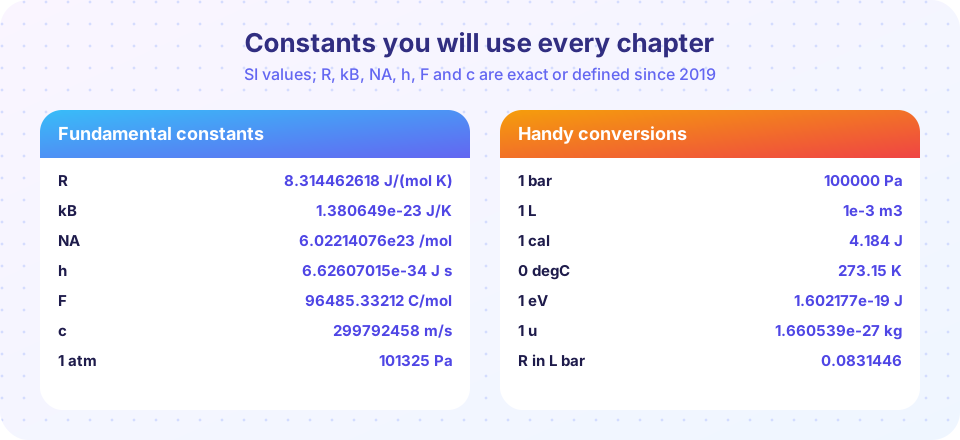
- 1 L = 10⁻³ m³ = 1 dm³
- 1 atm = 101 325 Pa (exact), 1 bar = 10⁵ Pa (exact), 1 torr = 101 325/760 Pa
- 1 cal (thermochemical) = 4.184 J (exact)
- 1 eV = 1.602 176 634 x 10⁻¹⁹ J (exact)
The fundamental constants
Since the 2019 redefinition of the SI, the following are exact by definition:
| Constant | Symbol | Value |
|---|---|---|
| Avogadro | NA | 6.022 140 76 x 10²³ mol⁻¹ |
| Boltzmann | kB | 1.380 649 x 10⁻²³ J K⁻¹ |
| Planck | h | 6.626 070 15 x 10⁻³⁴ J s |
| Speed of light | c | 299 792 458 m s⁻¹ |
| Elementary charge | e | 1.602 176 634 x 10⁻¹⁹ C |
From these follow two constants you will use daily:
- Gas constant
R = NA x kB = 8.314 462 618 J mol⁻¹ K⁻¹. In other units: 0.083 144 6 L bar mol⁻¹ K⁻¹ and 0.082 057 L atm mol⁻¹ K⁻¹. - Faraday constant
F = NA x e = 96 485.332 C mol⁻¹.
R is just Boltzmann's constant scaled from one molecule to one mole. That is why you will see kB T in molecular formulas and RT in molar ones.
Dimensional analysis
Dimensional analysis checks equations and converts units. Each side of an equation must have the same units, and only quantities of the same unit can be added.
Check: is PV = nRT consistent? Pa x m³ = N m⁻² x m³ = N m = J; and mol x J mol⁻¹ K⁻¹ x K = J. Both sides are energy.
Convert 2.50 atm to kPa:
2.50 atm x 101325 Pa/atm = 2.533 x 10^5 Pa = 253 kPa
Convert a rate constant of 3.0 L mol⁻¹ s⁻¹ to m³ mol⁻¹ s⁻¹: 3.0 x 10⁻³ m³ mol⁻¹ s⁻¹.
The rule: multiply by conversion factors written so that the unwanted unit cancels.
Significant figures
A measurement has limited precision, so an answer should too.
- In multiplication and division, keep as many significant figures as the least precise factor.
- In addition and subtraction, keep as many decimal places as the least precise term.
- Exact numbers (a count of 3 molecules, the defined 4.184 J/cal) have unlimited significant figures.
- Keep extra digits in intermediate steps and round only the final answer.
For example 8.314 x 298 / 101325 limited by the 3-figure temperature gives 0.0245, not 0.024455.
Logarithms are subtler: the number of decimal places in ln K equals the number of significant figures in K.
Worked example: a unit chain
An ideal gas at 2.00 atm and 300. K occupies 5.00 L. Find n.
- Convert pressure:
2.00 atm = 2.026 x 10⁵ Pa. - Convert volume:
5.00 L = 5.00 x 10⁻³ m³. n = PV/RT = (2.026e5 Pa x 5.00e-3 m³)/(8.3145 J mol⁻¹ K⁻¹ x 300. K) = 0.406 mol.
Cross-check with the other value of R: (2.00 atm x 5.00 L)/(0.082057 x 300.) = 0.406 mol. Two routes, one answer.
Common misconceptions
"Any temperature scale works in the gas law." Only kelvin does, because zero must mean no thermal energy.
"A liter is a base unit." It is a convenient non-SI unit equal to 10⁻³ m³.
"More digits on the calculator means more precision." Precision comes from the measurements, not from the display.
"R changes with the units." R is one constant; its numerical value changes with the units chosen.
Try it
This checker multiplies quantities with units automatically. It is a small hand-written helper (no external library), so you can see how dimensional analysis works.
Press Run (or Ctrl + Enter) to see the result here.
Program input · what you'd type while the program runs
Type the answers before you press Run, one per line. Each time the program reads a line (with input()), it gets the next line from this box.
Now convert pressures and verify R in two unit systems.
Press Run (or Ctrl + Enter) to see the result here.
Program input · what you'd type while the program runs
Type the answers before you press Run, one per line. Each time the program reads a line (with input()), it gets the next line from this box.
Check your understanding
Quick check · 5 questions
of 5 answered You scored / 5 · perfect!
-
1. What is the SI unit of pressure in base units?
Pressure is force per area: N m^-2 = kg m^-1 s^-2, which is the pascal. -
2. Which value of the gas constant goes with pressure in atm and volume in L?
R = 0.082057 L atm mol^-1 K^-1. The 0.0831446 value is for L bar. -
3. How many kJ is 25.0 kcal (thermochemical)?
25.0 x 4.184 = 104.6 kJ. -
4. Multiplying 3.2 (two significant figures) by 4.567 gives how many significant figures?
The least precise factor, 3.2, has two significant figures, so the product has two. -
5. R equals which product?
R = NA kB scales the per-molecule Boltzmann constant to a mole.
Summary
- Always carry units; they check equations and convert quantities.
- Use kelvin in physical chemistry equations; ΔT is the same in K and °C.
- NA, kB, h, c and e are exact; R = NA kB = 8.314 462 618 J mol⁻¹ K⁻¹.
- Key conversions: 1 atm = 101 325 Pa, 1 bar = 10⁵ Pa, 1 cal = 4.184 J, 1 L = 10⁻³ m³.
- Round only at the end, using the significant figures of the data.
Next: The mathematics toolkit
Track your progress
Create a free account to tick off lessons and pick up where you left off on any device.
of Physical Chemistry lessons completed