


















Lesson 48 of 49 · Projects and Practice
Cheat Sheet: Key Equations and Shapes
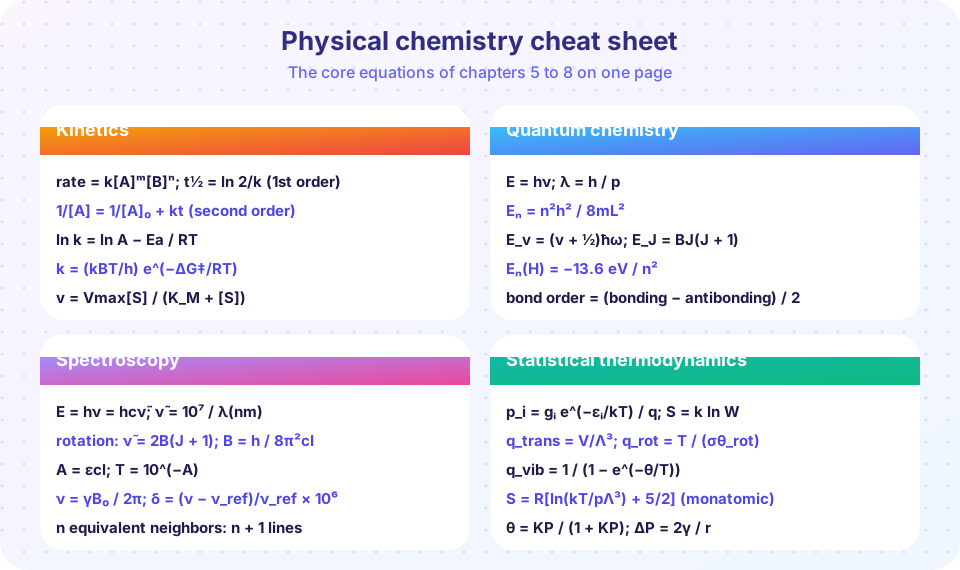
A one-page recap of the core equations of kinetics, quantum chemistry, spectroscopy, statistical thermodynamics and surfaces, with the characteristic curve shapes and unit conversions.
Print this page, pin it above your desk and stop memorizing what you can look up. The poster gathers the central equations of chapters 5 to 8. Below it are the characteristic shapes (what each relationship looks like when plotted), conversion factors and a short list of common pitfalls.
What you will learn
- Recall the key equation of each topic at a glance
- Recognize the shape of each relationship on a plot
- Convert quickly between energy units
The shapes to recognize
| Relationship | Plot it as | You see |
|---|---|---|
| First-order decay | ln[A] against t |
straight line, slope −k |
| Second-order decay | 1/[A] against t |
straight line, slope +k |
| Arrhenius | ln k against 1/T |
straight line, slope −Ea/R |
| Particle in a box | E against n | parabola, ∝ n² |
| Harmonic oscillator | E against v | straight line, equal spacing |
| Rigid rotor | E against J | parabola-like, ∝ J(J+1) |
| Hydrogen | E against n | rises toward 0, ∝ −1/n² |
| Beer–Lambert | A against c | straight line through the origin |
| Boltzmann populations | ln(population) against energy | straight line, slope −1/kT |
| Langmuir | θ against P | saturating curve, half at P = 1/K |
Conversions
| From | To | Factor |
|---|---|---|
| 1 eV | kJ mol⁻¹ | 96.485 |
| 1 eV | cm⁻¹ | 8065.54 |
| 1 cm⁻¹ | GHz | 29.9792 |
| 1 cm⁻¹ | J mol⁻¹ | 11.963 |
| wavelength (nm) | cm⁻¹ | 10⁷ / λ |
| wavelength (nm) | eV | 1239.84 / λ |
| kT at 298.15 K | 2.479 kJ mol⁻¹ = 207.2 cm⁻¹ = 0.02569 eV | |
| 1 kcal mol⁻¹ | kJ mol⁻¹ | 4.184 |
Pitfalls checklist
- First-order half-life does not depend on the concentration; second-order does.
- Use
Tin kelvin andRin J mol⁻¹ K⁻¹ for Arrhenius; keep Ea in joules in the exponent. - Particle in a box:
E ∝ 1/(mL²); check the mass and length units (1 nm = 10⁻⁹ m). - Rotational degeneracy is
2J + 1; vibration has none. - Infrared needs a changing dipole; microwave needs a permanent dipole.
- Absorbance is a logarithm:
A = 2means 1 % transmitted, not 20 %. - NMR coupling J is in Hz and independent of field; chemical shift is in ppm and independent of field.
- Remember σ in
q_rot, and N! inQ = qᴺ/N!. - Langmuir: half coverage at
P = 1/K.
Try it
First, the four standard shapes on one figure, using typical parameters, so you can see them side by side.
Press Run (or Ctrl + Enter) to see the result here.
Program input · what you'd type while the program runs
Type the answers before you press Run, one per line. Each time the program reads a line (with input()), it gets the next line from this box.
Second, an equation toolkit. The functions below implement the poster's most common formulas, so you can call them from your own scripts.
Press Run (or Ctrl + Enter) to see the result here.
Program input · what you'd type while the program runs
Type the answers before you press Run, one per line. Each time the program reads a line (with input()), it gets the next line from this box.
Check your understanding
Quick check · 4 questions
of 4 answered You scored / 4 · perfect!
-
1. On which plot is a second-order reaction a straight line?
1/[A] = 1/[A]₀ + kt. -
2. 1 eV is about how many cm⁻¹?
1 eV = 8065.54 cm⁻¹. -
3. Which statement about NMR is correct?
δ is defined relative to the spectrometer frequency, so it is field independent. -
4. In a Langmuir plot, half coverage occurs at
θ = ½ when KP = 1.
Summary
- Keep the poster in view; learn the shape of each relationship and the straight-line plots.
- Convert units first (eV, cm⁻¹, kJ/mol, nm) and keep kT = 207 cm⁻¹ in mind.
- Check pitfalls: σ, degeneracy, dipole rules, logarithmic absorbance.
Next: Further study
Track your progress
Create a free account to tick off lessons and pick up where you left off on any device.
of Physical Chemistry lessons completed